
 |
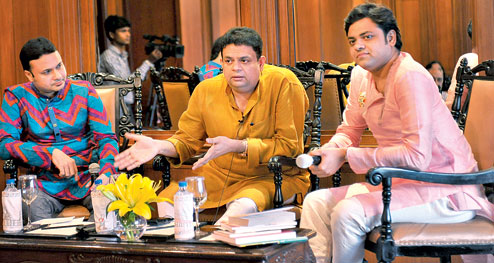
From Girija Devi and Gulzar to Bismillah Khan and Bollywood, writer-poet Yatindra Mishra spoke on the many biographies he’s written and the musical worlds he straddles at An Author’s Afternoon, presented by Shree Cement at Taj Bengal, along with Prabha Khaitan Foundation and Jaipur-based literary consultancy Siyahi. Speaking to him were musician duo Soumyojit Das and Sourendro Mullick of You & I. Excerpts.
Soumyojit Das: You write primarily in Hindi. Even in Hindi, Calcutta is known for its connect with poetry...
Yatindra Mishra: This city has given us Gurudev. I don’t think you can limit him to a language or a geographical location, because he is the first global poet of the 20th century. Just like we consider Kabir, 500 years back. If we think of Mahatma Gandhi in politics, similarly, we think of Rabindranath Tagore when it comes to poetry. And Tagore’s contribution for me is that he has created a genre that has been established in classical music, that is Rabindrasangeet. When you see dhrupad, you know Tansen did it, when you see khayal, you know it’s come from the court of Akbar and its pioneer was Amir Khusro.... But when you talk about the 20th century, you won’t find any genre... they’ve all been swept away with tradition. But this state gave us Rabindrasangeet. And I feel Jibanananda Das is not just Bengal’s poet but everyone else’s too.
Sourendro Mullick: During the translation of poetry and literature, there is also a translation of culture. In a concert in Paris, we sang Babul mora, naihar chhooto jaye, and after the thumri was over, a French girl came up to me and asked why is this song so sad, you said that the girl is getting married?
Yatindra: Do you know the story behind the creation of this thumri? When Wajid Ali Shah was leaving Metiabruz — the (East India) Company had said you have to leave — the last time that he was seeing his palace, and leaving Lucknow, that is when he wrote this thumri. Naihar means Lucknow, babul means khuda.... The third meaning behind this is when you’ve left this world.
Sourendro: A majority of your works are biographies, like you wrote Girija Devi’s biography, and Gulzar sa’ab’s. You’ve spent so much time with all these people. Who will you remember the most?
Yatindra: I will remember all of them, but will they remember me? I feel Bismillah Khan sa’ab was a very quiet and a very clean-hearted person. You could say that I was also diplomatic with all these people — I recorded everything when I was with them. I must have recorded Lataji (Mangeshkar) for almost 250 to 300 hours for an upcoming book. I have been speaking with her for almost five years now. When these people open up, they say such things that are eye-opening! And they speak about their passion. But there were many things that I didn’t put into my book, when they requested me not to.
Girija Devi was a very homely person, like a grandmother, in the way that she would sing in front of you, cook in front of you and scold you... things like that.
Sonal Mansinghji is a woman who lives like a star, like an aristocrat, with a lot of dignity, so I’m a bit afraid of her. She is a great dancer. But her temperament... when I used to interview her, I would reach her home in Delhi and she would say, ‘Today I’m not in the mood, I’ll give an interview after two days.’ I would say — ‘Sonalji, I’ve come only for three days. I’ll waste two days....’ And she would say, ‘But this is not my problem. Why did you choose me to write a book on?’
So in this situation, to try and eke out whatever I could was a challenge. She gave beautiful answers and she loved the book. It’s getting translated into English and French. I have also won awards for that book.
Soumyojit: A lot of digitalisation is happening these days and people are reading e-books. Do you see this as an advantage or disadvantage?
Yatindra: I feel I am young and belong to this new generation so I should get used to e-books and have a more comfortable relation with them. I have not gotten used to them yet.
Today before coming here I went to Symphony music store in Esplanade. They said, ‘Sir, these days less CDs are available.’ I said, ‘I’ve come from Lucknow, please show me some rare CDs.’
There is a nostalgic value of these old things. There was a time when there were LP records, before that there were cylinder recordings. Now they all belong to museums and archives. So I feel whatever technological innovations will come in the future, one will have to cope.
Music is still fine but for books I feel if they remain in the physical form, it is better. Its look, its smell, taking it out of the shelf, using a bookmark, keeping a dry flower in between pages or making notes on the sides — these are not possible with e-books.
Soumyojit: You went to the store and searched for CDs because you value them but if you surf and listen to a few songs, is it the same thing?
Yatindra: I do not think it is only about valuing, there should be madness and passion in whatever you do. Often people tell me that the collections I have are all available on YouTube and Google. When I started googling Lataji, I saw there was all kinds of wrong information. Wikipedia is the worst!
When I worked on Lataji, I decided to take a year off before getting back to her because there were many songs of hers that I didn’t have or hadn’t heard, and I wanted to hear them. I made a list of 1,500 to 2,000 songs and Lataji helped me get about 700 to 800 of them. Even HMV did not have all the songs I wanted. I started tapping private collectors in Indore, Nagpur, Patna, Samastipur, Bhopal, Hyderabad, Allahabad, Lucknow and old Delhi. A private collector in Hyderabad gave me Hindolana jhoolan aayee balma from the film Senapati at a hefty price.
So in 365 days I collected all the songs and listened to all of them. Then I looked at AIR. When she was 13, she had sung her first raag called Khambavati, after which her father passed away. The 18-minute recording of Khambavati was found in AIR’s archives, something that people probably don’t know about. With this example, I want to explain that it’s not important to have CDs and books to your name. There should be madness about you.
Sourendro: Why did your book on Bollywood music, Humsafar, end in 1985?
Yatindra: I ended it there because I felt the last important music director of the melodious era of the ’60s and ’70s ended with Bhupen Hazarika. After that, I feel we could talk about only A.R. Rahman and Jatin-Lalit, who have some innovations. The problem is when you’re writing the history of a specific thing, there are many people you can’t leave out, people who have contributed to the history. So in that list are musicians like Ravindra Jain, Anu Malik, Bappi Lahiri, Nadeem-Shravan, Anand-Milind, Vishal Bhardwaj.
But I am not happy with Bappi Lahiri or Nadeem-Shravan because I was working on people like Pankaj Mullick, Sajjad Hussain, Anil Biswas and Salil Chowdhury. While working on these people, how can one suddenly jump to Bappi Lahiri, especially when they are not your favourite musicians?! I was not writing a history book. In the very beginning I apologised that these are my favourite musicians in the last 100 years and that I’ve left many out from my list, saying someone else will write about them.
Soumyojit: The language of Bollywood has changed a lot in the past 100 years and in this era of globalisation, an American pop song and Bollywood song sound the same. So Indian music is becoming global....
Yatindra: The Mumbai film industry says that now Bollywood has become global and has got foreign acclaim, something that wasn’t there before. I do not believe this at all. Chetan Anand took his film Neecha Nagar to Cannes and it won an award. Then Apu trilogy, which established Satyajit Ray worldwide.
In 1974, Lata Mangeshkar sang for the first time at the Royal Albert Hall in London. At present we have become very technical, our technology has advanced and we are living in an era of information technology and everything seems to have come to our neighbourhood from around the world. Today people talk about Aishwarya Rai and Katrina Kaif. In the early ’60s, people used to talk about Madhubala. If Madhubala or KL Saigal were alive, they would have become global. Today if Premchand was alive, you can’t imagine what a big author he would have been....
It is true, a lot of good work is happening and is globally acclaimed but I question whether it is only talent that has worked behind the success of all these people. I think technology has also played a big role in it.
 |
‘Usually we have writers in English at An Author’s Afternoon but this time we tried something different. For the first time we got someone from Hindi literature. His depth of knowledge and study of music are things to marvel at,’said Sundeep Bhutoria of Prabha Khaitan Foundation.
 |
‘It was a very knowledgeable afternoon that spanned everything from music to literature to history to famous personalities. Yatindra Mishra is such an authority on music! I particularly loved listening to his insights on Lata Mangeshkar,’ said K. Mohanchandran, Taj Bengal GM
 |
. ‘He has some fascinating work and it reminds us about how little we know about these people and the great work they have done. It was inspiring and interesting to know Yatindra’s experience,’ said filmmaker Anandi Ghose.
 |
‘I feel that one is always enriched in the company of good music, literature and human beings. This afternoon was the perfect example of that. Yatindra Mishra is really knowledge-able and full of humility,’ said actor-filmmaker Arindam Sil.
 |
‘It was enthralling to listen to Yatindra Mishra. Not only was his knowledge sound, his articulation and clear intellect made him a very interesting speaker. It’s unusual to find a young person with so much commitment to archiving culture,’ said social entrepreneur Nandita Palchoudhuri.
Text: Malancha Dasgupta and Neha Banka