
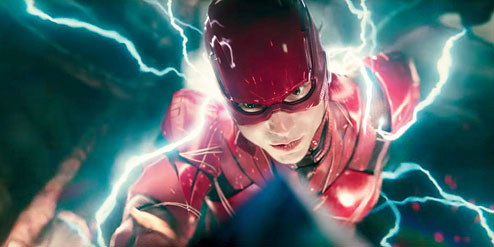

Ezra Miller is Barry Allen/ The Flash — the superhero with superhuman speed — in Justice League...
How much did you know about the Justice League or The Flash?
I’ve been a big comics fan from a very young age. Conveniently, I read a lot of DC as a tyke. I’ve always loved the terror and villainy in the DC universe. I was really into Batman and wore a foamy Superman suit around the house for a solid few months. As a kid, I also put a lot of time and energy into writing and drawing comics. I had a whole series about three elderly women who were assassins, which was called, ‘I’m Getting Too Old for This’. I even invented a superhero called ‘Super Pig’, who was a chameleonic swine of sorts. My nanny has a massive collection of Super Pig merchandise I handmade, including shirts, action figures and comic book issues; the comics were drawn with one crayon [laughs]. I was a one-man studio then!
I wasn’t a particularly big reader of The Flash at that age, but I do recall that as a youth, when I would be running around outside, I would often get a little ahead of myself and my feet and, as a result, would pull what quickly became known as a definitive move of mine, and what my mother called the face plant. This involved me taking a full nose-dive into concrete, potholes, other children… you name it. I went to the hospital for nose-dive-related injuries a few times. So, I feel the role of The Flash dwelled and swelled within me, even then.
When my parents took me into the city as a youngster, I’d always beg to go to a well-known comic book store called Forbidden Planet. I just wanted to live there, in the store, but also in the stories that rested on its shelves. And I do in a way get to live part-time in that dimension — the comic realm. We all have access to that. I still can’t really live in that store... there’d be zoning issues at the very least [laughs].
What aspects of The Flash and the character’s history did you connect with?
I really love and cherish that I had the opportunity to draw from the incredibly rich legacy of The Flash. I learnt there’s a wonderful interplay between inevitability and connection, and between death and love, that exists in all the Flash stories. Much of The Flash’s mythology is imbued with the sensations of Barry Allen’s heart through its anguishes and triumphs. It’s his heart that drives him to connect with and serve the world, even as the very force that gives him the power works to consume him and bring him into an ultimate unity with its current.
Barry is not infallible or immortal… he is very much a fragile, vulnerable human being. He also is not fearless. My version of Barry experiences crippling anxiety and terror. He uses wit and humour to deal with that fear. Barry has been endowed with these powers, some of which he’s incapable of handling because he’s human. At the same time, becoming a quantum anomaly of sorts is changing and growing Barry’s perceptual capacities and appreciation for everything that’s happening around him. This was all very inspiring for me to explore.
I found a link between myself and Barry in our admiration of the people around us. Barry and I are both nerds and fans of superheroes. There’s an appreciation, even in life-threatening situations, of the glory he’s beholding, and I found a port of access in that similarity.
I, too, was in awe of the people around me as they threw themselves headlong into this work.

What role does Barry play in the Justice League and how does he find his way into the group dynamic?
What’s so wonderful about the idea of a team of superheroes is the contradiction it presents to the premise of individual heroism so endemic in superhero mythology, in which one person with power is the only hope for salvation. In the Justice League, there’s a nice reminder that as interconnected beings, we need each other no matter how strong we are.
The Justice Society of America, the precursor to the Justice League, was the first-ever superhero team-up in comics history. What’s so great about this League is the idea that every member has something unique to offer, and through unification across lines of division and personal separateness, they become an even greater force. In the film, it’s cool the way each member works in different ways, non-hierarchically taking on the tasks they’re best suited for, based on each of their powers. It’s what we do on film sets too, you know? Jason Momoa breaks things and throws stuff and yells. Ray Fisher skulks and sulks and beeps and recalculates and smoulders. Zack Snyder directs. Ben Affleck keeps it real. Gal Gadot slays fools and keeps it hyper-awesome. It’s like a Walt Whitman poem.
Even though Barry is at an early stage of understanding his powers, he can offer a lot in terms of expedience, so he’s a very useful superhero to have around. Barry also brings some deficits, in terms of his inexperience and clumsiness during the early stages of harnessing his powers. He’s also somewhat socially inept. So, he brings both strength and weaknesses to the League. Barry appreciates the other members of the League as the incredible phenomena they are.
What was it like working with the members of your team — the ensemble of actors playing the other members of the League?
There is this incalculable and unpredictable thing that happens between people when you put them in a space and give them a task. We’re exploring that in the context of a superhero team-up, of course, but we were also exploring that on set as an ensemble of actors. I really have to give it up to everyone who brought this team together. We didn’t have weeks to rehearse before the start of production, so we largely got to know each other on set, just as our characters mostly meet in the timeline of our story and have to learn how to work together as a team in a very short time. I’m thankful that the natural chemistry of our group dynamic was there from the start.
How did you physically prepare to play The Flash?
In the few years leading up to Justice League, I trained in different capacities. I practised martial arts for two years, and even trained for a while in the Wudang mountains in China. To better understand The Flash’s movements, I worked with several dancers and choreographers, including gifted mages like Zack Winokur and Bobbi Jene Smith. Closer to the time of pre-production, I also started to work with [cast trainer] Mark Twight and his incredible team, who led me through this fascinating reflex training to bring in additional elements of awareness to the character’s physicality. The entire League trained really hard constantly throughout the shoot.
I was also fascinated with the idea of filling in the gaps of the Flash comics I was reading, which have this classic iconography of the conditioning of the character’s body, and I deconstructed and reconstructed those pieces and created a fluid language of how The Flash gets from one point to another. I took an interest in ballet and found a lot that was useful in the form of petit allegro — ‘little fast’ — quick, lively and small jumps. I spent a lot of time watching the RIP videos that a talented group of dancers in California make to honour the friends they’ve lost. The dancers in those videos do insane work with perceptual distortion of time and motion, and I was really moved and informed by their stuff. I was also inspired by crows, cheetahs, mongooses and other fast-moving and intelligent creatures, as well as by rushing water and, of course, lightning.
Why is Justice League an important movie for audiences today?
Obviously, Justice League is a fun comic book movie, but any story that reminds us of the simple, core truth that we are all living together on this earth, and of this earth, is welcome. We are experiencing quite a crisis on this prime planet of ours, and in many cases, it seems that we respond to crises by isolating ourselves in the groups we identify with most readily, which further deepens the trenches of our division. In doing so, we forget that we share this planet. It is a fragile and tenuously hospitable spaceship floating through the cold and dark, and a problem in any section of a spaceship is a problem for everyone on board.
We are all imperiled by the threat at hand, which is not approaching from a distant planet. It’s here. It’s us. It’s our fear. Our hate. It’s war. It’s terror. It’s pollution. Transcending our differences and coming together to accomplish a seemingly impossible task — saving our world — is an imperative. We need one big international justice league and we need most people to join.