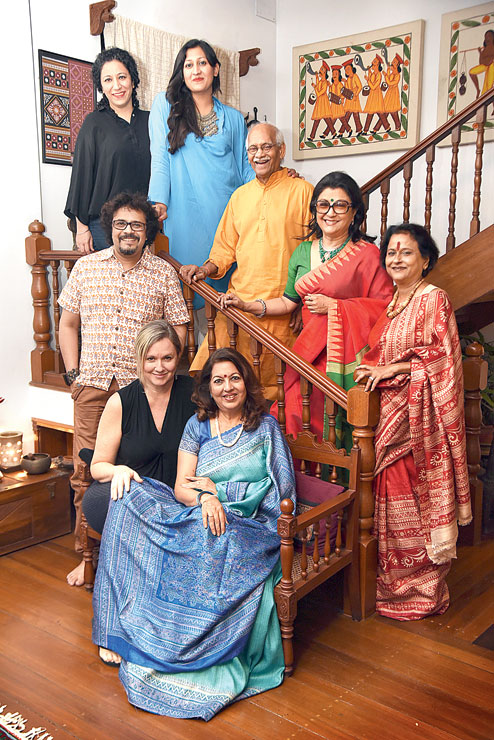
The “extended family” of Kanishka’s met over a tea party recently to reminisce about the brand started by Nandita and Dilip Raja, ahead of its 45th birthday to be held at CC&FC on Monday evening. t2 sat in on the chat...

Picture: Rashbehari Das
Jab we met
How did the journey begin?
Nandita Raja: I started in 1970. I told my husband (Dilip) that I wanted to work. Though I never painted, there was always this sense of patterns in my mind. If I spotted a good design, I would immediately cut it out and put it in my scrapbook. That was in my school days.... He inspired me to design. I would go to Mimi’s (Mimi De, an art college student), a small store on Hindusthan Road to get my old saris printed. One day he (Dilip) accompanied me to Mimi’s. I was going through the catalogues and wondering why people would stick to the same old phool, pata, paisley. Then he said, ‘Why don’t you do it?’
Dilip: She didn’t have any faith in me that I could draw.
Nandita: I gave him a black sari which I never wore. He pinned it up on a wall and started painting. I was stunned. He painted the hood of a snake with a lot of zodiac signs on them.
Dilip: That was the first sari that I made. Till today, I design each and every Kanishka’s block. I designed Usha’s (Uthup) ‘K’ bindi. She was going for a cricket match.
Nandita: Once she wanted the lyrics of her song printed on a sari.
Priyanka Raja (Nandita and Dilip’s younger daughter-in-law): Kanishka’s can customise every single piece. That’s amazing!
The woman, past and present
Aparna: My mother would go to Kanishka’s. I started going in the ’80s. My mother would in fact give saris for printing. I think one of my first piece was a tussore print. The first thing that strikes me when I enter Kanishka’s is that I hope I don’t overspend.
Nandita: Aparna would come with her mother and then Konkona (Sensharma) would come with Aparna. She would come in her school dress. When she was studying in Delhi, she picked up a lot of dhurries and cushion covers from us. Aparna’s didima had also come to us.
How are the three generations of Sens different when it comes to aesthetics?
Nandita: I didn’t get to interact with Aparna’s mother that much...
Aparna: Ma was very artistic.
Nandita: Konkana is very traditional in her taste.
Aparna: If I would ask her to wear something, she would invariably tell me: ‘Tumi chhotobelai erom sari portey?!’ She has grown up seeing what I have worn. I wear a lot of accessories, but she is very subdued.
What about you Ritadi?
Rita Bhimani: Around the time Kanishka’s started, I started with my public relations career too. Very frankly, I couldn’t it afford it then. Their innovation struck me. It is not a store you are going into. It’s a way of life. And Dilip is always looking for new ideas. For the World Cup, they gave me these lovely yellow bush shirts with a green football.
Aparna: I must take some for Haroon (Konkona’s son).
What about you Bickram?
Bickram Ghosh: For me the association started with Kanishka’s (Dilip and Nandita’s elder son after whom Kanishka’s is named) marriage. I had just started Rhythmscape and I performed at their marriage.... There were two Kanishka’s kurtas I had which I remember wearing to a lot of important shows because they had a sense of character. That went with what I was planning to portray with my fusion music at that point. They came with coconut-shell buttons. Look at the shirt I am wearing. Who would think of putting monkeys on a shirt? So funky.
Eina, tell us about your association with Kanishka’s...
I love saris but I don’t wear them very often. My mom looks very elegant in saris. I took my mom to Kanishhka’s. Then I met Priyanka and she said come and check out Kora (the brand’s pret line). And I went crazy. It was interesting, modern yet very traditional Indian fabrics. Very relevant.
How has the Calcutta woman changed?
Aparna: I have seen my mother... they used to wear fashionable saris. At one time you had matching blouses and at another time you had the contrast ones. I have seen my mother wear prints and backless cholis. What has changed is I think that the modern woman accessorises much more. It doesn’t have to be very expensive. Yesterday, I was wearing a black shirt and black jeans with a wooden black-and-white Madhubani pendant. My mother’s generation wore more gold jewellery. They never wore statement jewellery... less dramatic. As far as fashion goes, it’s not that each woman follows a fashion trend, but nowadays, you would find very few women going around shabbily.
Style story
Bickram: I was the first Indian classical musician to ever keep a goatee. I was playing with Pandit Ravi Shankar those days and he said he wouldn’t play with me unless I shaved! ‘You think you are a rockstar?’ were his exact words.
Aparna: I was in Shashi (Kapoor) and Jennifer’s (Kendal) house in Bombay and someone was coming to take an interview. I was sitting there and painting my nails. Jennifer was like, ‘What are you doing?’
The 45th birthday party
Priyanka: This programme has been co-conceived by Nandita Raja and Bickram. Ma wanted people to wear their favourite Kanishka’s kurta or sari and walk with their families or in groups. It will be opened by Rina mashi and Kalyan uncle (Aparna Sen and Kalyan Ray). It’s not a fashion show. Bickram said Kanishka’s has celebrated folk art for the longest time. Then why not celebrate that idea?
Bickram: I think we both represent that ethnicity is cool. Since Kanishka’s is all about hand-printing, I thought why not have a stress on primarily hand drums like Bangla dhol, sree khol, ghatam. It’s all going to be live. We will also have dhaak. After the walk is over, I’ll perform... a regular classical-based fusion show.
Aparna: Goopy Gyne Bagha Byne had lovely use of ghatam.
Bickram: Bagha was a Bangla dhol player. There was morsing too. He used it all... what research.... (And the adda continued over phuchkas, mushroom-stuffed eggs, crackers with chilli jam and cheese.)
Saionee Chakraborty