AL BARZA
It’s easy to forget about the region’s indigenous Emirati food in the melting pot of global cuisines that expats have brought to Dubai. Add to that a growing band of Michelin-starred chefs from the West serving up their signature addresses. But if you skip Emirati, you miss much of the flavour and warmth of Arab life.
Al Barza, a relatively young restaurant on Jumeirah done up with lattice motifs and Persian lamps, serves “traditional Emirati food”. As we settle down and start chatting, bowls of sticky dates and Labneh arrive at the table, along with the Arabic coffee, Gahwa. Labneh are slightly tangy, soft cheese balls that you feel like popping one after another. The Gahwa is pretty strong, quite like an espresso shot, and cuts the creaminess of the cheese.
“This is how Emiratis welcome guests into their house. As you chat, you drink the coffee and return the cup, and they will pour again. When you don’t want anymore, you hold the cup up and shake it once. That’s the sign,” says chef Bader, a young Emirati who’s taking us through a couple of ‘Hidden Gems’ on the culinary map as part of Dubai Food Festival 2017. “The Gahwa doesn’t come with sugar, so you have it with the dates or Luqaimat.” The Luqaimat is a sweet, fried dumpling that looks a lot like our pantua but, unlike it, is puffy.

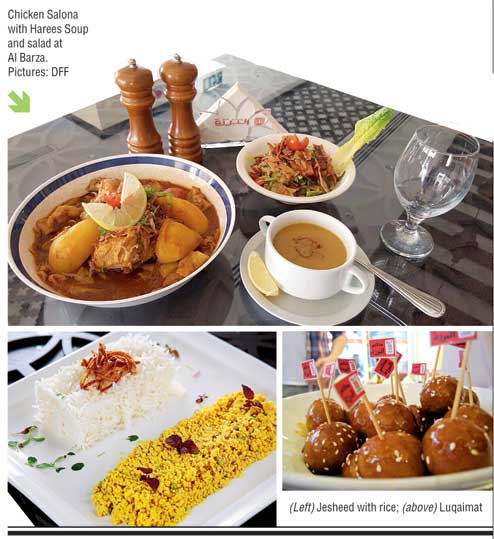
With one part of UAE coasting along the blue Persian Gulf, the star dishes in Emirati cuisine are centred around fish and meat — Fireed, Jesheed, Machboos, Harees, Salona, Aishu Laham.... Our meal begins with a traditional Roca Salad with Hamba (mango) and white radish and a bowl of yellowish Harees Soup. Food lore says our haleem is a descendant of the Middle Eastern Harees. It’s a porridge-like dish of meat and wheat, with a gooey thickness and a film of golden ghee on top. In taste, it’s closer to the haleem found in Hyderabad than the soupy version popular in Calcutta. The Chicken Salona feels closest to home in flavour, with big potatoes floating in a yummy red curry. The dish that you’d least expect is Jesheed, which is baby shark meat cooked with onions and saffron and other Arabic spices, to be had with spoonfuls of rice!
“In many houses, people still sit on the ground and eat. If you are eating with your grandparents especially, you eat in the traditional way,” says Bader. There’s one big tray and everyone sits around it, eating from it with their hands.
Cardamom tops the list of key spices in Emirati cuisine followed by saffron, cumin, coriander and loomi (dried lemon), which is a must ingredient for Machboos, a rice-and-meat dish that involves a long-drawn cooking process. “The taste of Machboos varies from house to house.... In winter, as soon as the weather gets colder, we head to the desert in the weekends with family and friends and we cook the Machboos in wood and fire, in the slow-cooking method,” says Bader, adding with a smile: “If you ask for the best Emirati restaurant, the answer will be our home.”

KA’AK AL MANARA
After you’ve been suitably blinded by the glitzy, humongous luxury malls, the Venetian charm of Merceto will feel very soothing. It looks anything but a shopping mall, and hence, just the right place to house a ‘Hidden Gem’ — Ka’ak Al Manara, a Lebanese street food stop, which was declared one of Dubai’s 50 “best-kept dining secrets” during the Dubai Food Festival 2017.
At the first-floor kiosk, look for Ziyad Ayass who quit his finance consultant’s job to bring the Ka’ak from Beirut to Dubai.
The Ka’ak — which rolls off Ziyad’s tongue as ‘kaaik’ — is a round wholewheat bread with a hole at the centre, topped with sesame seeds, and is a breakfast staple for the Lebanese. Ziyad makes sandwiches with the Ka’ak bread, as is the tradition in Lebanon, with sweet or savoury fillings. “Vendors hang the bread by the hole and it shouldn’t take you more than three-and-a-half minutes to get a Ka’ak sandwich. People buy the Ka’ak and put their own stuffings at home. Some people just have the bread with dry Zaatar (a Middle Eastern herb),” he says. The most popular is the Picon Cheese spread, called “the poor man’s Ka’ak”, which features on the Ka’ak Al Manara menu.

A must-try is the sweet bite Ka’ak with Knefeh (pronounced ‘nefe’) or Kunafa. “The Knefeh is an Arabic sweet and every kid in the Middle East wakes up in the morning wanting to have a Kunafa. The Lebanese way is to make it with Akawi cheese, which makes it very stretchy. In Beirut, the street vendors would stuff the Ka’ak with Kunafa, so it’s considered street food.... We are one of the first to introduce the Ka’ak to the Dubai F&B scene and many other places have started keeping similar options now,” says Ziyad. Well, this gem is worth the journey.

BOUTIQUE LE CHOCOLAT
As is with a lot of Dubai’s luxury lairs, this might end up as browsing rather than buying, yet a visit to City Walk for Boutique Le Chocolat is highly recommended to a chocolate devotee. For a feel of what it might be inside Charlie and the Chocolate Factory. You’ll forget about wanting a bite, so precious and decadent do the chocolates look, arranged like expensive jewellery or works of art, to be admired and feasted on only through the eyes. All that stuff is crafted by award-winning chocolatiers from across the globe. A few of the formidable names are Bernachon from Lyon, Boissier from Paris, Peter Beier from Denmark and Rococo from Chelsea.


COMPTOIR 102
This serene, white house on Jumeirah is great to start the day at — not just because of the food, which is all organic, sugar- and dairy-free — but also for the place per se. Comptoir 102 is a concept store-cum-cafe selling jewellery, clothes, home decor, furniture and organic grocery, and is very French chic, reflecting the touch of its Parisian owner Emmanuelle Sawko, who’s credited with starting the eat-healthy trend in Dubai.


The Healthy Cafe opens at 7.30am, so you can land up groggy-eyed. Sit out in the garden and soak in the morning light streaming in through the thatched roof. Order Buckwheat Pancakes with organic maple syrup and fresh berries, or Chia Seed Pudding, which has almond milk, coconut water, dates, vanilla, cinnamon, and orange blossom topped with banana and dates. It’s a good idea to go light and easy if you’ve planned a whole day of bingeing. Or come back later for a detox; they are open till 9pm.

RIPE MARKET
When the weather turns pleasant, the Ripe Market pops up over the weekends at a couple of spots across Dubai. This is the Zabeel Park Ripe Market... white-canopied kiosks of mostly organic food and produce, and some of clothing, accessories and knick-knacks. The idea behind the Ripe Market is to promote local businesses and it serves as a platform for many start-ups to test the waters. To the visitor, the Ripe Market gives an idea of all the food and beverage experiments happening in Dubai. And this is where Ka’ak Al Manara began its journey too! Some of our picks...

YUM BITES FROM ETISALAT BEACH CANTEEN AND STREET NIGHTS, DFF 2017
Beach pop-ups, food trucks, midnight munching... Dubai rolls out an all-you-can-eat binge fest with the Dubai Food Festival every year in February-March. Two of the best curated events of 2017 were the Etisalat Beach Canteen, a 17-day pop-up on Sunset Beach, and Street Nights, a two-day after-sundown event celebrating everything street, food to art to dance. Some of the short bites and stops are available in Dubai rest of the year too. Here’s what you can include in your street eat list on your next trip. If that means skipping the desert safari or a day at the Dubai Mall, so be it.