
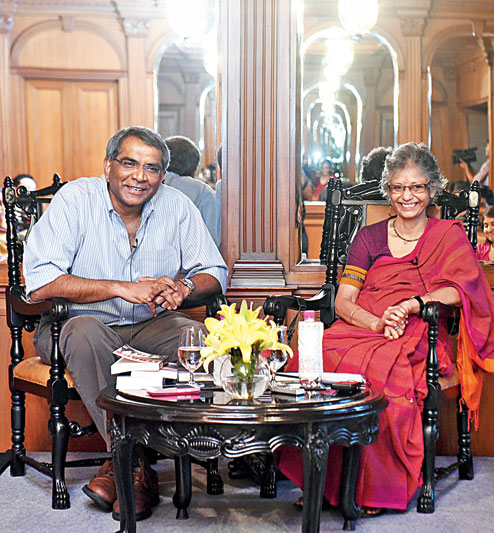

Publisher and writer David Davidar opened up about the ups and downs of the literary world, in conversation with publisher Mandira Sen, at An Author’s Afternoon, presented by Shree Cement and Taj Bengal, held in association with t2, Prabha Khaitan Foundation and literary agency Siyahi. Edited excerpts...
Mandira Sen: I’m going to ask you to tell us a little about your life because it is a varied and exciting trajectory, right from growing up near Nagercoil [in Kanyakumari] and then moving on to Bombay and Delhi and all over the world....
David Davidar: I’ll tell you briefly how I got into publishing. I was a journalist in Bombay in the ’80s and I worked with some fine editors. My first employer was Rajmohan Gandhi — Mahatma Gandhi’s grandson — who started a magazine called Himmat in response to the Emergency. He was fighting for what he believed in.... But his magazine shut down. Then I worked with a man as extraordinary, called Dom Moraes, who, in my opinion, is possibly the greatest English-language poet of the 20th century. Especially as a lyric poet. As a man he is a mess — he drank too much, he chased women… all of that fuelled his work.
My third job was with another magazine that didn’t last... it was a kind of features magazine. After two years there I got bored. A colleague of mine said I should go do this course in America. This was in Cambridge — the Harvard University course on publishing, which has now moved to Columbia, but it’s a prestigious course and I’d recommend it to anyone who wants to get into publishing.
After that, Peter Mayer, who was the chairman of Penguin Books globally, asked me if I wanted to go back to India because they were thinking of setting up a company there. I was 25 years old. I came back to Delhi, rented a two-bedroom flat. My only colleague was Khushwant Singh, who was going to be the adviser. Penguin India was Khushwant Singh, me, a peon and my secretary. Today it’s the largest company. It was a joint venture with ABP.
Mandira: You supervised the merger with a very famous publisher, with gorgeous illustrated books, called DK, didn’t you?
David: One has ups and downs and that was one of my down phases. Because DK was this vast, bloated organisation in India. Peter Kindersley, who founded DK, had a mad idea that India was going to be the engine that drove DK. So he hired a fellow who could write very well, Bikram Grewal, to set up DK, and told him to go forth and multiply.
Mandira: Peter Kindersley obviously thought big because he came to inaugurate the office on an elephant!
David: That was part of it. And then his big mistake was that he bought the Star Wars franchise to produce those books and they tanked. The problem with publishing is it’s a very inefficient business. You have to know how much money to pay, you have to know how much to print — not too much, not too little.
Pearson, the company that owned Penguin, came along and bought DK, and all the CEOs were told to integrate it into our companies. I remember walking into the DK office — there were 200 people — and I had to fire 180 or something. It was painful.
Mandira: After Penguin, from that gigantic company, you decided to do something on a more intimate scale [Aleph Book Company, an independent firm founded in 2011 with R.K. Mehra and Kapish Mehra of Rupa Publications]...
David: Well, I could either plant my garden in the mountains or I could do something that I really wanted to do. We were talking about how wasteful publishing can be, especially if you’re a very large company. The reason it’s an inexact business is because you take lots and lots of books and throw them at the wall and hope one or two of them stick.
In 1985 when Penguin India had started, the bestseller list was ruled by books from England and America. Today, the top 10 books are probably Indian. That’s why I’m so grateful for Rupa, because they said this is the cause they wanted to support. They wanted to do about 20 or 30 books a year and at least half of them would have to be good. And the reason I say forthrightly that at least half of them have to be very good because I know that in the large companies only 20 per cent of them are any good.

Mandira: So your model is something they used to have in England in the ’70s, up to the ’80s, where you had wonderful publishers like Michael Joseph, Knopf, and Faber and Faber. Quality books where you can relate to the authors and where you can nurture new talent. In India we are in a position to do this now...
David: In India there’s so little. Let me give you an example. Everyone has a stereotypical notion of what a Bengali is. But who are the Bengalis? Do we have a book that tells us about the Bengalis? That’s the book I’m going to commission next week. I’ve already commissioned a book on the Malayalis and the Tamils.... We are poor publishers for publishing second-rate novels.
I started off by keeping half my list to fiction. Next year five per cent is fiction. Unless a novel is spectacular, I will not publish it. We don’t have a single book on the six wars we’ve fought — I’m including skirmishes as well. Or, there isn’t a single good biography on the Ganga. There are two travelogues but no biography. What are we doing as publishers? Do we want to publish yet another bad novel?
I want to do books that will last 30 years. That’s the only thing that marks a good book for me. I don’t care if you win a prize because prizes are fallible. I don’t care if you sell 10,000 copies in the first year… will it last for 30 years?
Mandira: The other part of David is that he’s a writer. The first book, The House of Blue Mangoes, is a massive book on a Tolstoyan scale. It’s about a community we know little about — Christians near Nagercoil. After this, he did something more overtly serious, covering communal issues we are facing today. He calls it Solitude of Emperors. Why did you call it that?
David: So, this started when the Babri Masjid was broken. The Bombay riots… I was in a room with Khushwant Singh, L.K. Advani and a bunch of others. Khushwant Singh spent all his life fighting for peace. He said religious fundamentalism in this country will tear it apart if allowed to go unchecked. He didn’t discriminate against communities.
I asked myself who are the three greatest figures in history who have done their bit? I came up with Ashoka, Akbar and Gandhi. In their own ways they promoted this because India screwed up from the get go! When did these men become the way they were? If you read their lives, you’ll find each had a moment where they went from being ordinary to attaining the next level. That is what I wanted to explore in my book.
Mandira: The third novel is also in a different genre. It’s called Ithaca and it’s on publishing and what happens to someone who’s doing his best to climb the ladder very fast....
David: I’ll tell you where the germ of that came from. The nation is gripped today by Indrani Mukerjea. The most poignant thing about that is it’s a small-town crime. I don’t know, I think the desperation of small-town people to succeed lies at the root of all this. I had a similar experience where another lady, eerily also called Indrani, wrote this spectacular novel. She was a Bengali lady from a small town in Bihar....
Khushwant Singh and I agreed that her book — Daughters of the House — was the greatest book we’d read that year. She got famous, got lots of money and got reviewed well. And then a year later some obscure librarian in New Hampshire said that the book had passages that are exactly similar to her favourite novelist from the 1930s. We were being sued and they sent us passages. Ditto. She’d sent me her next manuscript, which I kept in my desk drawer for many, many years because it was so poignant. It was called ‘Hold My Hand, I’m Dying’. And that week she killed herself; she couldn’t bear the shame.
Text: Ramona Sen and Malancha Dasgupta