In quantum mechanics, Schrödinger’s cat is both alive and dead until observed. In contemporary India, that paradox has acquired a bureaucratic form. The voter, too, can exist in a state of superposition, simultaneously verified and deleted, present and absent, until the system decides otherwise. This is not a metaphor but an experience.
On March 30, 2026, I, along with lakhs of voters in Bengal, discovered that our names no longer appeared on the electoral rolls. When I checked the Election Commission of India’s website on March 31, my status was “deleted.” As of April 23, the website says that I am “excluded”.
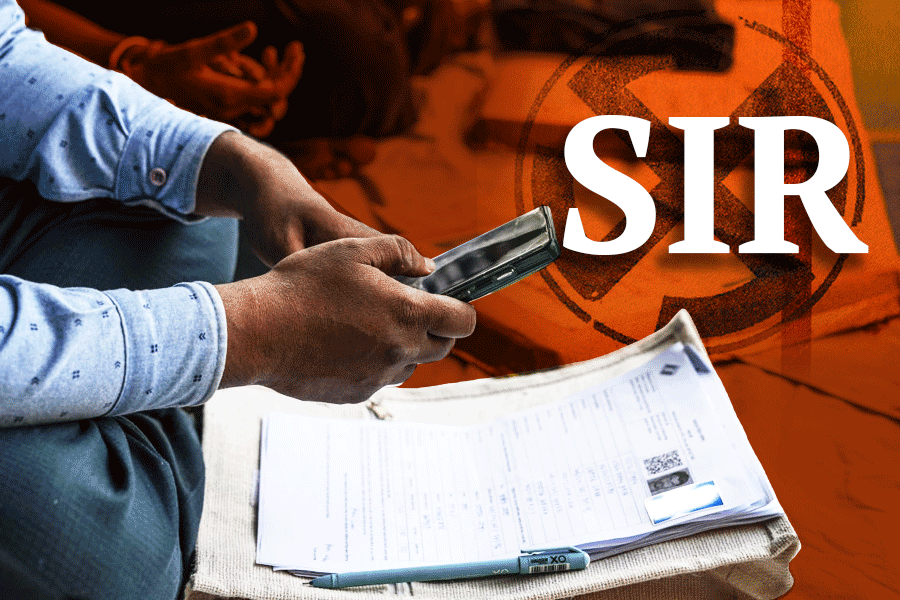
For many like me, this followed compliance with the procedures laid out under the Special Intensive Revision (SIR): forms filled, documents submitted, requests for correction or transfer duly initiated.
I filed Form 8 for a change in address. The EC website says that my field verification was satisfactorily completed on February 18, and on February 26, the status changed to ‘accepted’. A field verification conducted in mid-February confirms the presence of a voter at a given address, only for that same voter to be marked “deleted” by the end of March.
Logical discrepancies come in many forms. This is not a clerical error in the ordinary sense. It is not the kind of mistake that can be dismissed with a shrug and a promise of correction. What is at stake is something far more fundamental: the quiet transformation of citizenship into a probabilistic condition.
To be a voter is to be counted. It is to occupy a place in the ledger of the state, to be legible to the machinery that translates presence into participation. When that legibility breaks down, what remains is not merely inconvenience. It is a form of suspension. Today, 34 lakh voters in Bengal occupy that liminal space — appeals pending at the tribunal, waiting for natural justice, waiting for resolution.
The language of administration is often reassuring in its precision. There are processes, verifications and enumerations. Officers visit homes, databases store records, and systems update in real time. The promise is one of rationality and control: a large and complex democracy rendered manageable through procedure.
But scale has its own politics. When exercises of this magnitude are conducted under pressure in compressed timelines, the system does not merely strain. It begins to produce anomalies. And these anomalies are not distributed evenly. Reports from across regions suggest that exclusions are not isolated incidents but patterns.
What looks like a technical glitch from a distance resembles something else up close: a systemic vulnerability that attaches itself to those least equipped to contest it. And in all of this lies the unavoidable question of privilege. If these processes can falter for those like me, with documentation, institutional affiliation, education, technical prowess and the familiarity required to navigate them, then the implications for those without such privilege are harder to ignore.
The figures suggest that more than 90 lakh names have been removed under the SIR. At that scale, the issue is no longer one of isolated discrepancy. The question is no longer about who is excluded, but who is most easily made to disappear.
Exercises of this scale are, by their nature, demanding. They require time not only to gather information, but also to reconcile it, verify it, and ensure that correction does not become inadvertent exclusion. This SIR seems like a process conducted in haste, where the pressure to complete may have outpaced the capacity to carefully adjudicate.
To follow the process itself requires a certain familiarity: tracking status updates online, interpreting shifting classifications, uploading documents in prescribed formats, and responding within narrow windows.
Even for those equipped to do so, the infrastructure has not always cooperated. The EC’s website, now central to verification and correction, has been intermittently inaccessible, its interface opaque, its categories not always intuitive.
These may appear, individually, as minor frictions within a large administrative exercise. But taken together, they suggest something more consequential. When inclusion depends so heavily on procedural continuity, and when that continuity is so easily disrupted, the question is no longer who is on the roll, but how recognition itself is determined, and with what degree of reliability.
Democracy, at its most basic, rests on the principle of inclusion. It assumes that the governed are also the governing, and that the act of voting is the minimal expression of this relationship. When inclusion becomes uncertain, when participation is subject to administrative fluctuation, the very ground of that relationship shifts.
One could argue that no system is perfect, that errors are inevitable in a democracy of this scale. That is true. But the measure of a system is not whether it produces errors; it is how it responds to them.
At the moment, the burden seems to fall disproportionately on the voter. You must prove that you exist, even after the system has already seen you. You must reconcile the contradiction between verification and deletion, between presence and absence. You must, in effect, collapse your own wave function by insisting on a single, stable identity in a system that has rendered you multiple.
The honourable Supreme Court has said that tribunals must conduct proceedings in accordance with the principles of natural justice. However, in terms of implementation, the math, as they say, is not ‘mathing’.
As tens of thousands of appeals lie pending, so too does their citizenship. Until the system resolves itself, 34 lakh people are rendered Schrödinger’s voter by the state: present in reality, absent in democracy.
Nandita Roy teaches business ethics and communication at IIM Calcutta