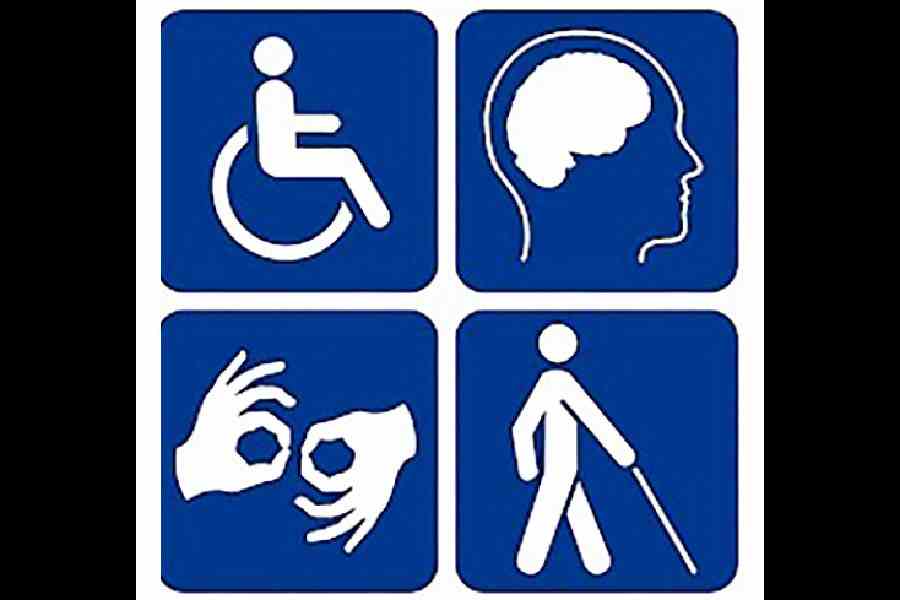
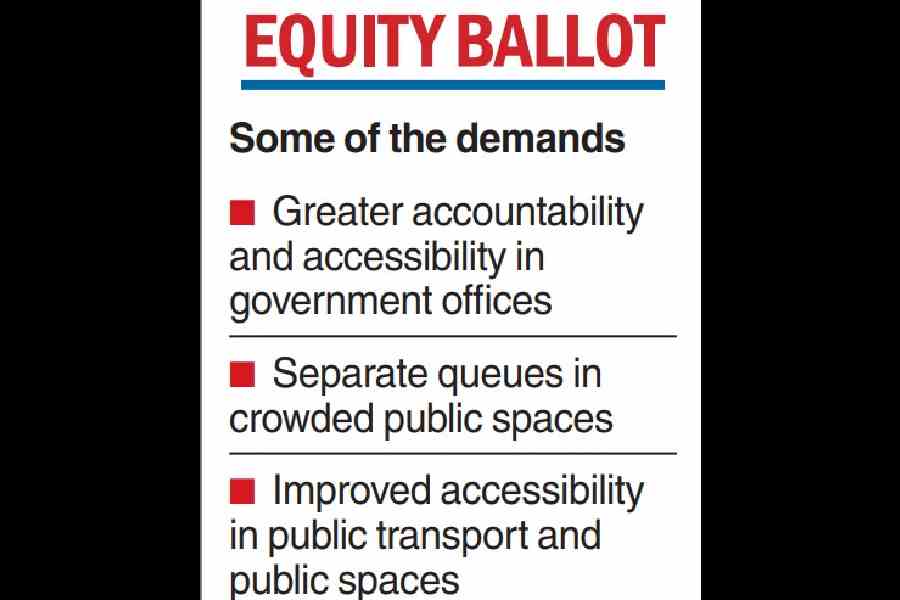
Buses should halt for persons with disabilities, public toilets and Metro stations need better accessibility, and certain public spaces should provide separate queues, said people with disabilities and those who work closely with them.
Equity is not a privilege but a right, and many neurodivergent individuals would vote for universal access, dignity, and fairness in a system that should be less discriminatory and exclusionary, they said.
“Why should a person with a disability avail of an app cab or a private vehicle and not public transport? A bus should stop when they see me,” said Sudipendu Dutta, an IT trainer at the Indian Institute of Cerebral Palsy, who has cerebral palsy.
Dutta will vote in the Behala West constituency on April 29.
While policy reforms and stronger implementation are essential, persons with disabilities and their parents are also seeking changes in everyday life.
“Whichever government comes to power, we want them to keep the promises they make. The roads should be pothole- and crater-free. That is something which will
benefit not just a person with a disability but everyone, including elderly people,” said Amitava Basu, 37, who has autism.
Not all disabilities are visible, and some get overlooked and thus are ignored.
There should be a separate queue for persons with disabilities at airports. We train our children to stand in queues, but for some individuals with autism, being surrounded
by crowds can be overwhelming, said Namita Somani of the Amrit Somani Memorial Centre.
Dutta said the demand is also for dignity.
“Persons with disabilities receive a ‘manabik’ (humanitarian) pension of ₹1,000 a month. A candidate from a political party has said it would be raised to ₹3,000 if their party comes to power. But the issue is not just about ₹1,000 or ₹3,000 — it is about dignity and rights,” said Dutta.
“More opportunities must be created for persons with disabilities to join the workforce,” he added.
Changes are needed not only at the political level but also among the broader population, who need to show more “compassion, empathy and treat people with dignity,” said Somani.
Arunasis Adhikari, who runs a residential facility for individuals with autism in Jamdoba village in West Burdwan, said special schools should be brought under a statutory body.
“That would improve accountability and ensure proper monitoring. It would also help guarantee that every special school has qualified special educators. The need for such schools has grown in the absence of inclusive mainstream institutions. While some children attend mainstream schools, many are simply present without any meaningful development or progress,” said Adhikari, who is also the parent of a child with autism.
Many parents of children with disabilities said their vote in this election would hinge
on the promise of more equitable opportunities for their children.
“We want to place our children in residential facilities that can provide assisted living after us. But these facilities do not grant inheritance rights to our children, which is a major concern,” said Nilanjana Rambothu, a mother who runs a special school.
Reena Sen, who has worked in the disability sector for close to five decades, said she will vote for someone who values diversity. “My vote will go to someone who will value and protect diversity of all kinds — caste, creed, religion, mental and physical health,” said Sen.
She also wants greater accountability and accessibility of public institutions. “There has to be a system of redressal of grievances and access to ministries and bureaucrats because they are there to serve us,” said Sen, vice-chairperson of the Indian Institute of Cerebral Palsy.
Workers in this sector face serious setbacks when government schemes that NGOs depend on are abruptly discontinued.
Whether at the state or central level, there must be accessible points of contact. Right now, it feels like hitting an impenetrable wall, said Sen.