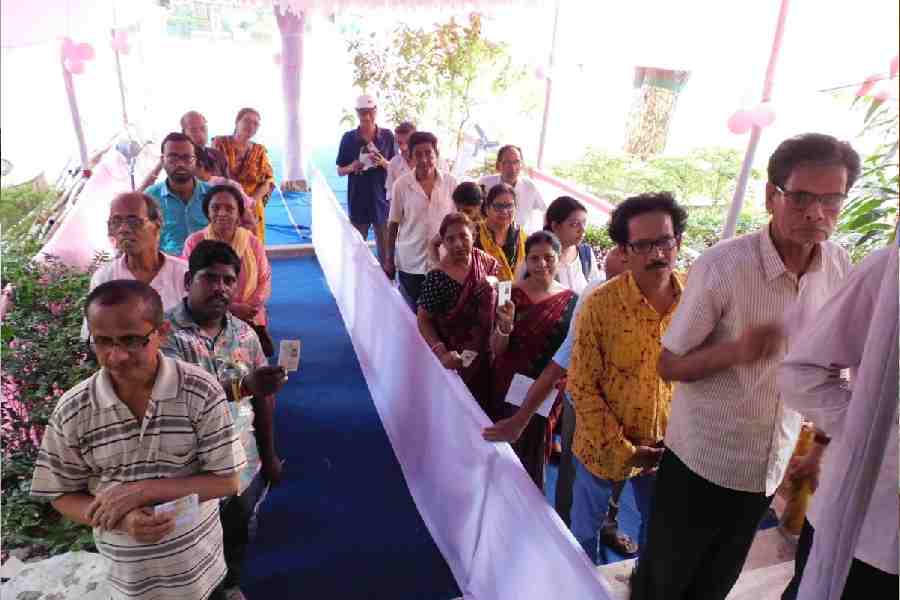
The record 92.35 per cent voter turnout in the first phase of the Bengal polls was not the only significant departure from the elections as we know them. Several polling officials whom The Telegraph spoke to said they didn’t encounter unfair practices such as fake and proxy voting — a fixture in previous elections — this time round.
A presiding officer of a booth in Birbhum’s Sainthia recounts the changes he witnessed this year:
I have been serving as a presiding officer since the 2011 Assembly elections. Barring the 2016 Assembly polls, when I was kept in reserve, I worked in all previous Assembly and Lok Sabha elections.
On Wednesday, I reached the booth with my team of polling officers and security personnel around 3pm. Soon after reaching the booth, the central force jawans — eight of them were there for two booths in the primary school where I was deputed — told us that we should work without hesitation and ask for their help if there was any problem.
The first change I noticed was in the behaviour of party cadres. Unlike previous years, no one approached us with food or extended hospitality.
Instead, we were told that the local self-help group would provide us with dinner on Wednesday and breakfast and lunch on the polling day.
When we held a meeting on Wednesday evening with the agents of political parties for a mock poll, one of them warned me against the ruling party trying to cast proxy votes through companion voting.
In my experience, false voting does not always mean capturing booths and casting willfully. The most scientific way to cast proxy votes is through companions. In the past elections, I had been intimidated and forced to allow such illegal proxy voting.
Rule 49N of the Conduct of the Elections Rules, 1961, allows blind and infirm voters to seek the help of a companion, who should be above 18 years of age, to reach the voting compartment and press the EVM button. But for this, Form 14A has to be filled out, and only one companion is allowed per voter.
In the 2019 Lok Sabha and 2021 Assembly polls, at least 60-70 voters had turned up with companions, and in all cases, the companions were men in their 30s. They introduced themselves as relatives of voters who were infirm, blind or had recently undergone eye surgery.
I could sense that the voters were not genuine. Even if they were genuine, they were not infirm or blind. The companion accompanied the voter to ensure that the vote was cast in favour of a particular political party.
I was often intimidated and forced to allow the companion. My helplessness was compounded by the silence of the agents of other political parties. I felt afraid to ask the voters to fill out Form 14A. I could not speak up even when I saw that 5-6 voters turned up with the same companion.
But this year, at the booth where I presided, only three voters out of 670 approached me for companion voting. One of them was an 85-year-old woman, who came with her daughter-in-law, and another was a blind man, who came with his son. The third voter was an 82-year-old man having difficulty walking. He came with his grandson.
I found all three cases genuine and allowed all of them to cast their votes through their companions. None of them refused to go through the required procedure.
When the election ended at 6pm on Thursday, I told the agent, who had alerted me in private, how his apprehension was wrong. He said security arrangements might have forced the “poll managers” to stay away.
I feel that the measure to allow a voter to enter the 100-metre radius of the booth only after getting clearance from the BLOs and central force jawans, who checked the ID cards, made the difference. Also, the deletion of bogus voters from the rolls narrowed the scope for such practice.
While returning home after submitting the ballot units, VVPATs and the EVMs at the DCRC (distribution centre and receiving centre), my colleagues also said they conducted polling peacefully without having to battle the scourge of companion votes.