
The magnificent gulmohar tree — with its bright orange blooms — moves us in different ways. Some write poetry, some take pictures, some paint the images in oil — and some eat them. I belong to the last group.
Well, I don’t really eat them now, but there was a time when, as a young boy with scraped knees, I couldn’t see a gulmohar flower without tearing off the small striped central part of the flower and popping it into my mouth. I am now better behaved, but I have to confess that I fondly remember its deliciously tart taste.
That flowers can be tasty has been recorded over the years. But in recent times, too, we’ve seen top chefs across the world serving edible flowers. French chef Pascal Aussignac, for instance, is known for his primavera tulip (organic tulips filled with peas and button mushrooms) and Spanish maestro Ferran Adrià of El Bulli for his soup prepared with mandarin orange flowers and white begonia.
In India, too, flowers have made their way to exotic menus. I remember chef Sharad Dewan of The Park, Calcutta, using them most innovatively for a special menu, where he flavoured and coloured the milky dessert rabri with marigold petals, and a thandai brûlée with rose leaves.

But now I find that they are increasingly being used in Oriental cuisine. For instance, when chef Vaibhav Bhargava prepares his seafood ceviche, he cooks it with pansies and mustard flowers. “I use edible flowers for their colour, taste and texture,” says the executive sous chef, Pan Asian, WelcomHotel Sheraton, New Delhi.
Indeed, the colours that flowers bring to a dish are vibrant. “Green brings coolness and calm; red stands for passion and excitement; black is a sign of elegance,” he says.
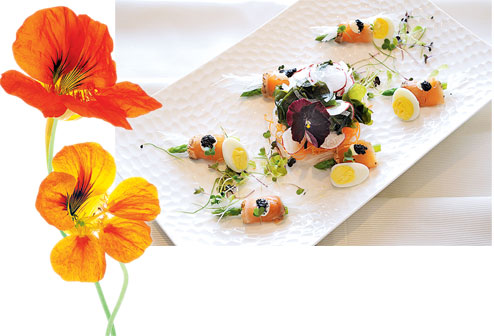
So he puts the orange nasturtium flower in his salmon tataki with Osetra caviar. “I use nasturtium with the salmon as the flowers are easy to grow from seed and pair well with fish,” he says.
Japan’s beautiful sakura flowers — cherry blossoms — find place in its cuisine. The hamachi sashimi is smoked with sakura wood for a floral aroma. Chef Bhargava’s micro herb salad uses a sakura flower dressing, prepared by mixing the flowers with salt, lemon juice, rice vinegar, salad oil, sugar and light soy. A few dianthus petals are added to the salad for colour and taste.

Another Japanese bloom, the violet hojiso hanaho, is used by Japanese chef Vadim Shin of B-Bar, an international Oriental chain, in Delhi. “We use this for sushi and sashimi as well as a topping for daikon noodles,” chef Shin says.
You will often find the wonderfully fragrant jasmine flowers in Asian food. The flowers add aroma to rice, and chef Rajesh Dubey of Speciality Restaurants (which includes the Mainland China chain) puts a few dry jasmine flowers in jasmine tea to enhance its flavour.
“For Southeast Asian cuisine, we use (pale pink) ginger flowers or torch ginger in a big way. It’s also eaten raw in salads,” he says.
Flower power, as you can see, adds a new dimension in Oriental cooking. But do remember that all flowers are not edible, and chefs suggest that when you do use edible flowers, select those organically grown without pesticide. And then, while cooking, don’t forget to stop and smell the flowers.
Photographs by Jagan Negi;
Courtesy: WelcomHotel Sheraton, New Delhi