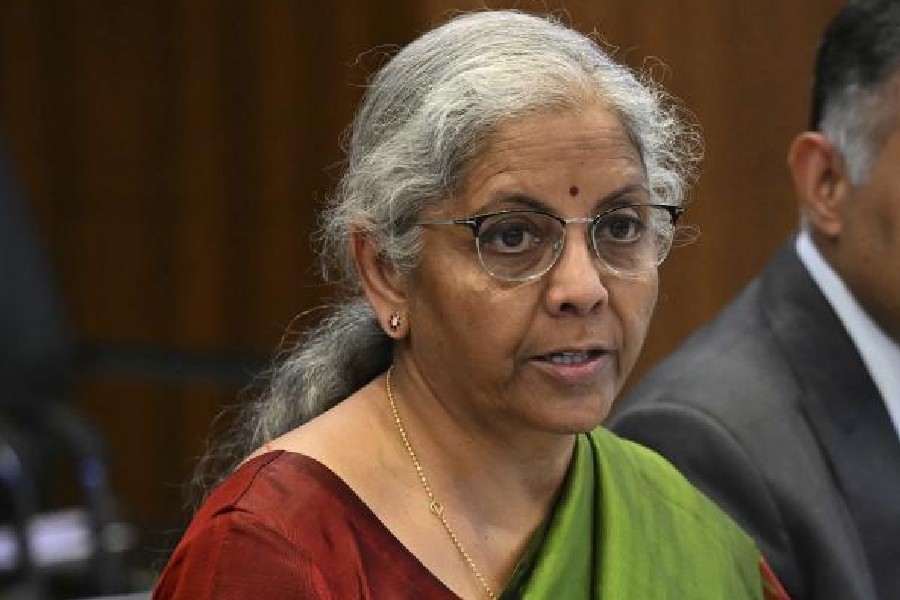
Finance minister Nirmala Sitharaman on Sunday said the Centre expects the fiscal deficit—the gap between government expenditure and income—to narrow to 4.3 per cent of GDP in FY27, marginally lower than the 4.4 per cent projected for the FY26, reiterating the government’s commitment to fiscal consolidation even as it seeks to sustain growth in a volatile global environment.
While market observers have flagged that the pace of deficit reduction as the slowest since the pandemic, Sitharaman defended the glide path as “responsible and realistic” and said it supports growth. She reiterated the government’s medium-term objective of reducing the debt-to-GDP ratio to 50±1 per cent by FY31. In line with this trajectory, the Centre estimates the debt-to-GDP ratio at 55.6 per cent in FY27 (Budget Estimates), down from 56.1 per cent in FY26 (Revised Estimates). A declining debt ratio, she said, would gradually free up resources for priority sector spending by lowering interest outgo.
For FY27, the government has projected capital expenditure growth of 11.5 per cent at ₹12.21 lakh crore, up from ₹10.97 lakh crore in FY26RE. However, the current year’s capex is below the ₹11.21 lakh crore budgeted for FY26, indicating a slowdown in spending in the second half of the ongoing fiscal, a trend that analysts are watching closely for its growth implications.
Analysts at Morgan Stanley India said the Budget maintains the fiscal-consolidation path, albeit at the shallowest pace since the pandemic. They expect the emphasis on capex to support a cyclical recovery while measures aimed at improving manufacturing competitiveness and services-sector attractiveness strengthen India’s growth outlook. The fiscal arithmetic, they added, appears realistic, with nominal GDP growth assumed at 10 per cent for FY27 and direct-tax revenues projected to grow 11.4 per cent.
Aditi Nayar, chief economist at ICRA, said that the new GDP series due by end-February could reveal higher nominal GDP levels after incorporating more updated information, potentially influencing deficit and debt ratios.
However, the government’s higher gross market borrowing has surprised economists. Upasna Bhardwaj, chief economist at Kotak Mahindra Bank, said that while the FY27 fiscal deficit of 4.3 per cent and net borrowing are broadly in line with expectations, the sharply higher-than-anticipated gross borrowing of ₹17.2 lakh crore could weigh on market sentiment. The absence of buybacks or switches, she said, has driven the upside surprise in gross borrowing.
DEA secretary Anuradha Thakur said the government’s fiscal-deficit financing will continue to rely on a mix of market borrowing and the National Small Savings Fund, with no major changes planned.