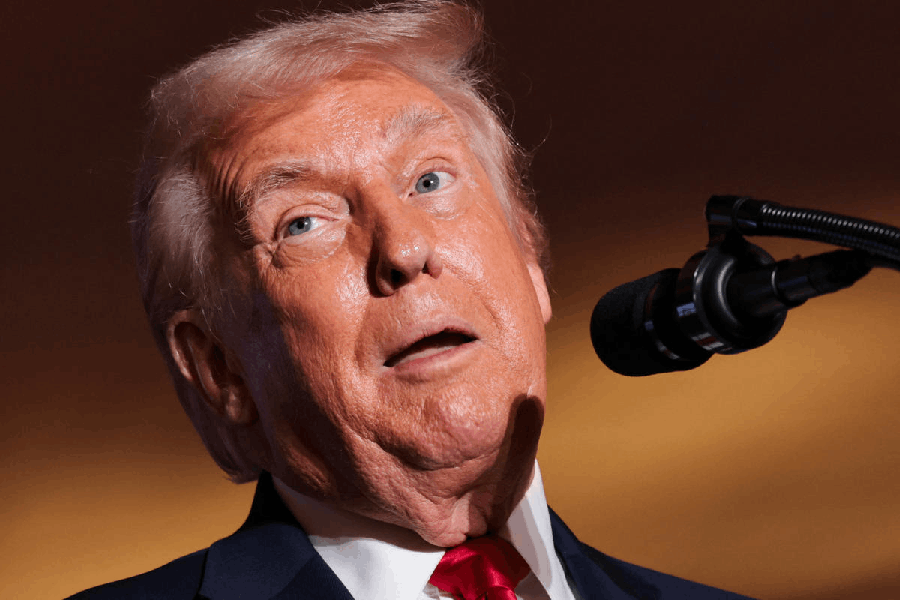
This was one of the most topsy-turvy years in living memory for financial markets, as U.S. President Donald Trump tore up the economic playbook that has shaped the multilateral, globalized world for decades.
The president's strategy may have been well telegraphed, but its impact on markets, growth, and policymaking turned out to be very different from what most Wall Street analysts had expected.
The global trade war of 2025 should not have come as a surprise. Trump campaigned on making American manufacturing great again.
"I love tariffs," Trump said at a rally in Las Vegas two weeks before the election. "I can make anybody do anything through the use of tariffs."
Trump said he would force countries around the world to pay for "ripping off" the U.S. with "unfair" trade practices – and he did just that on April 2, so-called "Liberation Day."
Despite months of warning, analysts and investors were still caught flat-footed by the chaotic rollout of a host of sky-high tariffs.
The S&P 500 lost nearly 15% in the three days after Liberation Day, only to recoup most of that in the next few days once Trump delayed some of the more extreme elements of his flagship policy.
Yet even after Trump's partial rollback, the trade landscape has been transformed. The effective U.S. tariff rate on imports at the end of last year was around 2.5%. It is now nearly 17%, according to The Budget Lab at Yale, the highest since 1935.
What is perhaps most surprising is how little most markets seem to care.
The S&P 500 was expected to end this year at 6,500 points, according to the consensus forecast in Reuters' 2024 year-end poll. That implied a rise of around 9%. The index is on track to gain twice as much, making a push for 7,000 points.
DOLLAR'S HISTORIC SLUMP
Want to find the biggest forecasting flub of the year? Look no further than the U.S. dollar. The greenback plunged 12% against a basket of major currencies in the first six months of 2025, its worst start to a year since President Richard Nixon took the U.S. off the gold standard and began the era of free-floating exchange rates more than half a century ago.
That wasn't supposed to happen. Trump's protectionist tariffs and onshoring were expected to be inflationary and thus liable to keep monetary policy relatively tight. That, in turn, would support foreign inflows into the U.S. and strengthen the dollar, or so the consensus view held.
But the rally never materialized, in large part because many global investors baulked at Trump's controversial policy agenda and trimmed their dollar exposure.
Foreign investors still wanted exposure to the U.S. tech boom and artificial intelligence revolution, so they piled into U.S. equities, but – in a break from the recent past – they hedged the currency risk.
As a result, this year featured a rare phenomenon: a Wall Street boom and a dollar slide.
THE YUAN ALSO RISES
The Chinese yuan - and, in many ways, China itself - was another major forecasting miss.
Analysts' consensus view early in the year was that Beijing would retaliate against Washington's tariffs by depreciating the yuan to boost exports, especially given the deflationary pressures bearing down on China's economy.
But the yuan moved in the opposite direction, at least against the dollar. China's currency is set to end this year at its strongest level against the greenback in 14 months, a whisker away from the all-important 7.00 yuan per dollar level.
This appreciation hasn't tanked China's export market, however. While the country's shipments to the U.S. have dropped nearly 20% this year, exports to the rest of the world have more than made up for this, pushing China's 2025 trade surplus above $1 trillion and disproving yet another economic rule of thumb. Rather than focus on boosting domestic demand, China appears as wedded as ever to an export-led growth model.
TRUMP'S SHADOW
Last but not least, there is the Federal Reserve.
A year ago, futures markets were pricing in only one full quarter-point interest rate cut in 2025, but the Fed delivered three, all coming in the last four months of the year.
Cynics might put this dovishness down to the intense political pressure bearing down on Chair Jerome Powell from the White House. Yet, if political interference is to blame, markets didn't appear overly concerned.
Fed independence is supposedly the cornerstone of the U.S. financial system, but Trump's actions have elicited barely a peep from investors, barring some ructions in May when Trump indicated that he might fire Powell.
Indeed, U.S. equities, the dollar, and 10-year Treasuries all rose in the second half of the year even as the president's shadow over the Fed lengthened.
For now, investors seem to be getting used to Trump's new economic playbook. Will that change next year? Many of the issues that dominated 2025 - worries over trade, an AI bubble, rising public debt, and central bank independence - are still very much in the 2026 mix. It could be another topsy-turvy year.
(The opinions expressed here are those of the author, a columnist for Reuters)
Enjoying this column? Check out Reuters Open Interest (ROI), your essential source for global financial commentary. ROI delivers thought-provoking, data-driven analysis of everything from swap rates to soybeans. Markets are moving faster than ever. ROI can help you keep up. Follow ROI on LinkedIn and X.