
New Delhi, Aug. 24: The fall in global crude prices to a six-and-a-half-year low to below $40 per barrel is likely to correct the balance of trade by reducing the import bill even as the depreciating rupee makes inbound shipments costlier.
While Brent crude was trading around $44 per barrel, its weakest since March 2009, US benchmark West Texas Intermediate was down to about $39 per barrel. The Indian basket of crude oil prices, which represents the average of Oman and Dubai sour-grade and sweet Brent crude processed in domestic refineries (in the ratio of 72:28), stood at $45.21 a barrel on August 21, the lowest in the past seven months since January 26.
The rupee has also plunged to a two-year low of Rs 66.66 against a dollar.
"The combined impact of the crude price slump and the depreciation in the rupee over the past few days will result in a Rs 100,500-crore (positive) impact on India's import bill along with a Rs 9,000-crore impact on the government's petroleum subsidy," K. Ravichandran, senior vice-president at research and ratings agency ICRA, said.
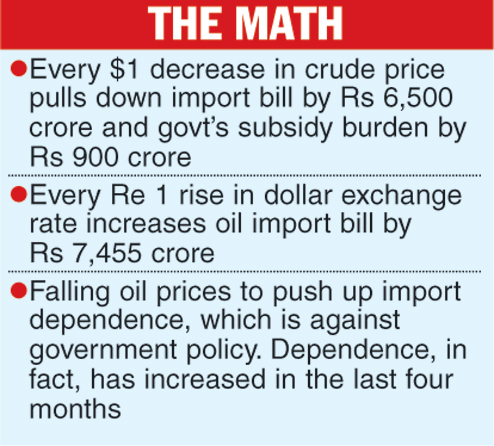
At present, every $1 decrease in crude prices pulls down the import bill by Rs 6,500 crore and the government's subsidy burden by Rs 900 crore. However, the benefit will be limited by the rupee depreciation. Every Re 1 increase in the exchange rate of the dollar increases the oil import bill by Rs 7,455 crore, according to the Petroleum Planning and Analysis Cell, an arm of the oil ministry.
The government had budgeted for an average crude price of $70 per barrel for this financial year.
The country imported 189 million tonnes (mt) of crude at a cost of $112 billion in 2014-15.
"The fall in crude prices has far more benefits to accrue for India than the depreciating rupee. Lower crude prices will contain inflation and current account deficit (CAD) for a longer period of time. The depreciating rupee will definitely hit CAD but the overall impact will not be substantial as it will be offset by the growth in exports, which has been sluggish this year," Hemal Shah, partner, advisory services at EY, said.