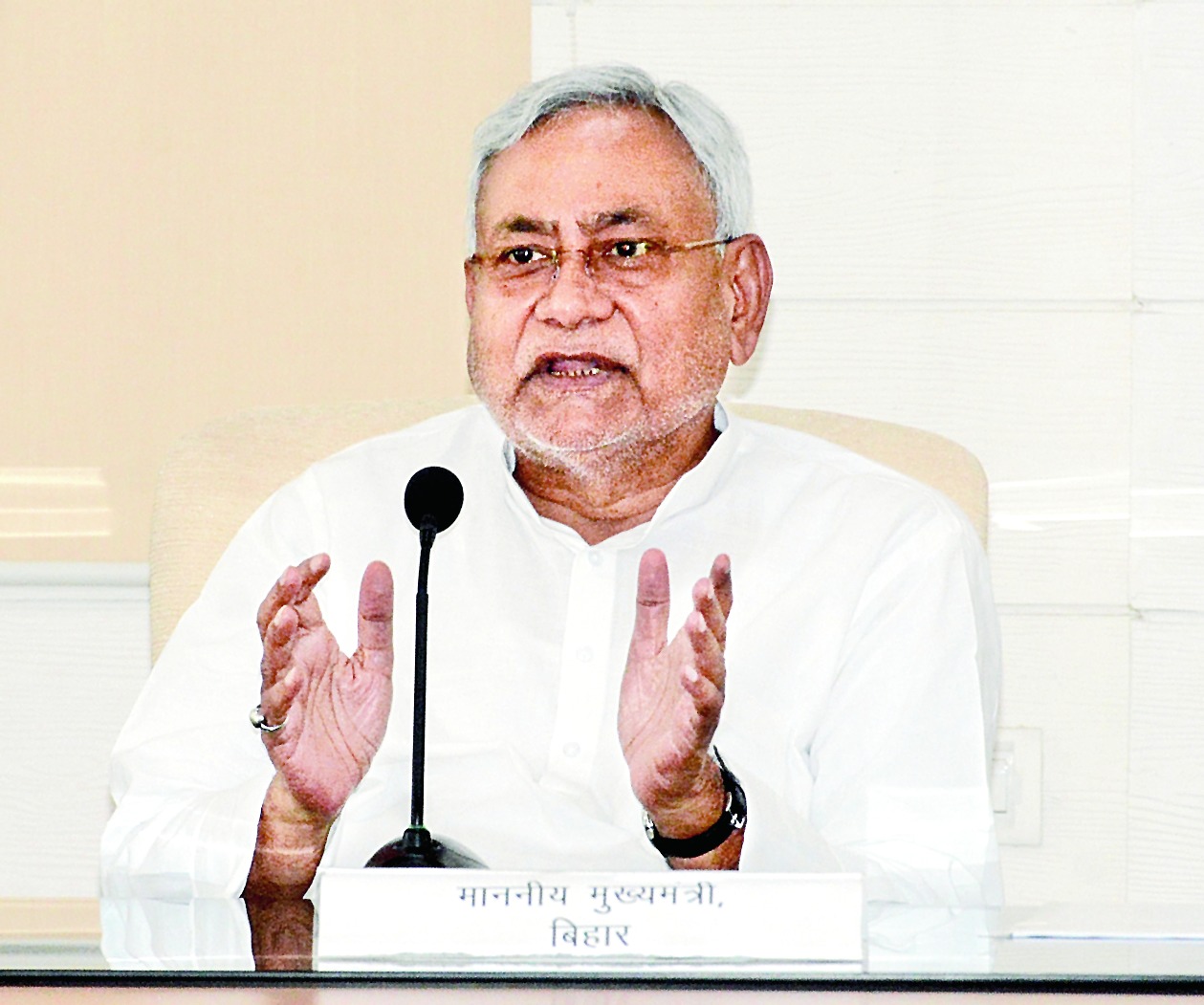

on Tuesday. Picture by Sachin
Steel framework would replace the entire concrete super-structure of Mahatma Gandhi Setu in seven years to make the bridge safer for traffic movement.
A senior official in the national highways wing in the state road construction department said Japan International Cooperation Agency (JICA) had submitted the final feasibility report for overall restoration of the bridge last month.
The Japanese agency has zeroed in on usage of steel framework to save the 33-year-old bridge from complete collapse and given details on the various aspects of the proposed technique in the feasibility report.
The Telegraph, in its January 7 edition, reported that the JICA, in its preliminary report, had proposed to repair the 5.575km bridge by demolishing the entire concrete superstructure of the road-deck and erect steel framework on the existing pillars to sustain the load.
"The JICA has submitted the final feasibility report to Union ministry of road transport and highways as per which, use of steel girders is the most feasible solution to restore Mahatma Gandhi Setu. The feasibility report would now be forwarded to the department of economic affairs, Union ministry of finance, for its consent, following which the detailed project report would be finalised and bidding process would start," said the senior official in the road construction department.
The official added that he Union ministry had asked the road construction department to complete all groundwork by the end of this year so that the repairs could start from next year.
According to sources, the feasibility report has suggested the use of steel girders for making truss - basically triangles with square shaped boxes underneath the bridge. The square-shaped boxes would act as castings in which concrete would be filled. As a result, the live load or the load of the vehicles would be transferred to the truss and the pillars would only have to bear the weight of the truss, which would be much less.
Though the use of truss-bridge technology would increase the longevity of Gandhi Setu but the cost factor involved in it would be quite high - estimated at Rs 2,000 crore.
Span repair
A three-member team comprising senior officials in the road construction department constituted in November last year to suggest ways for mending the tilt in pillar Nos. 34 and 35 in the Gandhi Setu has not recommended any repair.
"We did not recommend any structural repair as it is quite an arduous task. For instance, cutting one span of Gandhi Setu having a length of 120m takes more than six months. It's thought that it would be better to take up the overall restoration works on the bridge rather than taking up in bits and pieces. Besides, the reimbursement of the cost of repair is also mostly delayed by the Centre," said one of the committee members.
The committee, in its recommendation, has envisaged regulation on movement of heavy vehicles and prohibition on very heavy vehicles (10-12 wheels) on the bridge.
Pre-bid meeting
Bridge construction firms from countries like China, South Africa and around a dozen firms participated in a pre-bid meeting on the proposed Kachchi Dargah-Bidupur six-lane bridge in Patna on Monday. The proposed suspension bridge over the Ganga would be 9.76km long and its total length would be 22.76km with approach roads.
"We had a good response in the pre-bid meeting and we shall reply to their queries over the next few days. The bidding process is targeted to be finalised by July so that work can start from August," said a senior official of Bihar State Road development Corporation Limited, the project executing agency.