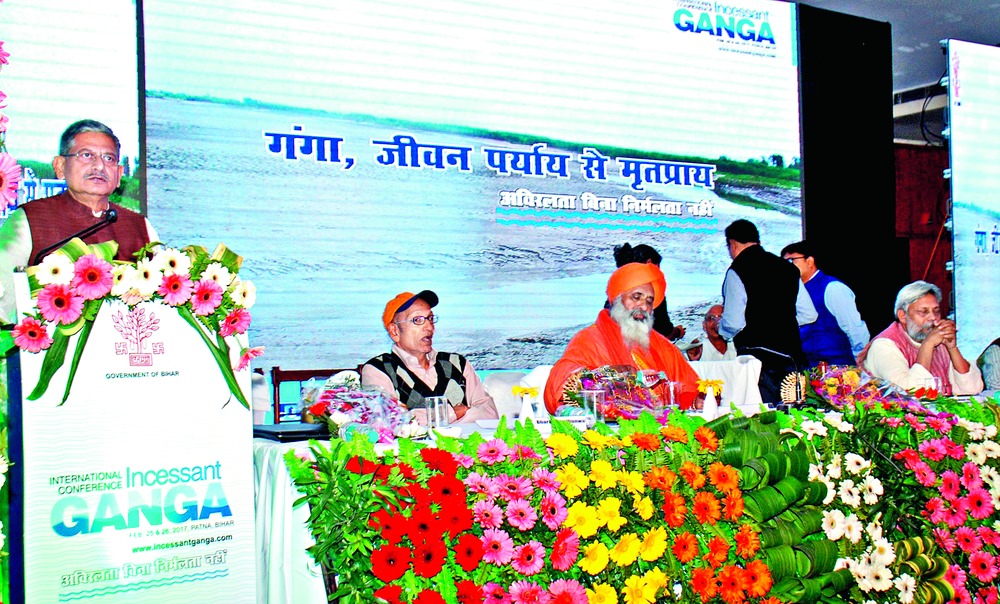

Rajendra Singh (far right in picture above), the "waterman" who has won the Magsaysay Award and the Stockholm Water Prize for community-based efforts for water conservation and reviving rivers in Rajasthan, was on Sunday taken aback when he with other experts conducted an aerial survey of the Ganga from Patna to Farakka. Singh, a member of the National Ganga River Basin Authority (NGRBA) who was here to attend the two-day international conference on "Incessant Ganga", expressed his concerns about the holy river while talking to Dev Raj. Excerpts:
What did you observe in the aerial survey?
I saw massive sand dunes along the Ganga in and around Patna district. The river seems to be lost into sand dunes in Raghopur (Vaishali district). The entire landscape seemed as if Jaisalmer's desert has come here. The holy river is in a sorry condition and its high time we make all-out efforts to save her.
What are the reasons for the Ganga's sorry state?
There could be many reasons for it, including unplanned, unmanaged development along the Ganga. But the biggest reason that we see today clearly with our eyes is the Farakka Barrage. It has engineering mistakes that got incorporated before its construction, and after completion no proper dredging or efforts to clean silt were taken up. The level of the riverbed and water is so high that the backwater comes up till Patna. Over 80 per cent of the problems in the Ganga is due to Farakka; the rest are due to interventions on both sides of the river from Gangotri to Gangasagar.
What challenges does the Ganga face?
Aviralta (incessant flow) and nirmalta (cleanliness) are the main challenges and both are interdependent.
If we want to make the Ganga incessant, we have to ensure that water from Gomukh, where the river originates, travels to Gangasagar to fall in the Bay of Bengal. At present not a single drop from Gomukh reaches Bihar. Dirty drains start emptying into the Ganga right from Gangotri. We will have to separate the river from sewer. If you think that making STP (sewage treatment plant) will solve the issues, you are wrong. Our governments face the big challenge of stopping dirty water falling into Ganga and ensuring that clean water comes to the Ganga. This is a big fight for states like Bihar, which should assert their right for water from Gomukh. If people unite, ensuring incessant flow will not be a difficult task.
What about the impact of dams and barrages?
All the dams, barrages on Ganga are very unscientific and are not operated and maintained properly. De-silting has never been done. They are not serving the purposes for which they were built. Glaring examples are the barrages at Farakka, Narora and Bijnor. They are disturbing the entire Ganga.
What are the solutions?
The foremost is to address Farakka Barrage issue by converting its present system of gates to "under-sluice gates". It could be applied to other barrages too. Socio-economically, we must start focusing on cultivating suitable crops in the diara (riverine) areas along the Ganga during the dry as well as rainy season. A Ganga literacy campaign should be started. People also need to cooperate and coexist with floods. The last is the spiritual part - to conserve a river that is a living entity and is ingrained in the Indian psyche as the embodiment of piety, continuity and cleanliness.
What obstacles do you see in implementing the solutions?
The biggest challenge is to work in a united manner for the Ganga. I will state the bitter truth that people of Bihar talk good things but do not work to implement it. Its high time to act. Knowledge and human resources, both are here. If work doesn't start, people like me will become mad.
Is breaking the Farakka Barrage a solution?
If we just say that Farakka Barrage should be destroyed, it will harm the entire country. We first need a proper study to understand the impact of the barrage, and then work on creating awareness on decommissioning it.