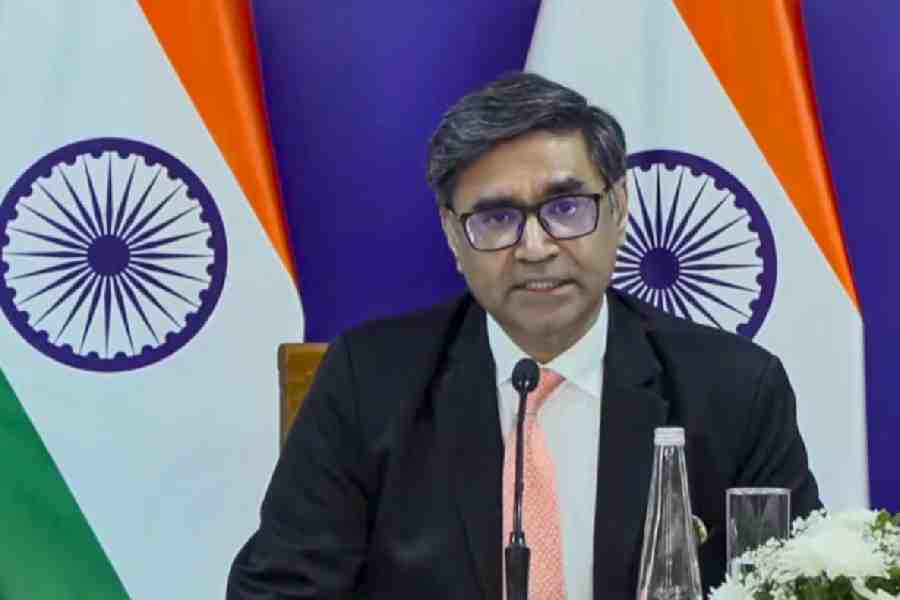
nWhat were the challenges before the police when you assumed charge as the state police chief? How far you have been able to contain crime in Bihar, which had once acquired the dubious distinction of being a lawless state?
I assumed charge as the director-general of police on March 1, 2010. My predecessors had undoubtedly done a lot to improve the law and order situation in the state. But every policeman has his own style of functioning. As I had worked in different capacities as SP, DIG, IG and ADG and mostly remained in field, the first thing that I did after becoming the DGP was to establish better co-ordination between the state government and the state police headquarters. I charted out my priorities and asked my colleagues to focus on quick response and right detection of criminal incidents. I believe that actual detection of offences is the best way to prevent crime.
The cases of kidnapping for ransom, crime against women, particularly rape, and murders are taken up for speedy trial and the culprits are prosecuted. Instructions were issued to submit chargesheets against those accused in rape cases in the shortest possible time and gather as much evidence as possible so that the culprits cannot evade punishment. Visibility of the men-in-uniform in public is important but sensitivity towards work is equally important. I try to identify the merit of every employee in the department and make his/her gainful (optimal) use. Work shirkers are sidelined. I want every person in the department to give his/her 100 per cent and for that you have to lead by example.
nAs law and order is priority for the Bihar government, what steps are being taken to strengthen the police force?
The state government has initiated the process of increasing the police-public ratio and achieve the national average of 145 policemen per lakh population against 80 policemen at present. About 45,000 constables and 9,500 sub-inspectors are to be appointed in phases in five years.
The government has increased the budget of the Home (police) department from Rs 1,100 crore in 2004-05 to Rs 3,582 crore in 2011-12. Even under non-plan head, the budget from Rs 10 to 20 crore has been increased to Rs 400 crore.
A police academy is being constructed at Rajgir at an estimated cost of Rs 206 crore for imparting proper training to police officials. There are plans to set up 19 additional police lines, each with the capacity to accommodate 300 policemen at Nalanda, Gaya, Aurangabad, Bhojpur, Rohtas, Buxar, Saran, Bettiah, Muzaffarpur, Siwan, Motihari, Samastipur, Purnea, Katihar, Bhagalpur, Munger, Begusarai, Sitamarhi and Nawada. Each barrack will cost Rs 4.72 crore. Besides eight new battalions of Bihar Military Police are to be raised. Four constable training schools (CTS) are to be set up in the state. At present, there is only one CTS at Nath Nagar (Bhagalpur) to impart training to constables.
The police headquarters has submitted a proposal for creation of 30 Scheduled Caste and Scheduled Tribe police stations in the state. In addition, there are plans to set up woman police stations in each of the 40 police districts. The proposal for raising two new India reserve pattern armed battalions has also been submitted to the government. Once the proposal is approved, the number of India reserve pattern battalions will go up to 19. Eighteen new riverine police stations are to be set up, five of the proposals have already been cleared. One women battalion is also being raised in the Bihar Military Police.
nTill a few years ago the morale of the state police was very low. What have you done to boost the morale of your juniors?
The policemen have been given the liberty to work according to the situation. There is no interference in the day-to-day functioning of the police. Also promotions have been carried out at all levels, from constabulary to the IPS, as promotions were due for long. The number of promotions in all ranks has been all time high in the past one year. The performers have been suitably rewarded. At the same time, those who have not performed up to the mark have been punished. Whenever I get an opportunity, I try to motivate the policemen. The biggest example is the Bihar home guard, which underwent a sea change during my tenure.
While the SPs have been empowered to give cash reward from Rs 500 to Rs 5000, the DGP has been empowered to honour cops with Rs 50,000 from Rs 10,000. The medical allowance for the policemen injured in encounters has been increased from Rs 50,000 to Rs 3 lakh. The insurance cover for the policemen posted in the districts covered under the security-related scheme (SRE) has been enhanced upto Rs 17 lakh. The process of payment of ex gratia has been made smooth and faster. Above all, there is co-ordination among the police officials and they were working as a team.
nAbout Neel Mani…
Fourth among the five children of late Awadhesh Prasad, a magistrate in the Indian Railways, Neel Mani was born in Muzaffarpur in 1952. He got his elementary education at Gandhi Middle School at Gonda in Uttar Pradesh. After completing his BSc from Degree College, Ghazipur, he appeared for the entrance examination of the Indian Institute of Technology (IIT) and got third position. He was allotted electronic engineering at IIT, Kharagpur, but he preferred to go for higher education. He took admission in M.Sc (Physics) at the Benaras Hindu University (BHU) and topped in the exams in 1971. However, he lost his father the same year.
He decided to pursue his career in the field of education and got enrolled as a research scholar. Seven of his research papers were published in reputed journals, including the American Physics Review. As he had topped the university examination, he was offered to work as a temporary lecturer in the university. He was expecting his position to become permanent at BHU when an outsider was appointed as a lecturer on pairvi (approach). This incident infuriated him and he decided to appear for the civil services. He joined the Indian Police Service in 1975.
nWhat you would have been had you not joined the IPS?
I would have become a teacher in the university. As I had worked as a lecturer at the Benaras Hindu University for one year before joining the IPS, I would have pursued a career in education. My father, who later became judicial magistrate, wanted me to join the All India Services. Though IAS was my first preference, I was allotted IPS. What fascinated me was the Bihar cadre, the state I wanted to serve.