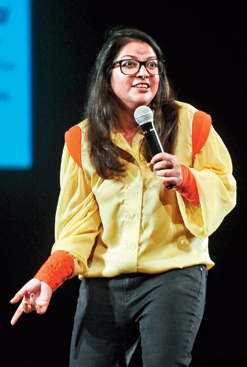

You know I have realised that saying the words ‘sanitary napkins’ in public is like standing in a Hogwarts common room and saying Voldermort
— Aditi Mittal
Oh, those trigger-happy Punjabis, freebie-loving Sindhis, and the lazy Bengalis with their funeral-like weddings. What the hell, why do the Anglicised Indian talk English like they have javelins up their a*#e? And what are Indians, a country which gave the Kamasutra, f@#king with if not only with our Constitution?
The lines were irreverent, the language was colourful and the humour was risqué. But, surprisingly, the famously conservative Chennai-ites were rolling down the aisles as stand-up comedians took the mike at the second edition of Laugh Ok Please, a laugh riot festival in the city, last Sunday.
"It is sheer entertainment," says Chennai homemaker Meera K. And no, she adds, she wasn't offended by the humour. "The nature of the genre is like that; you cannot be prudish about it. If you don't like the taste of it, don't go."
Not everybody thinks the same way. Earlier this week, a group of agitators ripped apart a show put up by All India Bakchod (AIB), a comedy collective, in Mumbai last month. The roast - a popular comedy format in the West - has a guest of honour who is the butt of jokes. In this case, actors Ranveer Singh and Arjun Kapoor were the guests. Host Karan Johar made fun of them, and was, in turn, roasted mercilessly by his guests. The audience loved it.
But some others didn't. The Maharashtra Navnirman Sena demanded an apology, a non government organisation (NGO) filed a police complaint against the roast, the Pune police filed a case against those who participated in the show and the Federation of Western India Cine Employees said "strict disciplinary" action would be taken against the Bollywood trio if they didn't apologise to the industry.
The AIB Knockout fracas will peter out over time, but the self-appointed moral police in the country are in for a bad time. They have to be everywhere, for stand-up comedy has spread like an epidemic across the nation. Artistes have been poking fun at everything from politics, religion, Bollywood and sanitary towels to caste and traffic. Nothing is sacrosant here. And while the dissenters may find them unfunny, the country cannot have enough of them.

Just a few years ago, it was a genre that was as low-key as it was rare. The few who were there in the field performed at open mike nights at pubs for a fee of "one plate of garlic bread and a coke", as one of the artistes puts it. Now stand-up comedians are being signed up by companies for employee entertainment shows for Rs 50,000-Rs 1,50,000 or for making videos for Rs 4 lakh or so.
The funnymen and women are scripting comic content for film award shows, for new television channels and for films. They are writing columns and plays. And you will find stand-up comic acts in colleges, pubs, restaurants, hotels and festivals. There are not enough comedians for all the work going around, the artistes say.
But the AIB episode has got some of the comics worried. "Comedy will be left alone in any other culture but ours," rues Anuvab Pal, playwright, author, screenwriter and stand-up comedian.
Pal, who was one of the first Indian comedians to be signed up in 2009 by the British Comedy Store when it opened its first branch in Mumbai, regards stand-up comedy not as comic profanity which provides shock value entertainment but as an art form which gives another "perspective" to an issue.
"It is an alternative way to think about something or show the absurdity of a situation," he says, pointing out that the protests against AIB are violating freedom of expression. "If you stop this show, tomorrow the public can start complaining and stopping shows over issues such as making fun of dwarfs, Gujaratis, or mineral water," he says with disgust.
If the comic artistes find the protests disheartening, what perks them up is the support that they get from humour lovers. "We are lucky to have support pouring in from all quarters," the AIB said in a statement after removing a video of the show from YouTube. The YouTube video AIB added got over 8 million views. "The people who liked them outnumbered the people who disliked them by 10 times to one. Yes, 10 times."
Clearly, if there are groups that seek to punish humour, they are many others who root for it. India, says 28-year-old funny woman Aditi Mittal, is just ripe for stand-up comedy.

Most people tweet photos of their cats. Salman Khan cannot because he probably shot the cat. He does two things with them — either shoots them or sleeps with them
— Sorabh Pant
Across the country, humour festivals are being held. After comedian Vir Das's successful Weirdass Pajama Festival 2015, the Laugh Ok Please three-day festival took place in Chennai. A Comedy Festival in Gujarat in September was hosted by stand-up comedian Manan Desai of The Comedy Factory. Only Much Louder's Stage 42 is slated to be held in seven cities with over 100 shows later this month.
Stand-up comedy, the artistes say, is catching on because the younger generation, not out to protect the holy cows, appreciates the shooting-from-the-hip jokes. Sorabh Pant, one of the founding members of East West Comedy, another comic platform, says that he is swamped by selfies from his young fans after a show.
That is not to say that earlier generations are not tickled by the sassy brand of humour. Mittal, who earlier this week was stopped from performing at a pub in Mumbai because she participated in the AIB programme, recalls how the wife of an army chief cornered her after one of her shows, with mascara dripping down one cheek. " Beta, you ruined my makeup! I laughed so much," she said.
The comedians stress that their strength lies in poking fun at Indian politics, Bollywood, celebrities, sex, religion - and anything that gets the Indians' goat in their daily lives.
"Comedy is the best form to make people question things," says Bhargav Ramakrishna, executive head of Evam Standup Tamasha, a division of Chennai's leading theatre company Evam. Standup Tamasha, which hosted the Laugh OK Please festival, was launched in 2011 and has seven comedians on board.
That the comedy canvas is growing becomes evident when you look at the interest shown by entrepreneurs. Ecommerce companies such as Snapdeal and dating app Woo have turned to stand-up to make promotional videos for them. Private portal Gigstart has climbed aboard the comedy bandwagon and lists comedians, providing their price quotes, videos and contact details for bookings.
Many comedians have started companies - including East West Comedy, AIB, Shits and Giggles, The Viral Fever, the Polished Bottoms and Weirdass Comedy. Says Sorabh Pant, one of the founding members of East West Comedy, "We were four stand-up comedians who got together. Kunal Rao, another stand-up and one of my partners with a chartered accountancy background, created a corporate structure."
Pant, who has nearly 100 corporate shows under his belt and travels with his "special" shows such as Ghanta film awards, highlights the role of the social media in the spread of humour. "Our live shows are fuelled by our YouTube videos," he says.
Indeed, comedians have to thank the Internet in general and YouTube in particular for the upsurge. Most stand-up comedians have built their audiences from comedy videos posted on YouTube. The Viral Fever's comedy online series Permanent Roommates and Kanan Gills's Pretentious Movie Reviews are hugely popular online.
Of course, not everybody finds everything funny. Abhijit Ganguly, a Delhi School of Economics alumnus who threw up a consulting job (and, he rues, lowered his marriage prospects) to become a stand-up comedian, may not subscribe to the AIB kind of humour but believes in people's right to their own tastes. "There has to be a tolerance for different sensibilities - that is symbolic of a free country," he says.
The problem they face is that there is always someone who is offended by something. Kenny Sebastian, a stand-up comedian from Bangalore, made fun of how he was forced to study Sanskrit in school. Soon, he started receiving hate mail on his Facebook and YouTube sites.
"I did not think I was being offensive, that was my experience with Sanskrit. But I received a lot of flak," he remembers.
However, instead of making him cautious about his lines, Sebastian decided to go in the opposite direction. "For the longest time my jokes were clean and non-offensive but now I joke on religion and crimes against women," he reveals.
Naveen Richard, another stand-up from Bangalore, was attacked for joking about Indian train toilets at a corporate event. "They told me I was lowering the image of India in front of foreigners," he says.
Pal fears that censoring may have a long-term effect on the industry. " If the public start censoring shows it is bad for the art form. Tomorrow organisers will be scared and not want to tempt trouble," he says with a sigh.
But then, are some jokes too offensive? Mittal, representing what she calls the "vagina quota" in an otherwise male dominated field, says she is not in favour of "misogynistic and regressive" jokes. "But jokes are to be cracked - not judged," she adds.
Ramakrishna has the perfect answer to the eternal conundrum of what's funny and what's offensive. First, he says, Indians have to learn to laugh at themselves. Second, instead of agitating against comedians, those who are offended by a particular brand of humour should protest by just not watching the show.
"You can hurt a comedian the most by not buying tickets for his or her show," he says.