|
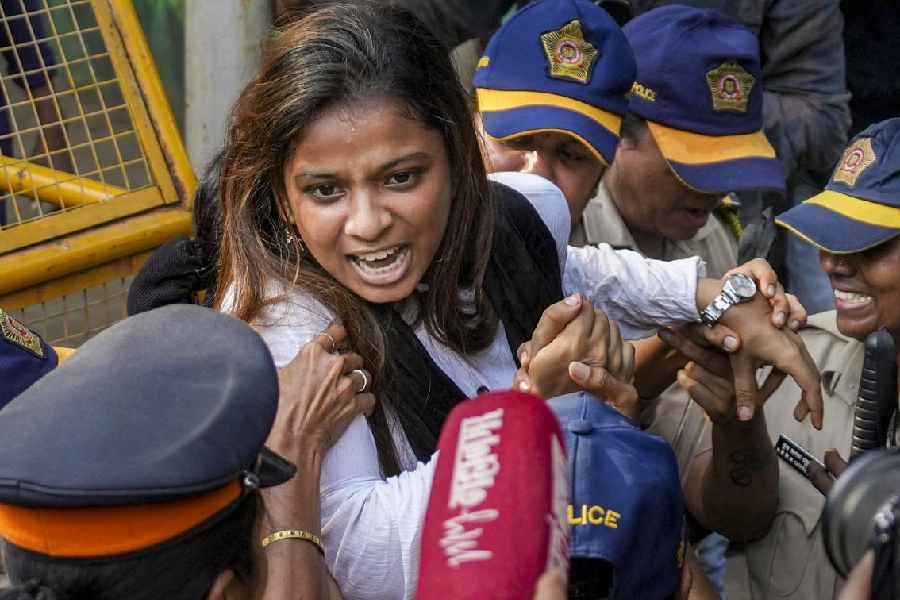
| Action, cut: Scene from Pyaar Ka Panchnama |
Ketan Mehta had to wait three years to get a certification for his film Rang Rasiya, based on the life of 19th century artist Raja Ravi Varma. But when the Central Board of Film Certification (CBFC) finally gave the sexually explicit film its nod, it did so without a single cut. And Rang Rasiya was screened at the recently concluded Kolkata Film Festival (KKF) to packed theatres.
Another film was not so lucky. The KKF decided to give Gandu, a controversial but critically acclaimed film, a pointed miss. Qaushik Mukherjee, aka Q, may have won plaudits at the Toronto Film Festival for Gandu, but he has not got a CBFC certification for it. Not because the board has denied it, but because he has not even applied for one formally. Q seems to have taken it for granted that given the CBFC’s record of not clearing films with daring content, Gandu (a film about a drug-taking loser with lots of sex scenes to boot) would face a similar fate.
“I had originally made Gandu for an international audience. But after the response we got for the film, we decided to release it in India,” says Q. “However, we haven’t applied for film certification officially as yet. We were negotiating with them to see if it could be released without any cuts. But it doesn’t seem likely.”
It’s not just Q who is cynical about the CBFC and its attitude to films with risqué or controversial content. A number of young directors who make movies that try to push the boundaries of conventional cinema have a similar complaint. Take Sudipto Chattopadhyay. He had to appear before five CBFC committees and even take the matter to the high court to get his film Pankh (2010) cleared. “I had been asked to make 32 cuts in my film. It took me 10 months to arrive at an agreement with the censor board. Finally, I compromised and blurred one scene,” says Chattopadhyay, whose film dealt with a child artiste’s mixed up gender identity.
Luv Ranjan, director of Pyaar Ka Panchnama (2011), too had to face the ire of the censor board for making a film that was to do with live-in relationships. Eventually, he got CBFC chairperson Leela Samson’s support to get a U/A (under adult supervision) certification for it.
Indeed, many of these young filmmakers feel they are singled out for ruthless treatment by the board because they don’t have the clout of more established filmmakers. “A filmmaker’s name, stature and banner plays a vital role in getting the film certification,” asserts Chattopadhyay. Adds Ranjan, “A Salman Khan slapping the dancer’s butt in a hit film song isn’t obscene. Neither is a risqué song like Bhaag DK Bose (in the film Delhi Belly) obscene in the eyes of the censor board. But when it comes to us, out comes their scissors.”
Others argue that if the CBFC comes down hard on avant- garde films made by young directors, they will end up killing their talent and initiative. “Censorship is indeed stifling young filmmakers. If filmmakers are under constant fear of their films being banned or denied certification, they will have second thoughts about making films. There will be a tendency to make films only for the festival circuit and then look for a back door entry into India,” says film critic S.V. Raman, who served two terms as a member for the CBFC, Calcutta.
Naturally, the CBFC dismisses the allegation that it’s unduly biased against young filmmakers. Says Pankaja Thakur, chief executive officer, CBFC, “Of course, we are not biased. It’s like a younger brother saying that his parents favour the older one.”
Film scholar and critic Ajit Duara too feels there is no such bias. “It’s to do with generation gap. It’s high time they brought in some young people on the panel,” he says.
 |
To be sure, it’s not just the current crop of young filmmakers who have had a rough time with the CBFC. The board has a long history of being excessively sensitive when it comes to certifying controversial films. Kissa Kursi Ka (1978), a political satire that was said to be based on the Gandhi family, was banned; Fire (1998), Deepa Mehta’s film on a same-sex relationship between two women, took two years to get past the censors; Anurag Kashyap’s directorial debut Panch (2003) is yet to get a certification on account of its violent content, as is Gulabi Aina (2003), a film that deals with the transgender community.
Even documentary filmmakers are not immune to the vagaries of the CBFC. Oscar nominated filmmaker Ashvin Kumar’s documentaries Dazed in Doon and Inshahallah Football have been banned. Documentary filmmaker Rakesh Sharma suffered the same fate. “The BJP government in Gujarat used its political influence to refuse a censor certificate to Rakesh Sharma’s Final Solution, a film about the 2002 Gujarat riots,” reveals Duara.
The CBFC, on its part, says that it does the best it can. “We have to certify the films universally and not for a certain section of society which might want to watch it,” says Thakur. “Most viewers want us to censor raunchy content.” Adds J.P. Singh, regional officer, CBFC, Mumbai. “We generally don’t ban any film unless its content is extremely provocative or pornographic in nature.”
Says Anand Patwardhan, the documentary filmmaker who had to go to the Supreme Court to get his film Father, Son and Holy War cleared, “The CBFC needs to realise that it is a certifying body and not a censoring body. It has no right to censor or ban films. A new kind of thinking should be infused among the panelists. Only then will this problem be resolved.”
Will the situation improve once the Cinematograph Bill, 2010 — which lays down a new way of certifying films and avoids censorship altogether — becomes a law? The CBFC officials certainly hope so. Says Thakur, “Once the new law comes into force, the certification will be based on the level of violence, sex, nudity and so on. There will be no need to chop off sections as we do now.”
Until then, films like Gandu will clearly be considered fair game for the scissors of the censor board.