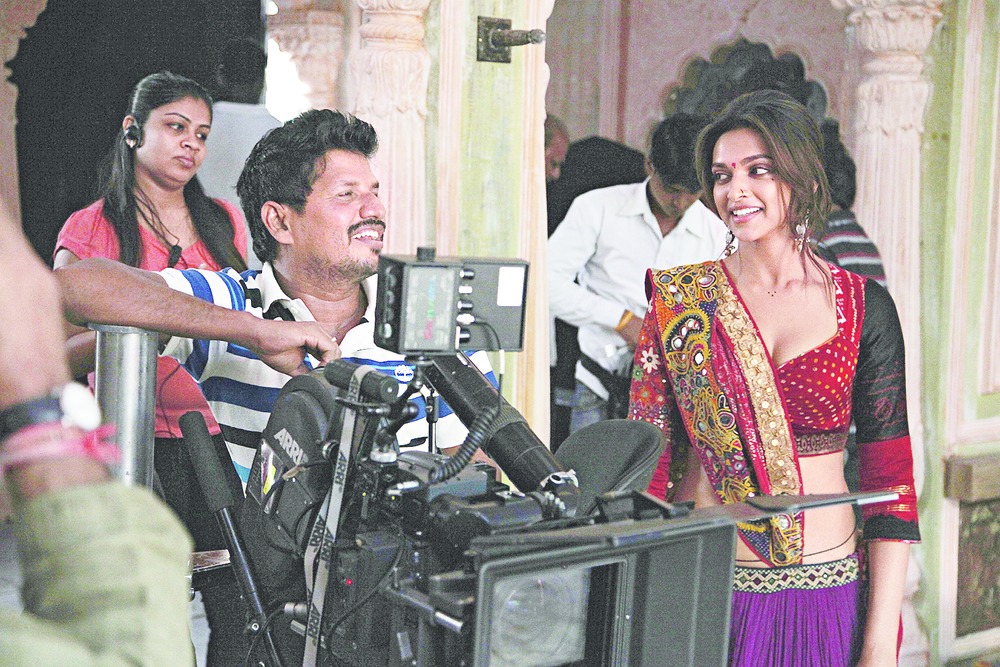

Ravi Varman's life is a bit like a film. The much sought after cinematographer ran away from home when he was young, slept on pavements and did odd jobs. His journey from a small village in Tamil Nadu to the glitzy, adrenaline-powered, mega budgeted film sets of Bollywood has been arduous.
But Varman, who has shot more than 30 films in his 17-year career, believes that the hard knocks toughened him up and helped him realise his dreams.
Varman, who got nationwide recognition after wielding the camera for Barfi!, Goliyon Ki Raasleela - Ram-leela and Tamasha, recently bagged some other prestigious projects - such as the US dance drama, Heartbeats, directed by Duane Adler, and Anurag Basu's Jagga Jasoos. This director of photography (DoP), who won a French award at the Festival des 3 Continents for his work in the Malayalam film Santham in 2001, will also shoot for Mani Ratnam's new film.
Seated in a small study in his Chennai flat, he talks eloquently about his craft, his love for haunting, poetic visuals, and his personal life but is notorious for being reticent and shy on Bollywood film sets.
A YouTube video shows him being teased in good humour by the Barfi! crew, as he is showered with kisses by women assistant directors after the shoot.
"I am incredibly shy and so they shot that video to make me chill. Priyanka [Chopra] asks me jokingly even today, is it OK to hug you," Varman says, looking a bit embarrassed.
A home theatre screen and a tall rack filled with around 2,000 DVDs of Iranian, Swedish, Irish, Scottish and other films adorn his study. Influenced by "realistic" French cinema, Varman reveres the work of Ingmar Bergman's cinematographer, Sven Nykvist, and Iranian French cinematographer, Darius Khondji, the DoP for Woody Allen's Midnight in Paris.
Relaxing at home with his wife and two kids, while waiting to resume shooting for the Ranbir Kapoor-Katrina Kaif-starrer Jagga Jasoos in Mumbai, Varman reveals that the film has been shot differently from Basu's Barfi!.
"I enjoy working with him because he knows his craft and tries different things," says Varman, who was picked by Basu after he saw his work in a Hindi film on AIDS, Phir Milenge.
He has finished shooting for Adler's Heartbeats. The American director wanted a DoP from the West at first but was convinced by the film's line producers to meet Varman. For the first 20 minutes, Adler complained about fast cuts, jumps and jerks and lack of continuity in Indian films until Varman made him see Raasleela... and Barfi!.
"He loved them. My advantage also lay in having shot songs which the film required because it is based at an Indian wedding. Finally, he gave me complete freedom and let my vision take over. I wanted to show India in a beautiful and celebratory light instead of focusing on ugly slums and dirty kids and shot the film using dawn and dusk lighting."
When he was shooting in Corsica for Imtiaz Ali's Tamasha, a foreign assistant director asked him if he was replicating cameraman Khondji's work because of the "grainy look" he was attempting. "I had seen and admired a lot of his films such as Midnight in Paris. It must have been an unconscious thing," Varman admits.
He infused Tamasha with a warm, chocolate colour and low lighting, inspired by the colour of sunlight in Corsica. Varman shot a scene of Deepika Padukone and Ranbir Kapoor crossing a Corsican street with a suitcase in the outdoor evening light, and then used that light, known as sodium light, as a reference through the film.
He enthuses over the "chemistry" between the lead actors, making it a delight to shoot them. "They are so good together especially in the song Tum saath ho, like the Kamal Haasan and Sridevi pair," he says.
Varman, who started his career as an assistant to another southern Bollywood cinematographer, Ravi K. Chandran, got his first break with the Malayalam film Jalamarmaram (Whisper of the Waters) in 1999, which went on to win several awards. After working in Malayalam and Tamil films, he did a Hindi film, Honey Irani's Armaan in 2003 with Amitabh Bachchan and Anil Kapoor, which Varman puts down as a learning experience. But hampered by not being able to speak Hindi, he went back to southern cinema.
In 2012, he got a call for Barfi! and his delightful camera work with his use of glare lighting gave the film a happy look.
"We did not want the actors to look sad or pathetic. It was a film about beautiful kids having a good time," he reminisces. In Raasleela..., he transformed the wide curved screen into an artist's canvas and shaded the frame with a brown, golden yellow hue, in tune with Gujarat's earthy colours.
At first, director Sanjay Leela Bhansali was worried, wondering if the frames were too warm and cluttered. But after seeing the rushes, he exulted that he was living with a "painter". Varman memorably broke his hand on the film set but went on to shoot a scene after that.
Varman's dark bent of mind, coming from, he says, his experiences of not having come to terms with his mother's death when he was a child, attracts him to shadows. But that dark mood transforms into a happy energy on the screen, he says, giving his mother and fate the credit.
A poet at heart, his dream is to capture each subtle, minuscule change in the nature of light as a new dawn breaks in his frame. He quotes Nyvist who advises to light up a frame without introducing light in the frame.
Cinematography should help the director tell a story and also make lasting visual imagery in the audience psyche, believes Varman, who admires Satyajit Ray, Guru Dutt and Mani Ratnam. And he seems to have done that, going by the stunning visuals of Rasleela, the merry frames of Barfi! and the melancholic, shadowy images of Tamasha.
Once he had a goal - to go back to his village a successful man in a Mercedes Benz. That dream has been replaced with a deep desire to keep moving and relishing every moment of his life.