
Over the last few days a Puja pandal putting up type buzz has prevailed at the Victoria and Albert Museum in London. An exhibition, The Fabric of India, is being installed, supervised by Rosemary Crill and Divia Patel, who are internationally respected India experts in their capacity as senior curator and curator, respectively, in the V&A's Asian department.
Highlights include Tipu Sultan's "spectacular" tent which has been erected so that visitors can walk underneath it. It is so luxurious that Tipu (1750-1799) probably dozed off after a good biryani luncheon and woke up to find that the battle plus all his possessions, tent included, had been lost to the scheming Brits.
The exhibition - on from October 3 to January 10, 2016 - is going into the prestige galleries vacated by Alexander McQueen's wildly popular Savage Beauty. "Wealth, power and religious devotion are all expressed through textiles," V&A stresses in a formal note.
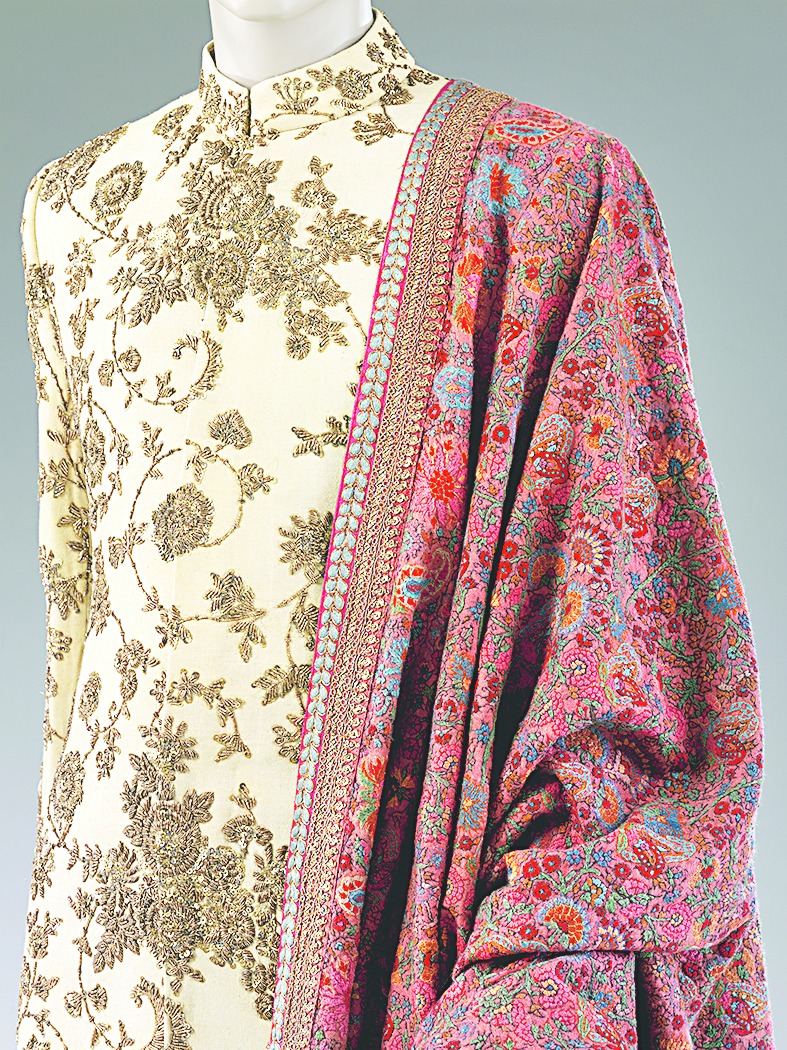
There is a bride-bridegroom wedding ensemble by Calcutta boy Sabyasachi Mukherjee, which is "encrusted with jewels and zardozi embroidery" and "muted tones with beautiful moss green and pink".

There is also the costume that was designed by Bollywood fashionistas Abu Jani and Sandeep Khosla for Madhuri Dixit in Sanjay Leela Bansali's Devdas in 2002. It has been picked to demonstrate the "incredible" Gujarati traditions of mirror work.
"All we need is for Madhuri to wear it at the launch party," pronounces a wit.
Actually, that wouldn't be such a bad idea because the Indian and British elite will turn out en masse. Part of the fun will be to go into the V&A shop after the exhibition (though philistines tend to do it the other way round) and stock up on clothing items and jewellery which either replicate the exhibits or are inspired by them. The lavishly illustrated catalogue (hardback £30), edited by Crill, is itself a collectors' item.
"The Fabric of India will be the first exhibition to fully explore the incomparably rich world of handmade textiles from India. From the earliest known Indian textile fragments to contemporary fashion, the exhibition will illustrate the technical mastery and creativity of Indian textiles," the V&A note states.
On display will be "approximately 200 objects made by hand," which will include "examples of everyday fabrics and previously unseen treasures; from ancient ceremonial banners to contemporary saris, from sacred temple hangings to bandanna handkerchiefs".
It goes on: "Highlights will range from muslin embroidered with glittering green beetle wings, sequins and gold wire, to a vast wall hanging appliquéd with designs of elephants and geometrical patterns, to a boy's jacket densely embroidered with brightly coloured silk thread and mirrors."
The exhibition's backers themselves form an interesting mix: Good Earth India, a design house; Experion, real estate developers; and jewellers Nirav Modi.
Patel, who has grabbed a few minutes to talk to The Telegraph, says that two-thirds of the exhibits have come from the V&A which has "one of the most important Indian textile collections in the world".
The rest has been lent by national museums in India and across the world.
As co-curators, she and Crill thought "it would be great to give an entire overview of how Indian textiles have made an impact, not only nationally, but internationally from the 3rd century through to the 21st".
She sets out the broad themes: "We start with 'Nature in Making' which is all about the raw materials. The reason India became such an important place for textile manufacture was because it had all of these raw materials - the silks, the cottons - and then it was able to process them, to dye them, to print them, to weave them, to embellish them and so all of these skills is what gives India its mastery."

Next there is the "Splendid Section" which looks at the "high culture of India and the Mughal, Rajput and Deccan courts", she says. "Then we go into 'Global Trade' - how India made an impact across the globe, from China, the Southeast Asian and Middle Eastern trade all the way to Africa and America."
The "Modern and Contemporary" section deals with industrialisation in the West. "From about the 1730s Britain and Europe have machines that make thread, that gets exported back to India and then fabric which gets exported back into India," Patel says.
"And then this is what sparks the 'Freedom Movement' and Mahatma Gandhi's call for people to spin, weave and make their own fabric, so the influx of foreign fabric is what sparks the Independence movement and khadi becoming the national symbol of Indian independence. After Independence the government also puts in key initiatives to keep handloom fabrics in production, and so what Gandhi has done is politicised fabric. He's made it part of India's national identity."
Traditional techniques are then used for the phenomenon of "the Indian wedding".
A section looks at the "cutting edge of contemporary fashion" - the use of handloom by designers and "also how the definition of craft has expanded with people like Manish Arora," Patel says, adding that the exhibitions has work by Abraham & Thakore and a "beautiful" sari by Neeru Kumar.
Making the choices was "hugely difficult", she reveals. "But for Rosemary it's been her lifetime career to study these textiles; for me it's actually bringing in a new element of the modern and contemporary."