
Srijit Mukherji is on a roll. Bengal's most sought after filmmaker is in a euphoric state, having bagged two National Film Awards - as the best director and the best original screenplay writer for his 2014 film Chotushkone.
"To be recognised in the national arena is a once-in-a-lifetime moment," he says. But in an interview just days before he went to attend the 62nd National Awards ceremony in Delhi (and where he fractured his leg in a road accident), Mukherji indicates that he is ready to move on.
Last year, his film Jaatishwar had won four National Awards - but the best director prize eluded him. Many had then held that he deserved the award for direction, views that he had characteristically shrugged off. Today, fans of the Bengali director stand vindicated.
But Mukherji's mind is on his new offering, Nirbaak (Speechless), released on May 1. He describes the film as his "most experimental and niche film" to date.
"Not everyone will enjoy it, but those who did were ecstatic. In fact, it got more bouquets than brickbats. It has also had a good box-office opening," he says sounding satisfied. "The good thing is that, like it or not, people recognised that it was a different kind of an effort, a different attempt at storytelling and a step forward for Bengali cinema."
From a superstar, a serial killer and a suicidal aspirant to a detective, a reincarnated historical character and a filmmaker, Mukherji has been there, done that. But he likes to describe himself as "simply a storyteller" stringing tales together.
"Given that our time on this earth is finite, I would like to tell as many stories as possible," the 37-year-old director says. "That is why at times I use episodic, hyperlinked narratives so that I can squeeze in more stories."
Nirbaak is an example of that. Touted as Sushmita Sen's homecoming film, it is an interconnected, episodic journey of a woman, with four love stories woven into the plot.
Another film that he is visibly excited about is his period piece Rajkahini, slated for a mid-August release. He claims that this is by far his "most disturbing and thought-provoking film." Incidents surrounding Partition form the premise, centering on a brothel.
That will be his eighth film in five years. It was just in 2010 that he arrived with a splash with Autograph, starring Prosenjit and Nandana Sen. The debut film was followed by Baishe Srabon, Hemlock Society, Mishawr Rawhoshyo and Jaatishwar in quick succession.
But Mukherji seeks to stress that his films are not necessarily all cerebral.
"I watch everything, say from a Michael Haneke film to a Govinda starrer, read everything and listen to all kinds of music. I don't believe in the arrogance of highbrow art, and I feel 'populist' is a much abused word. For me, art is that which disturbs the comfortable and comforts the disturbed," he says with a wave of his hands, adding as an afterthought, "As a student of economics, I can map it all on the utility curve that renders the same level of satisfaction for the consumer."
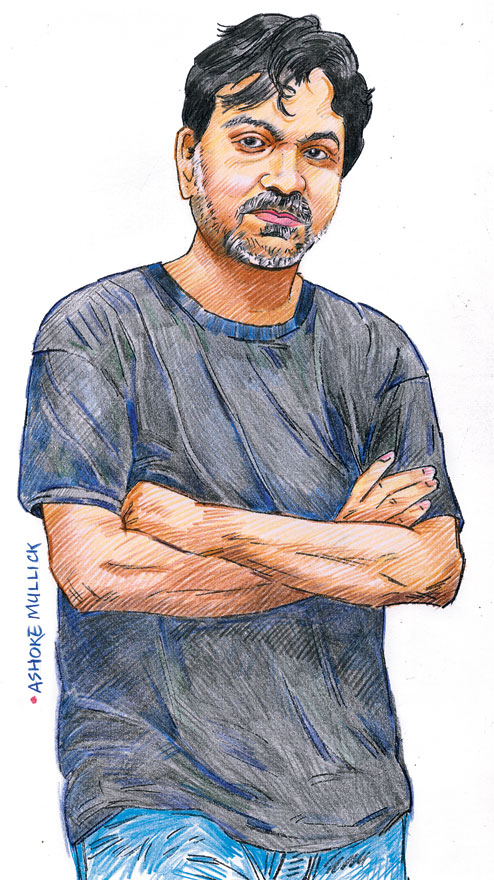
The inadvertent marriage of economics and filmmaking underscores the contradictory nature of the director. His looks are a case in point. His carefully careless appearance is further accentuated by his Abdul Kalam-like locks, conflicting with his manicured Amitabh Bachchan-like beard and broad physique. He is casually dressed - in a black round-necked tee, jeans and sandals - but seems totally in control as he struts around a studio in south Calcutta.
And one can't exactly tell how the wide acclaim that has followed his work affects him. On the one hand, he refers to this lavish praise as a "by-product" and holds that filmmakers are taken too seriously. "A filmmaker is like any other storyteller simply using celluloid - he doesn't impact society the way a social activist would. It's more of a placebo rather than medicine that filmmakers have on offer," he stresses.
O<,>n the other hand, he suddenly surprises you by rattling off statistics to highlight his "Ulyssean journey" into cinema. "In all, 125 awards for six films, 595 box office days in total, 14 national and international film festivals," he recites.
Of course, it has been quite a journey for the Calcutta boy who left the city for higher studies and work, only to return to direct films. It is perhaps his parents - both former professors - who shaped his thinking in his formative years. Later, it was Delhi's Jawaharlal Nehru University (JNU) which made him, by his own admission, what he is today.
"I learnt from my parents that simple living, high thinking is not a choice, it's a compulsion," he laughs. Using the metaphor of a toothpaste, he explains, "Toothpaste meant it had to be Forhans - solid and strong, with no additional frills. I grew up that way - grounded and with a sense of austerity."
JNU - where he did his MA and MPhil in environmental economics - helped him find himself. "It helped me develop a worldview on everything right from politics and gender awareness to music and matters of the heart," he stresses passionately. And it is this passion that drives him. "For me, my personal life is non-existent. If I sit and reflect, I'd rather think of a new story."
That's how Rajkahini was born. The idea for the film was triggered by his reading of Saadat Hasan Manto's Mottled Dawn: Fifty Sketches and Stories of Partition. From Manto, he moved on to Ismat Chughtai, the equally controversial writer of the 20th century, who is yet another influence that surfaces in the film.
"Partition, for us, is akin to the Holocaust. But we have not been able to implant this in the Indian consciousness; the younger generation is devoid of that sense of history, unlike the Germans. There have been sporadic attempts to revisit the Partition and its repercussions through films and books, but not many from a subaltern perspective," he says.
His story, he adds, emerges from a "whorehouse" and deals with the lives of those "pawns whose story has never been told". His research into the subject - helped by the works of feminist writers such as Urvashi Butalia and Joya Chatterjee - led him to understand how women were affected and used as a commodity, and how the honour of the country was equated with the honour of its women.
Clearly, the subjects he deals with are diverse. Mukherji explains that he doesn't like to repeat himself. And that would explain why he chucked up a career in the corporate world to return to Calcutta, marking his arrival with Autograph when he was 33.
B<,>efore that, it was a daily grind while working in Bangalore - relieved by his passion for theatre. "In fact, as a stage actor I had made quite a name for myself in the Bangalore theatre circuit," he announces with pride. But he gave that up along with his job when he decided to focus on cinema.
The director is now working on the second film of his Kakababu trilogy which began with Mishawr Rawhoshyo, an adventure film based on one of Sunil Gangopadhyay's children's books. The 2014 film, he admits, was his weakest in terms of plot.
"It was more of an expedition rather than a rahasya or mystery, but then I was just being true to the actual narrative." Now he is set to go to the Alps - where he has set part of the film, which was originally meant to be shot in Nepal.
On the personal front, his parents separated when he was 15, and ever since he has been living with his mother, although he is still friends with his father who has remarried. "My mother is non-interfering, and her questions to me are tangible ones. "Will you have dinner at home tonight? Have you taken your medicines?" he says, almost enacting it out like a character from a script.
He did not believe in role models, and with confidence in his own abilities all that he occasionally looked for was a father-figure, one that he searched for in Kabir Suman's songs, in Satyajit Ray's films and in his innumerable interests - ranging from movies, music and theatre to sports, wildlife and history.
His parents' break-up, he adds, hasn't really affected his own life. "Nothing is in the offing now, but I do plan to settle down one day. I have had a string of relationships and affairs, some worked, some didn't; some were bad, some really bad," he guffaws. "But I don't really take myself seriously. As of now, I am in that frame of mind where I simply want to tell stories through films, and have fun doing so."
Is that for real? Somehow, one just can't tell with Srijit Mukherji.