-

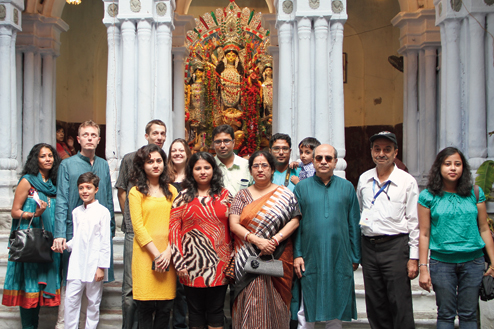
Pujas with a difference: Members of a WBTDC tour last year at the 300-year-old puja of the Goswamis of Serampore
Tired of the lights, the noise, the crowds and the glitter of the Pujas of Calcutta? You could just take a bus and travel into another time.
Tourists and devotees from across the world have been bypassing Calcutta for a closer look at the Pujas in the interiors of Bengal. Among them is Meenakshi Ghosh, a 60-year-old resident of Manama, Bahrain. For the last three years, Ghosh has been visiting bonedi bari (traditional homes) outside Calcutta. 'I enjoy 'authentic' puja rituals, kept alive for several centuries,' she says.
Slowly, as the Pujas in Calcutta become more and more frenzied, people are opting out of the sound-and-light shows that many city Pujas have turned into. 'Far away from the cacophony of glitzy Pujas that vie for awards you get to see unique rituals conducted by hereditary priests,' says Sandipan Dasgupta, a West Bengal government employee. Dasgupta travels to the areas around Hooghly to witness what he calls the 'pure' Pujas, some of which are a couple of centuries old.
Many seek the 'warmth' of the old Pujas — which they believe is missing in modernised community Pujas. Even the old idols, they point out, are vastly different from those in Calcutta and some of the other busy cities. 'A festivity meant to celebrate the harvest season by tribals has changed beyond recognition,' says author Sanjib Chattopadhyay.
Not surprisingly, people are making a beeline for old family Pujas — often in buses that organise such tours. Ghosh has travelled by West Bengal Tourism Development Corporation (WBTDC) buses which conduct tours of Pujas held in palatial thakurdalans — colonnaded grand courtyards — owned by erstwhile zamindars and aristocrats, some 60-80km from Calcutta.
These trips started in 2005 with just eight people in a Tata Sumo. 'We wanted to offer them the 'real' feel of traditional Pujas in the lush green countryside,' says Amitabha Datta, a former WBTDC official.
-

Abhaya, an incarnation in which the goddess does not carry any arms; Pic: Swarupam Chakrborty
A top official in the corporation adds that, to begin with, tours were restricted to a few Pujas in Hooghly. 'But now we have six packages in five districts on all four days. In some districts, we have to arrange four buses each day. Bookings open four months ahead of the Pujas. This year, 95 per cent of seats have already been booked. Seats are also booked online and even foreigners join the trips.'
Private operators offer similar services. 'With the growing demand for such trips, our members scout around for century-old Pujas in the interiors and organise day trips,' says Anil Panjabi, chairman (east), Travel Agents Federation of India.
Wheelers Forum, a club for car owners, has introduced a 'Drive Out' tour to the Dashghara royal family (Biswas Bari), 68km from Calcutta, to take part in the 300th year of the Puja. 'We expect at least 60 families that wish to get away from the maddening crowd to join us. The fleet of cars will be escorted by pilot vehicles, service crew and a medical team,' says Souvik Ghosh, leader, Wheeler's Forum. The Biswas family will prepare the bhog for the travellers.
Like the Biswas family, Sheoraphuli's former royal family is also ready to welcome tourists at its ancestral 281-year-old Puja. 'We wish to showcase our rich family heritage to anyone who wants to enjoy the elaborate rituals of worship of Sarvamangala (a form of Durga),' says Ashish Ghosh, a senior member of the family. 'The deity is made of eight precious metals (astadhatu) — unlike clay idols in most places. Our Devi isn't surrounded by her children and she rides a lion that looks more like a horse (haya-griba).' The idol is not immersed after the Pujas but is worshipped round the year in a temple beside the family mansion.
Visitors also throng the Puja organised by the Dey family of Borshul in Burdwan. The idol in this Puja is made of clay — with Durga and her family built on the base of a single hemispheric structure (ekchaala). 'Our Durga is in the lap of a gigantic Shiva. The goddess doesn't have the usual 10 hands, nor does she ride a lion because our ancestors believed the Devi to be a loving mother in a happy family,' says family member Himadri Sankar Dey.
The Goswami family at Serampore, Hooghly, too has been worshipping ekchaala Durgas for over 300 years.
Many of the idols are traditional in form, which is becoming increasingly rare in cities. 'The ethnic design of the idol in a well-balanced geometric pattern is now more an exception than the norm,' says Sushovan Adhikary, curator, Viswa-Bharati. 'Most of the so-called 'art' in themed Pujas deviates from traditional aesthetics. In some cases it's just an eyesore'.
Even the rituals that take place in the old Pujas are often very different from those followed in the community Pujas. The 550-year-old temple of Sri Dayamayee Durga in Guptipara follows the rituals of the Vaishnava and Shakta traditions, the Chongdars at Gushkara near Bolpur follow tantric rituals in their 500-year-old Puja. 'Goats are sacrificed at the Devi's altar and offered to her,' says Budhaditya Chongdar, who represents the eighth generation of the former zamindar family.
The bhog, too, varies. The Navami offering consists of goat meat cooked without onions or garlic. 'Whole spices are bundled in a cloth bag and cooked with the meat till it is tender,' Chongdar says.
The Sheoraphuli Ghosh family, following a Shakta tradition, serves hilsa fish with paranthas on Saptami. 'It may sound an odd combination, but we also have a dish called macchi-muli (fish cooked with radishes),' says family member Basabi Pal, who teaches French at Chandernagore Government College. According to her, the fusion food underlines the family's close relation with the former royals of Bhagalpur in Bihar.
Gurgaon-based food consultant Pritha Sen stresses that 'matsya bhog' or fish platters offered to the deity are a custom followed by many traditional households. 'You'll find unusual dishes prepared with fish such as shol or lyata in family Pujas following tantric rituals,' she says. Some households that follow strict Vaisnavite traditions shun non-vegetarian food — and even cereals such as rice — during the Pujas.
Surul's Sarkar family, for instance, prepares its bhog without rice and offers a wide variety of traditional sweets, including a special type of monda. 'Kochu saag or colocasia is offered almost every day of the Pujas because it represents Goddess Kalika as depicted in the Kalika Puran code of rituals,' she says.
The trend of going back into time is a reaction to Pujas that have become too ornate and represents a yearning for something kalpanik (or imagined), holds Rachel Fell McDermott, professor and researcher of religious traditions at Columbia University and author of the book Revelry, Rivalry, and Longing for the Goddesses of Bengal. 'It could also be a longing for the past or a cultural nostalgia by tourists as well as members of aristocratic families,' she says.
The growing interest gives the old Pujas a boost. And for some, it's a new lease of life.