

What started out as a personal journey for Andrew Duff, retracing the trek undertaken by his grandfather nearly a century earlier, turned into an adventure involving kings and queens, prime ministers and presidents. Sikkim: Requiem for a Himalayan Kingdom was published recently - a fruit of his consuming passion for the tiny state that became part of India in 1975.
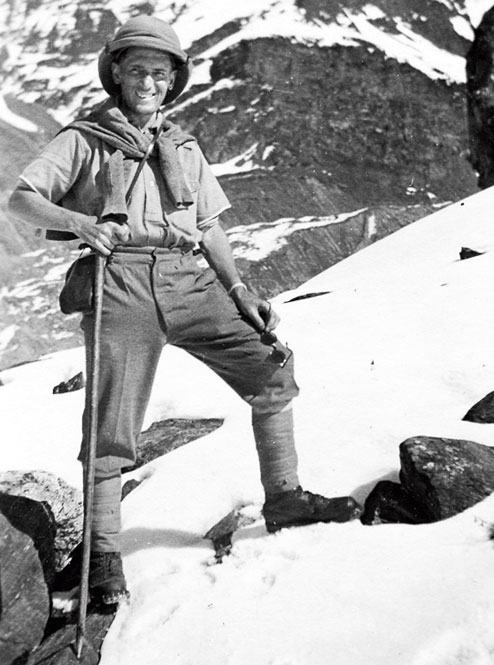
Duff was a teenager living in Edinburgh, the picturesque capital of Scotland, when his paternal grandparents died in 1988 within three months of each other. Among the belongings that found their way to Duff's home were albums of photographs that his grandfather had taken during the decades that he lived in India. Of all the albums, the one that captivated him the most was the brown, leather-bound book marked Sikkim and filled with photographs and notes of the 10-day trek his grandfather and three friends went on from Darjeeling to Sikkim in 1922.
"My grandfather went to Calcutta in 1920 and lived in what was then Dover Park and worked in tea and then moved on to jute. He married in 1929 and both my grandmother and he loved India. My father and aunt were brought up in Calcutta until World War II when they were sent back to Scotland," says Duff, as we sip coffee at the cafe in the courtyard of the majestic Royal Academy at Piccadilly in London.
Working as a journalist and strategy consultant in the UK, it wasn't until 2008 that Duff was first able to come to India. "I decided to take a one-way flight to India, with my grandfather's Himalayan notes and photographs tucked in the bottom of my rucksack. By April 2009 I had reached Darjeeling where I began to follow my grandfather's footsteps, walking down 5,000 feet to the river that marks the border into Sikkim," says Duff. "The experience was wonderful. I had not pre-booked any accommodation but I found the people so friendly and welcoming", he adds as a warm smile lights up his face.
Like his grandfather, he made his way to the Pemayangste Monastery and stayed in the small, modest home of a Buddhist monk, who gave him a book called Smash and Grab: Annexation of Sikkim, written by veteran journalist Sunanda K. Datta-Ray in 1984. "It was a compelling story of intrigue and tragedy about the last king of Sikkim and I was totally gripped," he recounts.
When he had embarked on his Himalayan adventure, Duff had thought he would reconnect with his grandfather and probably write a book about his personal journey. The fate of Sikkim was furthest from his mind. "There is no denying that my book couldn't have been written without Sunanda's book, and I could never write what he has because he was an eyewitness to the annexation and also a personal friend of Thondup Namgyal, the last king," admits Duff.

Once he returned to Scotland, Duff became obsessed with Sikkim. Seeing his interest, some friends of Duff's parents introduced him to Martha Steedman (nee Hamilton), who had been headmistress of the main girls' school in Gangtok, between 1959 and 1966. "Martha was a bright, energetic Scottish woman in her late seventies who during her time in Gangtok had direct access to the palace," says Duff. More importantly, Martha used to write a letter home to her mother each week giving a detailed account of the life and events she was witnessing in Sikkim. "To my surprise Martha's mother had kept her letters and when Martha offered to show me the letters and pictures I found I had three boxes of letters that brought the world of Thondup and Hope to life", says Duff.
Martha also introduced Duff to her successor at the school from 1966 to 1996, Ishbel Ritchie, another Scot who also followed the same practice of writing home and was willing to share her letters. Duff realised he had stumbled across a treasure trove of insightful, first-hand accounts of Sikkim at that time. "Ishbel was in Sikkim during the time of the annexation and the Emergency and when she realised that her letters were likely to be read by Indian censors she began to write them in broad Scottish as code. As a Scot I could understand everything she had written. I felt I was unravelling a mystery," says Duff.
Totally immersed in his project, Duff researched in the National Archives in London where he found recently declassified, secret documents demonstrating the British government's role in the annexation. And then just as he thought he had everything, in early 2013 Wikileaks released a tranche of US government cables from the mid-1970s which also had some 500 cables on Sikkim that "brought to life the extraordinary Cold War background to Sikkim's demise". "I realised that this tiny state of 40 by 70 miles was important to India, Pakistan, the US and China and Thondup didn't have a hope in hell of saving his kingdom," he says.
In his superbly researched book, Duff pieces together the last days of a kingdom, as well as the very human love story of King Thondup and his second wife. "Hope was young and beautiful when she married Thondup, a man almost double her age. She was described by Oprah when she appeared on her show as the intellectual Grace Kelly," he says.
Beginning in 1941 with the 18-year-old Thondup Namgyal returning home after seven years at Bishop Cotton School in Shimla, the book traces his life from being a shy, young prince who is thrust into kingship after the untimely death of his elder brother, to his meeting Hope and their efforts to reinvigorate their kingdom. There are detailed accounts of the power play that went on by the British both before and after Independence, the roles played by Indira Gandhi, Henry Kissinger and Zhou Enlai in the fate of the Himalayan kingdom, Namgyal's attempts to keep his kingdom, the family being forced to flee eventually, and of his ultimate death.
Was Hope Cooke a CIA agent as she was rumoured to be?
"I don't think so. She was young and naïve, well-meaning and ill-judged," he replies. Duff is in touch with the erstwhile queen who now lives in New York with her children. In Duff's view, Sikkim's demise was inevitable and "it is a cautionary tale of what can happen when a small kingdom tugs at the tailcoats of the Great Powers".
Sikkim: Requiem for a Himalayan Kingdom is Duff's first book but definitely not his last. His love affair with the sub-continent has well and truly begun. "I have the title for my next book - Where Empires Meet. Now I am waiting for the sources to fall into my lap," he says with a smile.