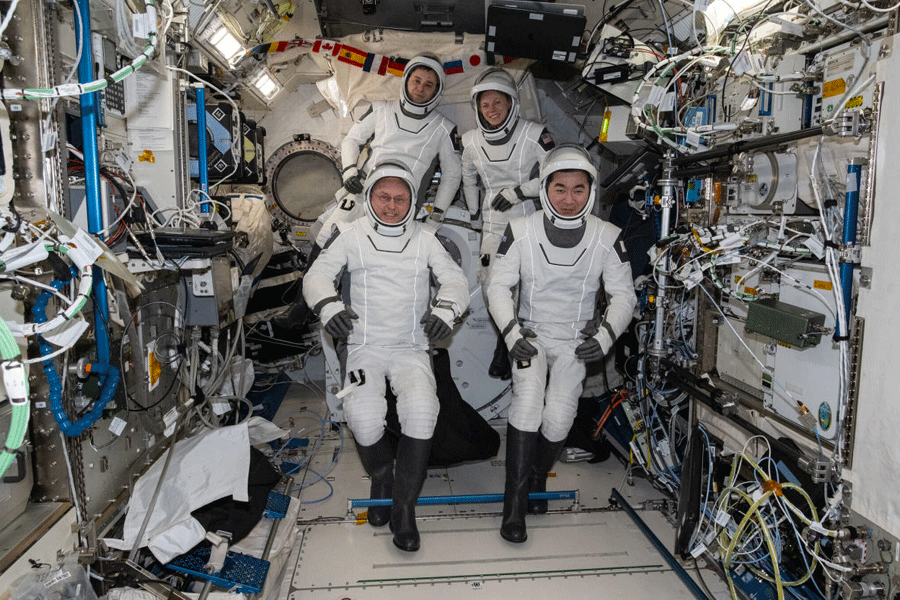
A SpaceX Crew Dragon capsule carrying four astronauts safely splashed down in the Pacific Ocean off the coast of California early Thursday, marking NASA’s first-ever medical evacuation from orbit and ending the crew’s International Space Station (ISS) mission more than a month early.
The capsule parachuted into calm waters near San Diego at about 12:45 a.m. EST (0845 GMT), capping a descent of more than 10 hours from the ISS and a fiery re-entry through Earth’s atmosphere. The splashdown was carried live on a joint NASA-SpaceX webcast.
The early return was prompted by an undisclosed serious medical condition affecting one of the astronauts. Officials declined to identify the individual or provide details, citing medical privacy.
NASA said the astronaut was stable while in orbit but needed to return to Earth as soon as possible for proper care and diagnostic testing.
NASA’s Zena Cardman and Mike Fincke were joined on the return flight by Japan’s Kimiya Yui and Russia’s Oleg Platonov. The mission, which began in August, concluded unexpectedly, leaving the orbiting laboratory with just one American and two Russian astronauts on board.
SpaceX guided the capsule to a middle-of-the-night splashdown less than 11 hours after the astronauts exited the space station. Officials said the re-entry and recovery required no special changes or accommodations, and the recovery ship carried its usual complement of medical experts. It was not immediately known when the astronauts would travel from California to their home bases in Houston or, in Platonov’s case, Moscow.
NASA stressed that the situation was not considered an emergency. The health issue surfaced on January 7, prompting the agency to cancel a planned spacewalk the following day and ultimately decide on an early return. This marked the first time NASA shortened a space mission for medical reasons, though similar steps were taken by Russia decades ago.
The space station has previously operated with three astronauts, and at times even fewer. However, NASA said it will be unable to conduct a spacewalk, even in an emergency, until the arrival of the next crew. The launch of a fresh four-member team—two Americans, one French astronaut and one Russian—is currently targeted for mid-February, with efforts under way to move it up if possible.