Mayor Zohran Mamdani represents a range of demographics that New York City has not seen before in top leadership: South Asian, millennial, Muslim.
For the hundreds of thousands of Muslim residents who have taken pride in seeing one of their own rise to the mayoralty, his inauguration brought another significant first.
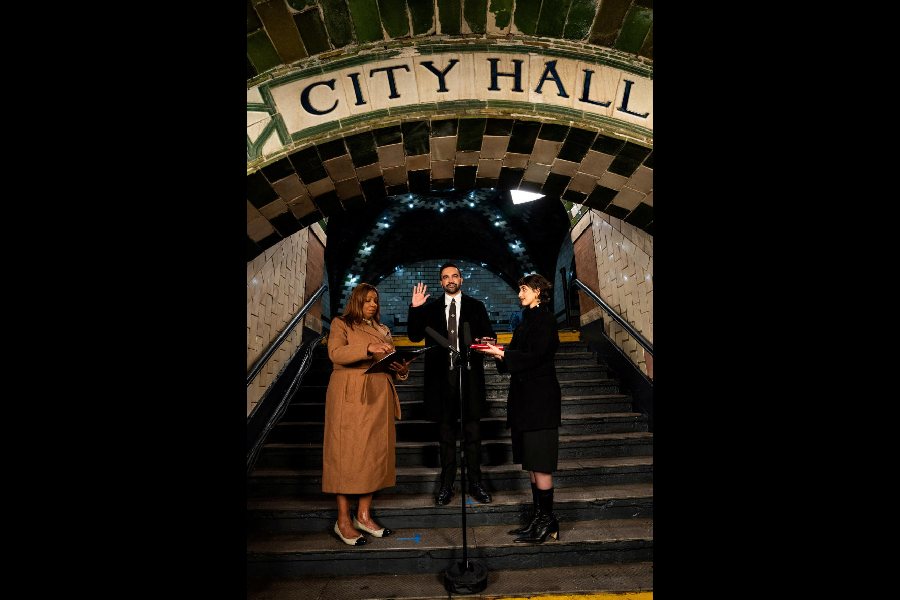
During his swearing-in ceremony shortly after midnight on Thursday, he put his hand on the Quran, Islam’s holiest book, making him the first mayor in New York City to do so.
One of the Qurans was from Mamdani’s grandfather. The other once belonged to Arturo Schomburg, the Black writer and historian. It was lent to the mayor by the New York Public Library.
For a separate public ceremony at City Hall on Thursday afternoon, Mamdani used his grandfather’s Quran and one owned by his grandmother.
Showcasing the Quran that belonged to Schomburg, an Afro-Latino writer whose work shaped the Harlem Renaissance, underlines the city’s blend of faiths and racial and ethnic backgrounds.
“It’s a highly symbolic choice because we’re about to have a Muslim mayor swearing in using the Quran, but also a mayor who was born on the African continent, in Uganda,” Hiba Abid, the library’s curator for Middle Eastern and Islamic Studies, said ahead of Mamdani’s swearing-in ceremony.
Abid helped Zara Rahim, a senior adviser to Mamdani, and Rama Duwaji, Mamdani’s wife, select the Quran for the inauguration. “It really brings together here elements of faith, identity and New York history,” she said.
Schomburg’s Quran will be on public display for the first time as part of a special exhibit at the New York Public Library that coincides with a yearlong celebration of the 100th anniversary of the Schomburg Center. The exhibit will begin on Tuesday.
Schomburg, who was born in Puerto Rico, was not a Muslim but kept the Quran as part of his archive of books and artefacts. He sold his collection, which contained more than 4,000 pieces, to the New York Public Library in 1926, building the foundation of the Schomburg Center for Research in Black Culture. He died in 1938.
His inclusion of the Quran in his collection was meant to show the full expanse of Black artistic, cultural and religious life.
He also wanted to rebut a claim from a childhood teacher, who once remarked to him that Black people lacked significant figures or history. His Quran was acquired from Ottoman Syria and was written and designed for everyday use, as evidenced by the style of its script and binding.
Abid said she hoped that putting Schomburg’s Quran on display would allow New Yorkers to learn more about the holy book and Muslim life in the city. She and Mamdani’s advisers also plan to use the display to encourage more people to take advantage of the archival resources that are available at the library.
Though it is traditional for most elected officials to take the oath of office with their hand on a religious text, they are not required by law to use one — or any book,for that matter.
Most past mayors have placed their hands on a Bible. But Mamdani’s faith was a defining feature of his campaign.
In a statement, Rahim said that Mamdani’s use of the Quran would correct “a long-deferred absence” of Muslims in the city’s public life.
“This moment will mark a turning point in the civic history of New York City, and it belongs to every New Yorker whose lives shaped this city quietly, without ever being reflected back to them,” she said.
Mayors have opted for a mix of personal heirlooms and artefacts while being sworn in. In 2021, Eric Adams took his oath of office with one hand on his mother’s Bible and in the other a framed photo of her image floating in a brandy snifter. His predecessor, Bill de Blasio, put his hand on a Bible that once belonged to President Franklin D. Roosevelt.
Mamdani will join a small group of prominent elected officials in the US to use a Quran for their swearing-in. Keith Ellison, Minnesota’s attorney general, became one of the first American elected officials to put his hand on the book when he was sworn into Congress in 2007. Representative Ilhan Omar of Minnesota, who succeeded Ellison, also put her hand on a Quran for her swearing-in.
In New York, Shahana Hanif was sworn in to the City Council in 2022 with her hand on a family Quran that her sister used during her wedding. Hanif said Mamdani’s plan to use the Quran highlighted the inroads that Muslims have made in city politics.
“Let’s be honest, Muslims have not been in electoral life for decades like other ethnic groups and communities,” she said. “I think the Quran represents this example of extending solidarity to the Muslim community in New York City and, really, abroad.”
New York Times News Service