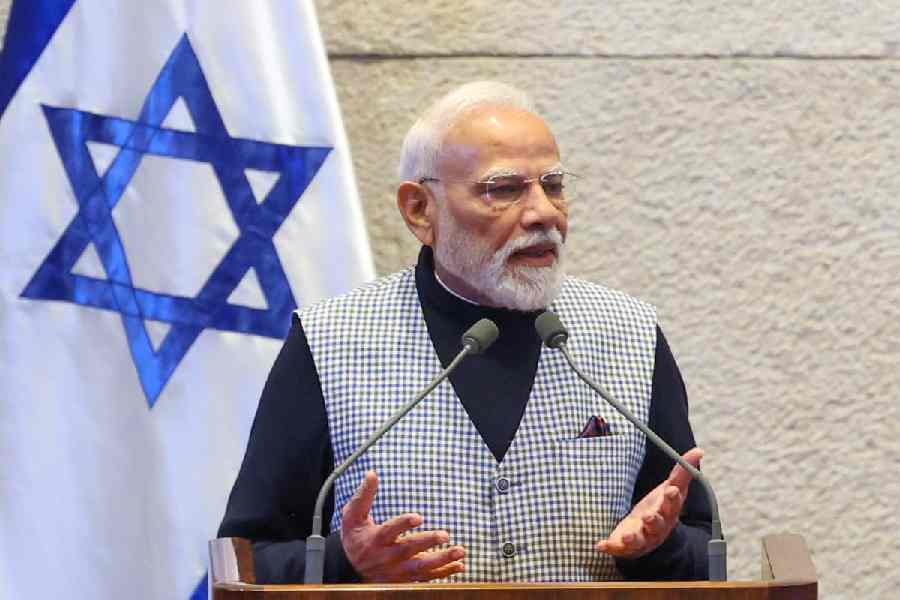
Prime Minister Narendra Modi on Wednesday reaffirmed India’s support for Israel’s fight against terrorism, backed the Gaza Peace Initiative, and urged Tel Aviv not to give up on the possibility of peace that the Abraham Accords had opened up despite the challenges.
Addressing the Knesset — Israel’s parliament — Modi expressed solidarity with Tel Aviv over the October 7, 2023, Hamas attack that killed close to 1,200 Israelis. But he made no reference to Israel’s retaliatory savagery in Gaza, where its continued attacks have killed at least 75,000 people, more than 20,000 of them children.
On the 2023 Hamas attack, he said: “I also carry with me the deepest condolences of the people of India for every life lost and for every family whose world was shattered in the barbaric terrorist attack by Hamas on October 7. We feel your pain. We share your grief. India stands with Israel, firmly, with full conviction, in this moment, and beyond.
“No cause can justify the murder of civilians. Nothing can justify terrorism. India has also endured the pain of terrorism for a long time. We remember the 26/11 Mumbai attacks and the innocent lives lost, including (those of) Israeli citizens.”
Modi told the Israel parliament: “Like you, we have a consistent and uncompromising policy of zero tolerance for terrorism, with no double standards. Terrorism aims to destabilise societies, to block development, and to erode trust.
“Countering terrorism requires sustained and coordinated global action, because terror anywhere threatens peace everywhere. That is why, India supports all efforts that contribute to durable peace and regional stability.”
Modi’s only, fleeting mention of the Palestine issue came in the form of advocacy for the Gaza Peace Initiative.
“The Gaza Peace Initiative that was endorsed by the UN Security Council offers a pathway. India has expressed its firm support for the initiative. We believe that it holds the promise of a just and durable peace for all the people of the region including by addressing the Palestine Issue,” the Prime Minister said.
“Let all our efforts be guided by wisdom, courage and humanity. The road to peace is not always easy. But India joins you and the world for dialogue, peace and stability in this region.”
Referring to the Abraham Accords, signed between Israel and several Arab nations in September 2020, Modi recalled that India had applauded Israel’s courage and vision.
“It was a moment of new hope for a long-troubled region. Since then, the situation has changed significantly. The path is even more challenging. Yet it is important to sustain that hope,” he said.
On the bilateral relationship, the Prime Minister said the two countries were committed to expanding trade, strengthening investment flows and promoting joint infrastructure development.
He acknowledged that the bilateral goods trade had grown manifold in recent years but said it did not reflect the full scope of the opportunity.
“That is why our teams are working hard to negotiate an ambitious free trade agreement (FTA). It will unlock the vast untapped potential in our trade relationship.”
The first round of talks on the FTA began in Delhi on Monday ahead of what is Modi’s second visit to Israel, and is expected to continue till Thursday, according to the commerce ministry.
Modi received several rounds of standing ovation before and during his speech – the first by any Indian Premier in the Knesset.
Addressing the House before Modi, Israel Prime Minister Benjamin Netanyahu was effusive in his praise for his Indian counterpart, describing him as “more than a friend, a brother”.
Netanyahu said the two countries had “shared interests” and spoke about the deepening cooperation.
He was deeply appreciative of India’s response after October 7: “You stood by Israel. You stood for Israel. You stood for the truth.”
The Israeli Opposition, which had threatened to boycott the Prime Minister’s address in protest against the government’s decision not to invite the Supreme Court president to the special session as is customary, turned up to hear Modi after staying away during both Netanyahu’s and the Knesset Speaker’s speeches.
Leader of the Opposition Yair Lapid spoke briefly, acknowledging India’s solidarity with Israel after October 7. He noted that both sides of the aisle were present to listen to Modi, apparently trying to underscore that the boycott threat had not been directed against him and stemmed from domestic politics.