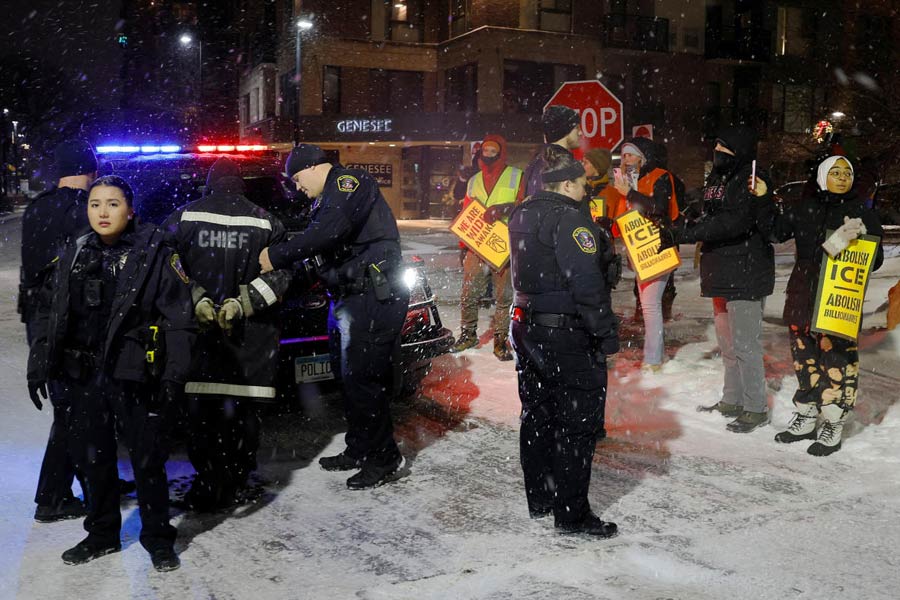
A federal judge in Minnesota on Friday ordered sweeping limits on how U.S. immigration agents may conduct enforcement operations in the Minneapolis area, barring them from detaining or using force against peaceful protesters and observers.
U.S. District Judge Kate Menendez issued an injunction prohibiting federal agents from retaliating against individuals engaged in peaceful, unobstructive protest activity. Officers are explicitly barred from arresting or detaining peaceful protesters or people engaged in orderly observation unless there is reasonable suspicion they have committed a crime or are interfering with law enforcement.
The order also bans the use of pepper spray, tear gas or other crowd-control munitions against peaceful demonstrators or bystanders who are observing and recording immigration enforcement operations.
The ruling stems from a lawsuit filed in December on behalf of six Minnesota activists, amid what the U.S. Department of Homeland Security has described as the largest immigration enforcement operation in its history.
The Trump administration announced the deployment of 2,000 immigration agents to the Minneapolis area nearly two weeks ago, a surge that has since grown to nearly 3,000 officers from Immigration and Customs Enforcement and Border Patrol, outnumbering local police in the Twin Cities metropolitan area.
Thousands of people have been observing ICE and Border Patrol activities in the Minneapolis–Saint Paul area since early December, as tensions mounted over the heavily armed deployment.
Those tensions intensified further after an ICE agent fatally shot 37-year-old mother of three Renee Good in January while she was sitting behind the wheel of her car.
At the time, Good was participating in one of several neighborhood patrols organised by local activists to monitor ICE activity.
In her ruling, Menendez said federal officers participating in the operation cannot detain drivers or passengers in vehicles without reasonable suspicion that they are obstructing or interfering with officers.
Safely following agents “at an appropriate distance does not, by itself, create reasonable suspicion to justify a vehicle stop,” the ruling said.
She also ruled that agents cannot arrest individuals without probable cause or reasonable suspicion that the person has committed a crime or interfered with enforcement activities.
The activists are represented by the American Civil Liberties Union of Minnesota, which argues that federal officers have been violating the constitutional rights of Twin Cities residents. Government attorneys countered that agents have acted within their legal authority to enforce immigration laws and protect themselves.
Menendez is also presiding over a separate lawsuit filed this week by the state of Minnesota and the cities of Minneapolis and Saint Paul seeking to halt the enforcement crackdown.
At a hearing Wednesday, she declined to grant an immediate temporary restraining order in that case.
“What we need most of all right now is a pause. The temperature needs to be lowered,” state Assistant Attorney General Brian Carter told her.
Menendez said the issues raised by the state and cities are “enormously important,” but noted that the case involves high-level constitutional and legal questions with limited precedent. She ordered both sides to submit additional briefs next week.