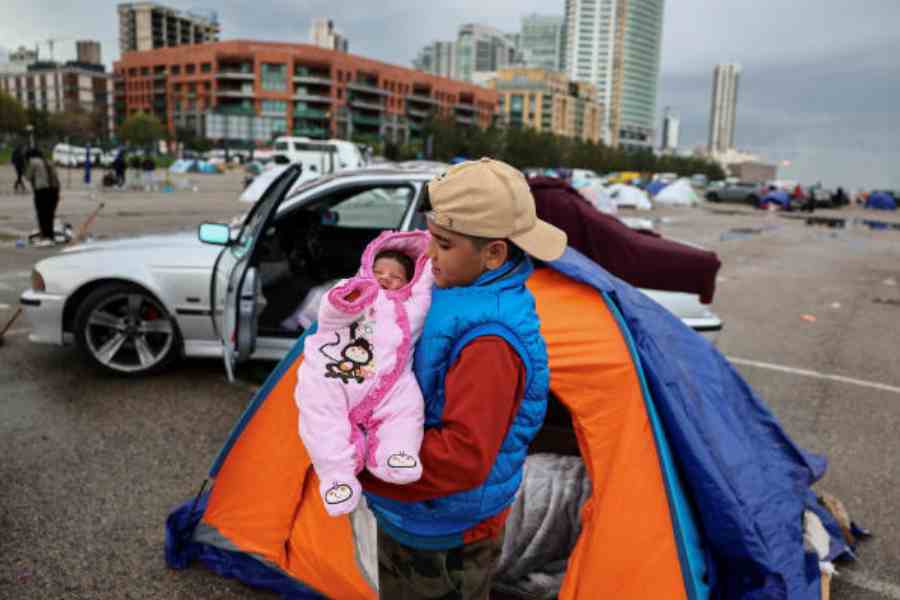
The shirtless jogger, his headphones in and his back slick with sweat, ran past a row of tents pitched along the seafront in downtown Beirut, Lebanon’s capital. In one tent, a displaced family of four — uprooted by weeks of war that have convulsed the nation — watched him pass.
For a moment, the scene held its uneasy calm. The evening sun faded into the Mediterranean Sea, the steady rhythm of the waves softened the edges of the day, and the runner kept his pace, eyes forward. And then a deafening roar shattered it all: An Israeli airstrike had hit a nearby neighbourhood, sending plumes of smoke into the sky.
“We chose the seaside because it is peaceful,” said Hussein Hame, 37, who, along with his wife and two children, was displaced this month from Dahiya, a collection of neighbourhoods on the southern outskirts of Beirut where Hezbollah holds sway. “But this war finds you everywhere.”
War has returned to Lebanon, and the capital’s meandering seafront has become an unlikely front line. Here, a stark contrast has emerged: The displaced and destitute sit in the cold, while others live life as usual — jogging, cycling — amid the dizzying wealth and luxury that exist nearby.
Israel’s strikes have killed more than 1,000 people, injured more than 2,700 and put Lebanon, once again, on the precipice of disaster.
On the city’s seafront, the human toll is visible in stark detail: Tents line the promenade, cars serve as makeshift shelters and bundles of clothes scatter the sidewalks. Teenagers, with nowhere to go and no school to attend, roam around. Toddlers, hungry and exhausted, cry and fuss.
Families huddle through cold nights, lighting small bonfires that do little against the wind and rain. There is nowhere to shower, nowhere to change, barely enough to eat — especially difficult for those who were fasting during Ramzan.
The displaced form a mosaic of Lebanon itself: locals uprooted from homes, businesses and farmlands. But there are also foreigners, many of whom are domestic workers and day labourers. They arrived from Africa, Asia and across West Asia in search of better economic opportunities and safety only to find uncertainty.
A week into the fighting, an Israeli strike hit several cars along the seaside corniche, killing at least eight people and injuring dozens more, health officials said.
But even as suffering persists along the waterfront, a different reality unfolds beside it.
From the corniche, the city opens to a breathtaking panorama: the glittering Mediterranean, the rugged peaks of Mount Lebanon and the iconic Raouché Rocks rising from the sea.
The promenade is also one of the city’s most affluent stretches, lined with upscale apartments and hotels, luxury car dealerships and swanky restaurants with well-heeled patrons sipping cocktails. Those displaced share the same stretch with cyclists, joggers in sleek athletic wear, families out for evening strolls and fishermen casting lines from the rocks below.
On a recent afternoon, Vera Noon, who was walking along the seafront, described a swell of conflicting emotions. Some people moved along the corniche, walking their dogs and laughing as if nothing had changed, seemingly untouched by the surrounding suffering. And yet, she said, she understood that people were navigating the crisis in their own ways.
“They didn’t choose this war,” said Noon, a Lebanese doctoral student at the University of Edinburgh who is researching the connection between the Mediterranean and her country’s heritage.
The seafront, she said, offers a sanctuary for both those clinging to daily routines and those with nowhere else to go.
“The sea is the last refuge,” Noon said. “It gives people peace. They relax, it gives them calm.”
New York Times News Service