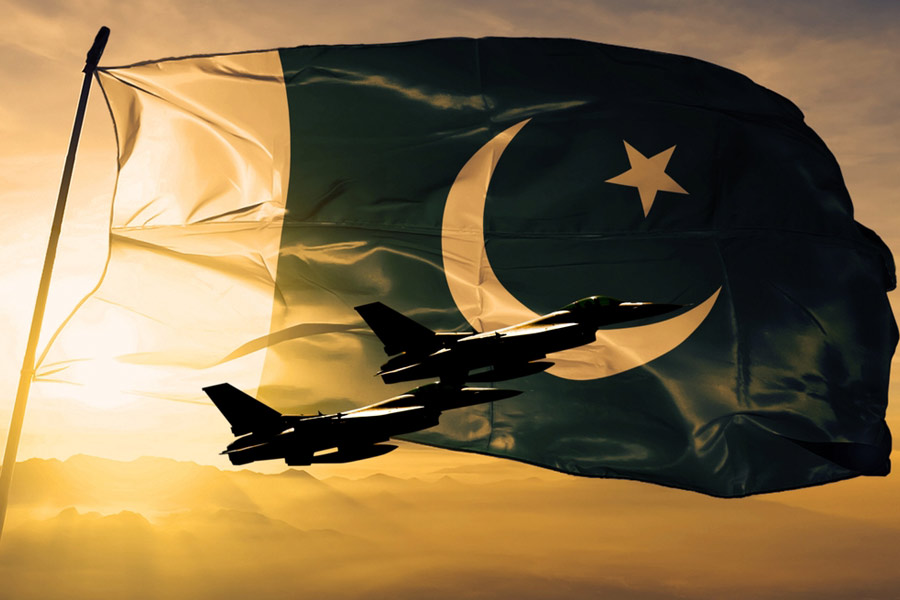
The year 2025 marked the most serious military confrontation between India and Pakistan in decades, a crisis that tested the resilience of a financially strained Islamabad and exposed old and deep vulnerabilities at home and abroad.
The escalation began in the summer, when India carried out coordinated missile strikes under Operation Sindoor, targeting terrorist infrastructure in Pakistan and Pakistan-occupied Kashmir. The action followed the Pahalgam terror attack, in which 26 people were killed after terrorists singled them out for being Hindu.
In the early hours of May 7, hours after the strikes, foreign secretary Vikram Misri said India had acted on intelligence inputs indicating further imminent attacks. “Pre-emptive and precautionary strikes were therefore necessary,” he said.
Delhi later said that at least a dozen Pakistani military aircraft, including US-made F-16s, were destroyed or damaged during the exchanges. The assessment was made public by Air Chief Marshal A.P. Singh.
India also later admitted it suffered losses but they were never enumerated.
After four days of intense military action, the two sides agreed to halt operations on May 10, bringing the crisis to a close.
Pakistan’s reliance on Chinese defence hardware became evident during the conflict. Turkey and Azerbaijan emerged as Islamabad’s diplomatic supporters during the standoff.
Defence analyst Zia Khan told PTI that critics acknowledged Pakistan’s “calibrated” military response during Operation Sindoor, arguing that restraint helped prevent wider escalation and improved Islamabad’s standing among global powers.
Asim Munir, Tr(i)ump(hant)
Trump, in a move that raised eyebrows, invited Pakistan Army chief General Asim Munir to the White House for dinner. Munir, who was later elevated to the rank of Field Marshal, appeared to strike a rapport with Trump, who went on to publicly repeat his ceasefire claims for months.
Pakistan’s regional positioning shifted further in September with the signing of a Strategic Mutual Defence Agreement (SMDA) with Saudi Arabia. The pact formalised long-standing security cooperation and stated that an attack on either country would be treated as an attack on both.
Following the May confrontation, Pakistan also stepped up its diplomatic outreach and was among the Muslim-majority countries consulted by Trump on the Gaza crisis. Islamabad is expected to contribute troops to an international stabilisation force there.
Trouble with Afghanistan and within
Even as Pakistan’s eastern border cooled, tensions flared to the west. In October, clashes erupted between Pakistan and Afghanistan. Islamabad claimed that over 200 Afghan Taliban fighters and 110 Tehreek-e-Taliban Pakistan (TTP) operatives were killed, along with 23 Pakistani soldiers.
Despite several rounds of talks, progress remained limited, though tentative efforts were made towards the end of the year to address disagreements over the banned TTP.
Domestically, Pakistan’s political climate remained volatile. Sweeping changes to army laws, coupled with the continued imprisonment of former prime minister Imran Khan, fuelled unrest.
The armed forces underwent a major internal restructuring to centralise command in a move widely seen as cementing military dominance over civilian institutions. Munir’s elevation to Field Marshal and his appointment as the first Chief of Defence Forces marked an unprecedented consolidation of power.
Khan’s party, Pakistan Tehreek-e-Insaf (PTI), alleged that the changes were designed to entrench what it termed the “Asim Law”.
In December, a special court sentenced Khan and his wife Bushra Bibi to 17 years in prison in the Toshakhana-II corruption case, triggering violent protests in Rawalpindi and Islamabad.
From Adiala Jail, Khan dismissed the proceedings as a “military-style sham” and renewed his call for a nationwide Haqeeqi Azadi movement.
The same month, a military court sentenced former ISI chief Lt Gen (retd) Faiz Hameed to 14 years in prison on multiple charges, including political interference and violations of the Official Secrets Act. Hameed was widely seen as close to Khan.
Terrorism and economic strain persist
Pakistan continued to face a surge in militant violence, with terror incidents rising by 25 per cent in 2025 compared to the previous year. Khyber Pakhtunkhwa remained the worst-affected province.
The Islamabad-based Centre for Research and Security Studies reported a sharp spike in violence during a three-month period, driven by increased militant activity and intensified counter-terror operations.
On the economic front, the IMF said Pakistan had achieved short-term stability but remained weighed down by heavy debt, weak investment and sluggish job creation.
IMF projections released alongside a fresh disbursement of about $1.2 billion showed growth rising modestly from 2.6 per cent in FY25 to 3.2 per cent in FY26, barely keeping pace with population growth in a country of over 240 million people.