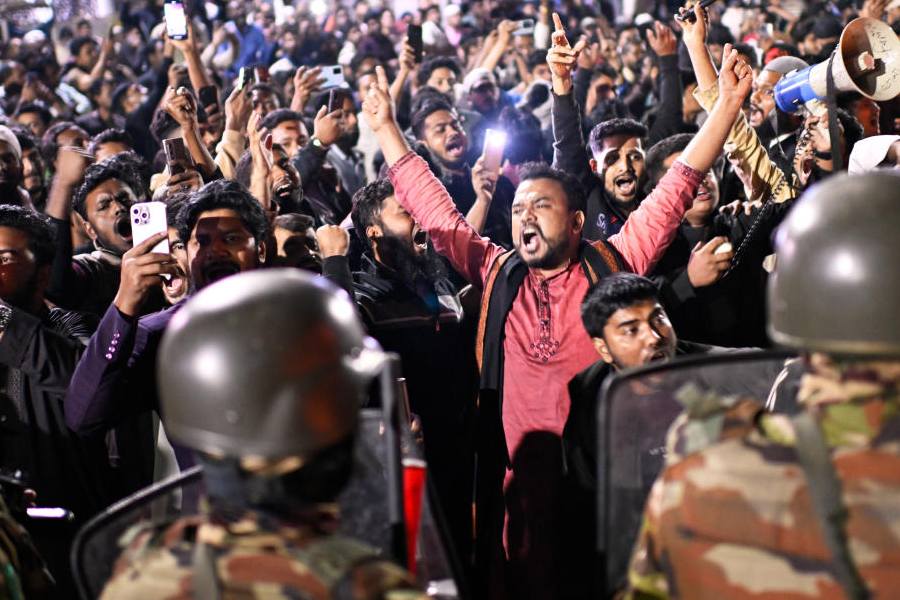
Bangladesh is witnessing a fault line between the interim government and sections of the media as violence continues to spread in the aftermath of the killing of Inqilab Mancha leader Sharif Osman Hadi.
Hadi was shot in the head on December 12 during an election campaign in Dhaka. He was airlifted to Singapore for advanced treatment but died on December 18.
The same evening, mobs set fire to the offices of two mass-circulation newspapers —Daily Star and Prothom Alo. Progressive cultural institutions Chayanat and Udichi Shilpi Goshthi, both over five decades old, were also attacked in the capital.
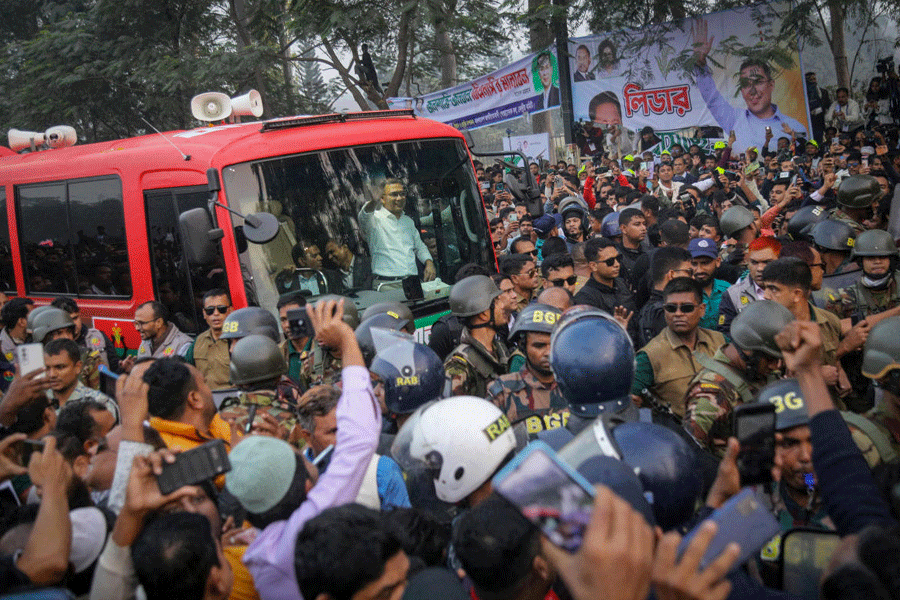
In central Mymensingh, a Hindu factory worker was lynched. Addressing an event organised by the Broadcast Journalists Centre (BJC), Editors Council President Nurul Kabir alleged that the violence was allowed to unfold despite prior warnings.
“We clearly know an announcement came to demolish the Prothom Alo, Daily Star and the Chhyanat one or two days before the attacks. The people of the country know, and the government as well knows who gave the announcement,” Kabir said.
Calling such announcements a criminal offence under the law, he added, “Yet the government did not arrest them to prevent the mayhem . . . that is why we said indeed a section of the government allowed the rampage to go on.”
Kabir, who is also the editor of New Age, said the attacks were carried out by an organised force and claimed that “the political identity of theirs was revealed clearly” among those arrested so far.
Responding at the same event, Interim government’s Information and Broadcast Adviser Syeda Rizwana Hasan said the perpetrators were “our common adversaries”. She said they had also tried to “intimidate me by hurling bombs in front of my house”.
Hasan argued that confrontation between the media and the government would be counterproductive, saying, “it will not yield any result if one thinks the other as rivals”.
The allegations against the interim administration sharpened days earlier when Hadi’s brother Omar accused a section within the government of plotting the killing to derail the general election scheduled for February 12.
Addressing a protest rally in the capital, Omar said, “It is you who got Osman Hadi killed, and now you are trying to foil the election by using this as an issue. Those who are in power when Osman Hadi was killed, you won't be able to evade responsibility.”
Hours after his remarks, Chief Adviser Muhammad Yunus’ special assistant on home affairs, Muhammad Khuda Baksh Chowdhury, resigned.
Omar demanded that the government “immediately expose the entire group involved” in his brother’s killing or “otherwise, you will be forced to flee the country,” invoking the fate of the deposed Sheikh Hasina-led Awami League government.
Even as political accusations mounted, fresh violence was reported across the country. In northwestern Thakurgaon, a mob vandalised the shrine of a Sufi saint in the early hours of Saturday, with police saying the attackers were yet to be identified.
On Friday, a powerful explosion tore through the walls of an Islamic seminary in Keraniganj on the outskirts of Dhaka, injuring four people. Police said bomb-making materials and crude bombs were recovered from the site.
A local resident said there were no students inside the seminary at the time of the blast. Hadi, a fierce critic of India and the Awami League, had emerged as a prominent face during last year’s violent student-led protests known as the July Uprising, which led to the fall of the Hasina government.
He later helped float the Inqilab Mancha. His killing, and the violence that followed, has now placed the interim government under sustained scrutiny at a time when Bangladesh is heading into a crucial election.