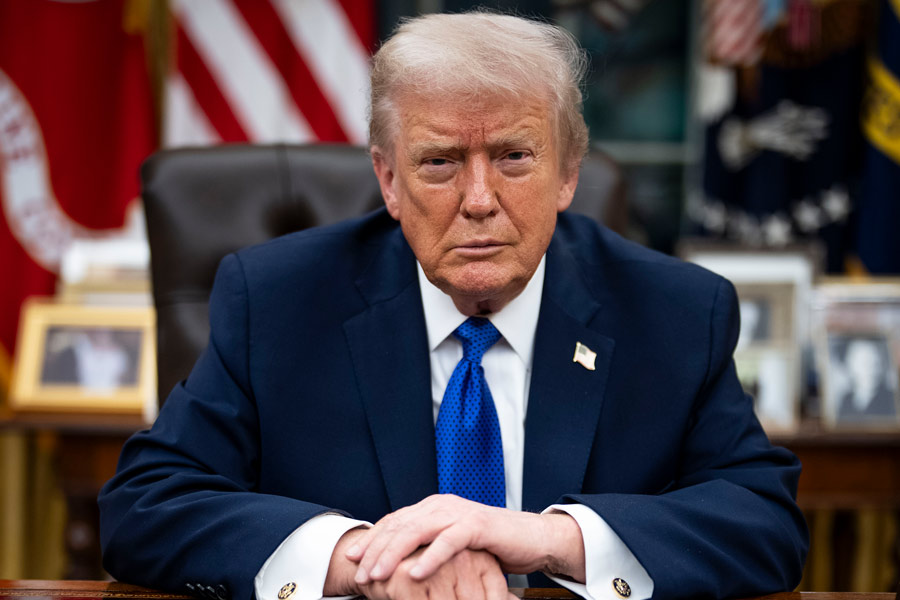
President Donald Trump declared Wednesday evening that his power as commander in chief is constrained only by his “own morality,” brushing aside international law and other checks on his ability to use military might to strike, invade or coerce nations around the world.
Asked in a wide-ranging interview with The New York Times if there were any limits on his global powers, Trump said: “Yeah, there is one thing. My own morality. My own mind. It’s the only thing that can stop me.”
“I don’t need international law,” he added. “I’m not looking to hurt people.”
When pressed further about whether his administration needed to abide by international law, Trump said, “I do.” But he made clear he would be the arbiter when such constraints applied to the United States.
“It depends what your definition of international law is,” he said.
Trump’s assessment of his own freedom to use any instrument of military, economic or political power to cement U.S. supremacy was the most blunt acknowledgment yet of his worldview. At its core is the concept that national strength, rather than laws, treaties and conventions, should be the deciding factor as powers collide.
He did acknowledge some constraints at home, even as he has pursued a maximalist strategy of punishing institutions he dislikes, exacting retribution against political opponents and deploying the National Guard to cities over the objections of state and local officials.
He made clear that he uses his reputation for unpredictability and a willingness to resort quickly to military action, often in service of coercing other nations. During his interview with the Times, he took a lengthy call from President Gustavo Petro of Colombia, who was clearly concerned after repeated threats that Trump was thinking of an attack on the country similar to the one on Venezuela.
“Well, we are in danger,” Petro said in an interview with the Times just before the call. “Because the threat is real. It was made by Trump.”
The call between the two leaders, the contents of which were off the record, was an example of coercive diplomacy in action. And it came just hours after Trump and Secretary of State Marco Rubio had extracted the United States from dozens of international organizations intended to foster multinational cooperation.
In his conversation with the Times, Trump sounded more emboldened than ever. He cited the success of his strike on Iran’s nuclear program — he keeps a model of the B-2 bombers used in the mission on his desk; the speed with which he decapitated the Venezuelan government last weekend; and his designs on Greenland, which is controlled by Denmark, a NATO ally.
When asked what was his higher priority, obtaining Greenland or preserving NATO, Trump declined to answer directly, but acknowledged “it may be a choice.” He made clear that the trans-Atlantic alliance was essentially useless without the United States at its core.
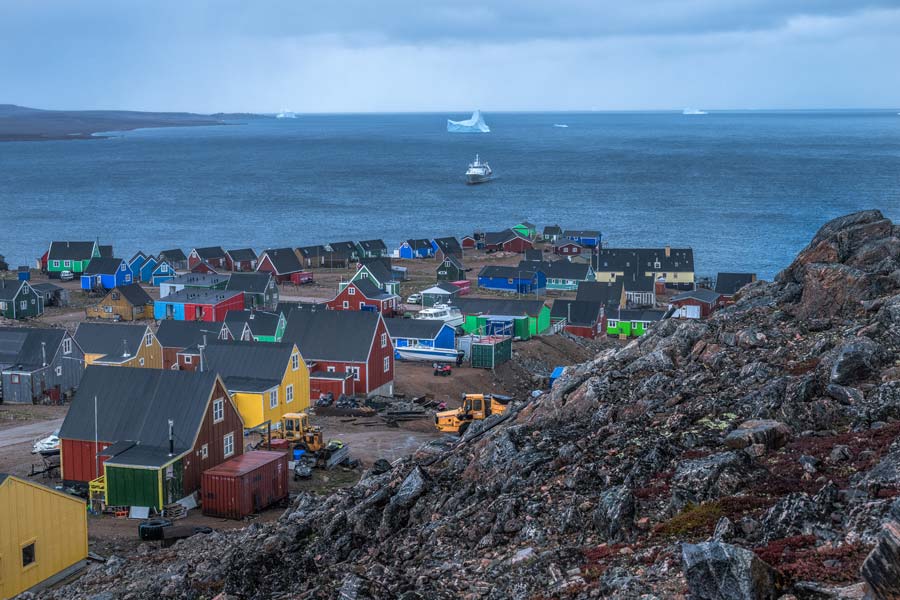
FILE — The remote town of Ittoqqortoormiit, Greenland, on Sept. 4, 2025. (Esther Horvath/The New York Times)
Even as he characterized the norms of the post-World War II order as unnecessary burdens on a superpower, Trump was dismissive of the idea that Chinese leader Xi Jinping or Russian President Vladimir Putin could use similar logic to the detriment of the United States. On topic after topic, he made clear that in his mind, U.S. power is the determining factor — and that previous presidents have been too cautious to make use of it for political supremacy or national profit.
The president’s insistence that Greenland must become part of the United States was a prime example of his worldview. It was not enough to exercise the U.S. right, under a 1951 treaty, to reopen long-closed military bases on the huge landmass, which is a strategically important crossroads for U.S., European, Chinese and Russian naval operations.
“Ownership is very important,” Trump said as he discussed, with a real estate mogul’s eye, the landmass of Greenland — three times the size of Texas but with a population of less than 60,000. He seemed to dismiss the value of having Greenland under the control of a close NATO ally.
When asked why he needed to possess the territory, he said: “Because that’s what I feel is psychologically needed for success. I think that ownership gives you a thing that you can’t do, whether you’re talking about a lease or a treaty. Ownership gives you things and elements that you can’t get from just signing a document.”
The conversation made clear that in Trump’s view, sovereignty and national borders are less important than the singular role the United States plays as the protector of the West.
He argued that only he — and not two predecessors on whom he heaped scorn, Joe Biden and Barack Obama — had proved capable of persuading NATO nations to spend 5% of the gross domestic product on defense. (About 1.5% of that is actually for domestic infrastructure — from power grids to cybersecurity — that can support defense. The target does not kick in until 2035, six years after Trump leaves office.)
“I want them to shape up,” he said. “I think we’ll always get along with Europe, but I want them to shape up. I’m the one that got them to spend more on the, you know, more GDP on NATO. But if you look at NATO, Russia I can tell you is not at all concerned with any other country but us.”
The president added: “I’ve been very loyal to Europe. I’ve done a good job. If it weren’t for me, Russia would have all of Ukraine right now.”
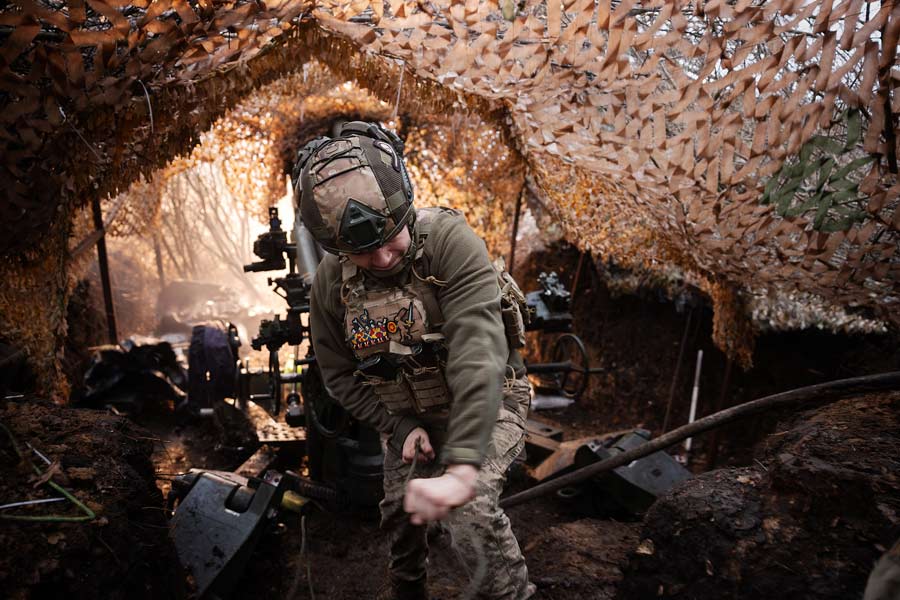
FILE — Ukrainian soldiers fire howitzer weapons at Russian positions in the Donbas region of Ukraine on Dec. 21, 2025. (Tyler Hicks/The New York Times)
He seemed unconcerned that the last major nuclear arms control agreement with Russia was set to expire in four weeks, leaving the world’s two largest nuclear powers free to expand their arsenals without limit, for the first time in half a century.
“If it expires, it expires,” he said. “We’ll just do a better agreement,” he added, insisting that China, which has the fastest-growing arsenal in the world, should be incorporated in any future agreement.
“You probably want to get a couple of other players involved also,” Trump said.
The president seemed equally sanguine about whether his decision to send Special Operations forces into Caracas to remove Nicolás Maduro of Venezuela would be exploited by China or Russia. In the days since the action in Venezuela, there have been arguments that the U.S. precedent would help justify a Chinese effort to take Taiwan, or a Russian attempt to seize Ukraine, which Putin has described as a historical part of the Russian empire, dating back more than a dozen centuries.
Asked whether he had created a precedent that he may later regret, Trump argued that his view of the threat posed by Maduro’s Venezuela was quite different from Xi’s view of Taiwan.
“This was a real threat,” he said of Venezuela. “You didn’t have people pouring into China,” he argued, repeating his oft-made claim that Maduro dumped gang members into the United States.
Trump added: “You didn’t have drugs pouring into China. You didn’t have all of the bad things that we’ve had. You didn’t have the jails of Taiwan opened up and the people pouring into China,” or, he said later, criminals and others “pouring into Russia.”
When a reporter noted that Xi regarded Taiwan as a separatist threat to China, Trump said: “That’s up to him, what he’s going to be doing. But, you know, I’ve expressed to him that I would be very unhappy if he did that, and I don’t think he’ll do that. I hope he doesn’t.”
Then, asked whether Xi might seize on recent events to attack or choke off Taiwan, he suggested that the Chinese leader would not dare to take that step while Trump was in office. “He may do it after we have a different president, but I don’t think he’s going to do it with me as president,” he said.
On Thursday, in a rare assertion of congressional authority over the president’s war powers, the Senate agreed to debate a resolution aimed at curbing Trump’s use of military force in Venezuela. Sen. Rand Paul, R-Ky., said one factor that may have tipped the vote was the president’s comment during Wednesday’s interview that the United States might remain involved in Venezuela for years.
On the domestic front, Trump suggested that judges only have power to restrict his domestic policy agenda — from the deployment of the National Guard to the imposition of tariffs — “under certain circumstances.”
But he was already considering workarounds. He raised the possibility that if his tariffs issued under emergency authorities were struck down by the Supreme Court, he could repackage them as licensing fees. And Trump, who said he was elected to restore law and order, reiterated that he was willing to invoke the Insurrection Act and deploy the military inside the United States and federalize some National Guard units if he felt it was important to do so.
So far, he said, “I haven’t really felt the need to do it.”
The New York Times News Service