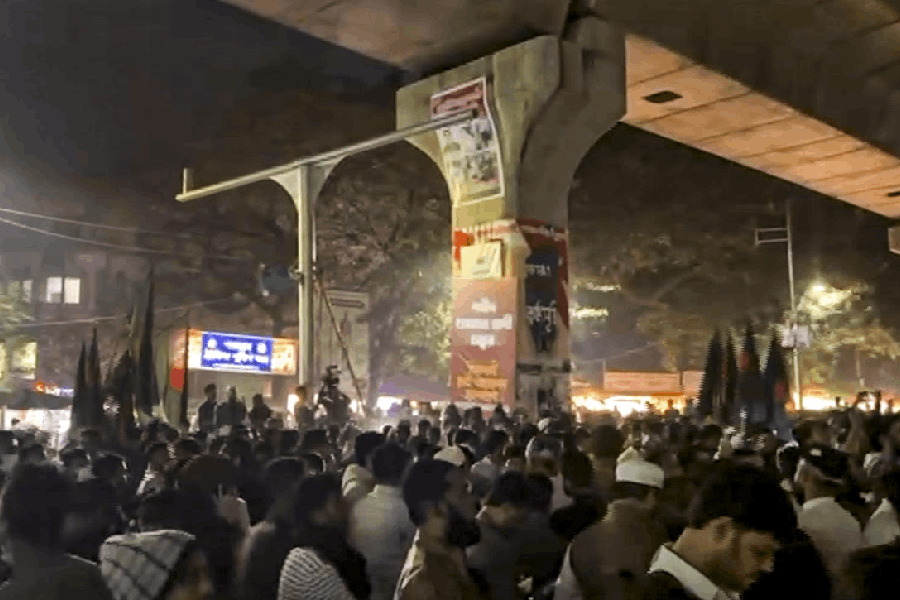
Bangladesh’s interim government on Friday urged citizens to resist violence by “fringe elements” as the body of prominent youth leader Sharif Osman Hadi arrived in Dhaka from Singapore, amid fresh unrest in the capital following overnight rampages triggered by his death.
According to police, alleged radical right-wing activists set fire to the main office of the left-leaning Udichi Shilpigoshthi in the capital shortly after Hadi’s body arrived.
“The arson destroyed everything (inside Udichi's office),” said Jamshed Anwar, general secretary of the country’s largest cultural organisation, founded in 1968.
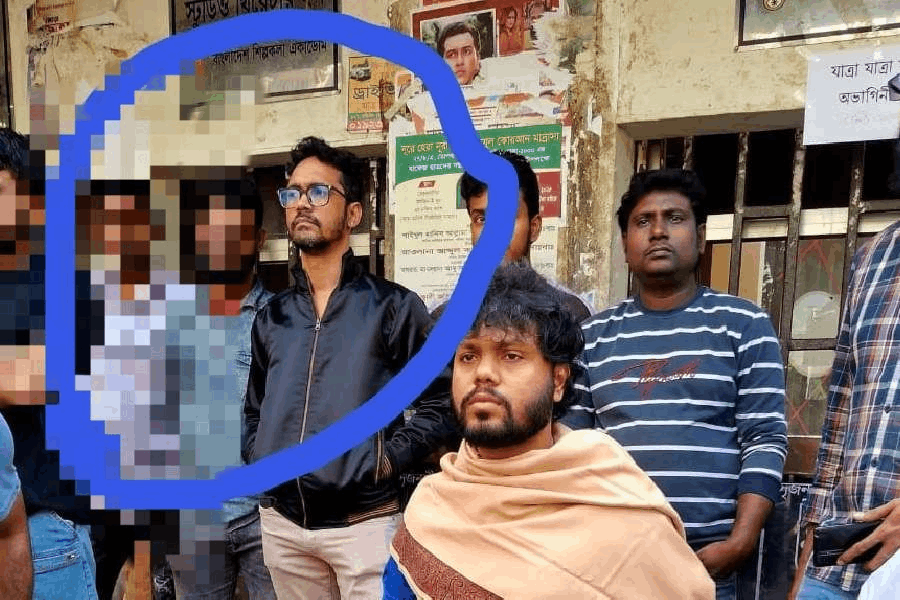
The fire service said the blaze had been brought under control. A large number of police personnel, Border Guard Bangladesh members and army troops were deployed in front of the office.
His body arrived at Hazrat Shahjalal International Airport at around 6 pm local time on a Biman Bangladesh Airlines flight amid tight security and widespread public mourning, state-run news agency BSS reported, quoting Biman General Manager (Public Relations) Boshra Islam.
Members of the Bangladesh Army, Armed Forces Battalion and police were deployed in large numbers as the body was taken out of the airport.
Videos shared on social media showed Hadi’s followers lining both sides of the road from the airport to Shahbagh after the flight from Singapore landed.
His coffin, draped in the national flag, was taken to the Dhaka University Central Mosque for a public meeting.
The interim government’s press wing announced that Hadi’s funeral prayer will be held at the South Plaza of the National Parliament Building at 2 pm on Saturday, revising an earlier announcement of 2.30 pm.
Those wishing to attend were requested not to carry bags or heavy items.
In a social media post, Inqilab Mancha said, “Upon the family's wishes, a decision has been taken to bury Hadi beside the grave of national poet Kazi Nazrul Islam and to hold his funeral prayer after Zuhr tomorrow at Manik Mia Avenue.”
The party said there would be no public viewing of the body and urged people to pray for Hadi while maintaining order. It also announced that a janaza would be held on Saturday after Zuhr prayers at Manik Mia Avenue.
The US Embassy in Dhaka on Friday issued an advisory urging American citizens to exercise caution, warning that “gatherings intended to be peaceful can turn confrontational and escalate into violence,” and advising them to avoid demonstrations and large gatherings.
The UK Foreign, Commonwealth and Development Office also issued a travel advisory, urging British citizens to avoid travel, unless very essential, to the Chittagong Hill Tracts, citing reports of violence and criminal activity, particularly in remote areas.
Hadi had been undergoing treatment in Singapore for fatal gunshot wounds inflicted by masked gunmen on 12 December.
Hadi was among the leaders who took part in last year’s student-led protests, termed the July Uprising, and was a candidate for the scheduled 12 February general elections. He was also the spokesperson of Inqilab Mancha.
In a televised address late Thursday, interim government Chief Adviser Muhammad Yunus vowed swift justice for those involved in Hadi’s killing, saying, “no leniency will be shown” to the killers.
He also urged citizens to maintain “patience and restraint” and later declared a one-day state mourning on Saturday.
Despite the appeal, various parts of the country were rocked by attacks and vandalism on Thursday night.
Incidents included stone-hurling at the residence of the Assistant Indian High Commissioner in Chattogram, attacks on the offices of leading newspapers Prothom Alo and Daily Star, vandalism of the Bangabandhu Memorial Museum in Dhaka, and the demolition of an office of deposed prime minister Sheikh Hasina’s now disbanded Awami League party in Rajshahi.
“From the beginning, the ongoing failure of the current interim government to prevent mob violence has been evident, and the latest incident is yet another horrific example,” the Editors' Council and the Newspaper Owners' Association of Bangladesh said in a joint statement.
Another mob attacked the seven-storey building of progressive cultural group Chhayanat, founded in 1961, in the Dhanmondi area, ransacking the premises floor by floor and destroying musical instruments, artworks and important documents.
On Thursday night, the National Citizen Party, a major offshoot of Students Against Discrimination that led the July uprising which ousted the Hasina-led government, joined a mourning procession on the Dhaka University campus.
Supporters raised anti-India slogans, alleging that Hadi’s assailants fled to India after the murder, and demanded the closure of the Indian High Commission.
“The interim government must close the Indian High Commission in Bangladesh until India returns the assassins of Hadi bhai. Now or never. We are in a war,” said Sarjis Alm, a key NCP leader.
Sporadic violence was also reported from other parts of the country. In Mymensingh city, a Hindu man was lynched to death and his body set on fire over alleged blasphemy.
The deceased was identified as 25-year-old factory worker Dipu Chandra Das. The interim government condemned the lynching, saying there is no space for such violence in the new Bangladesh. “The perpetrators of this heinous crime will not be spared,” it said.
Hadi was shot in the head last week by masked gunmen as he began his election campaign in central Dhaka’s Bijoynagar area.
Bangladesh Nationalist Party Secretary General Mirza Fakhrul Islam Alamgir told BBC Bangla that the mobs, vandalism and arson linked to the incident were part of a broader conspiracy to destabilise the country.
Condemning the killing, he said, “We think these mobs, attacks and acts of vandalism surrounding this incident are all part of a blueprint.” He added, “Through these activities, there is an attempt to establish extremism in Bangladesh.”