Countries across Asia are bracing for a complete cutoff in coming days of Middle Eastern liquefied natural gas, a fuel that underpins power generation and industrial output across much of the region.
The blockade of the Strait of Hormuz as well as repeated strikes on the world’s largest LNG export complex in Qatar have knocked roughly 28 million tons of supply from the market this year. That represents nearly the entire global supply growth forecast for 2026. It could take years for the flow of LNG from the Mideast to return to prewar levels.
“It’s a significant tightening of the market — we’re talking reduced production until the end of the decade,” said Henning Gloystein, managing director for energy at Eurasia Group, a political risk research firm. In Asia, in the next week, “that’s when the actual impact, the physical impact, of nondelivery will begin to happen,” he said.
Until now, Asia has been shielded by a buffer of cargoes from the Persian Gulf already at sea before the strait’s closing. But the last of those ships will arrive within the next few days. That will leave Asia, which buys about 90% of the LNG that the Middle East produces, bracing for a gap between supply and how much it needs. That gap will show little sign of easing until at least 2028, when a wave of U.S. gas production is expected to bring new volumes.
Asia’s biggest economies — China, Japan, India and South Korea — and emerging markets such as Vietnam and Thailand all rely significantly on LNG for power. This unexpected disruption threatens the region’s industrial output and may undermine its willingness in the future to rely on the fuel to power its growing energy needs.
Signs of a squeeze are already appearing. Countries across Asia that can are switching to oil- and coal-powered electricity generation and in some cases aggressively curtailing consumption. These measures are likely to intensify as the war’s disruption of energy flows drags on, energy experts say.
Switching Fuels
“Basically, when there’s less supply in the market, that means demand will need to come down,” said Daniel Toleman, a research director for global LNG at the energy consultant Wood Mackenzie. As a first resort, “what you’re going to see is countries switching to other fuels wherever is possible.”
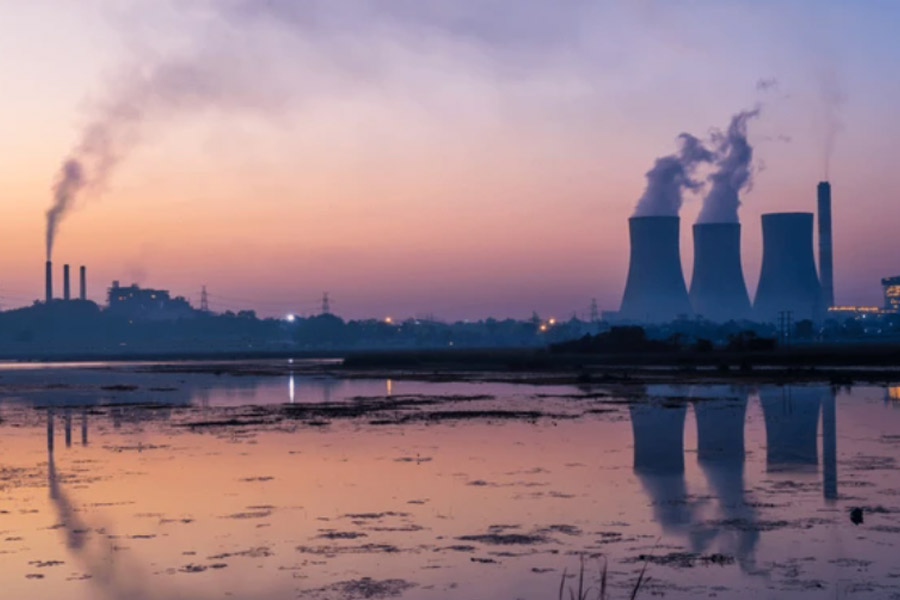
Some nations with ample coal-fired power plants can pivot relatively swiftly. A Wood Mackenzie analysis shows that in South Korea, which imports almost a fifth of its LNG from the Middle East, increasing use of its coal plants could allow it to fill its entire gas gap until summer. In Japan, coal could offset up to 70% of gas-fired power generation.
This retreat to coal power — which releases roughly twice as much carbon dioxide into the atmosphere as natural gas — risks derailing decarbonization timelines and climate goals. But in the interest of securing immediate industrial survival, many countries are plowing ahead.
In response to energy-supply disruptions, the South Korean government announced plans to lift its cap on coal-fired power plant use that had been in place to help protect air quality. Both Seoul and Tokyo have also indicated they would take steps to bolster nuclear power generation.
India is another major importer of Middle Eastern LNG that is likely to pivot significantly to coal, according to Wood Mackenzie. It has vast domestic reserves, and since the outbreak of the war, New Delhi has issued directives to maximize coal-fired output, ordering coal plants to operate at full capacity for three months starting in April.
China likewise possesses huge domestic coal reserves, which, alongside gas piped in from Russia and a world-leading wind and solar fleet tied to the world’s largest energy storage network, have shielded the country from the worst of the LNG supply shocks.
Other governments in the region have fewer options. Taiwan, which draws roughly 30% of its LNG through contracts with Qatar, has retired much of its coal operations in recent years, and its nuclear capacity has been phased out. A move to bring back mothballed coal plants would be time-consuming and expensive.
Still, for wealthier economies in Northeast Asia, the crisis will be expensive but probably more manageable because they can bid competitively for gas on the spot market, a venue for immediate LNG deliveries from the United States and elsewhere at market prices.
“Because they’re richer, they can resolve this with money,” Eurasia Group’s Gloystein said. Bigger economies like Japan, when in need, can snap up expensive cargoes from the spot market. “That will, of course, come at the expense of poorer countries,” he said.
Curtailing Use
In South and Southeast Asia, for countries such as Pakistan and Bangladesh, “it’s going to be more of a story of curtailments,” Toleman said. In that region, “countries really have to choose between the energy costs and effectively paying to import high-priced LNG or slowing the economy and cutting gas demand.”
The industrial toll is mounting. Sectors such as glass, steel and ceramics require high-temperature furnaces that run almost exclusively on gas. Fertilizer production requires natural gas as a primary ingredient for ammonia, making these plants among the first to shutter when supply vanishes.
Steel and fertilizer operations have been affected in Vietnam. In India and Pakistan, a shortage of liquefied petroleum gas has left millions unable to cook daily meals, forcing the closing of thousands of small businesses and restaurants.
Some governments are already starting to ration. The Philippines, which recently declared a national emergency because of surging fuel prices, has experimented with shortened workweeks, and Pakistan has closed schools to conserve energy. In India, gas distributors have reduced supply to one of the world’s largest centers for manufacturing ceramics, to give priority to residential needs.
The crisis arrives at a precarious moment in particular for Southeast Asia, which has seen a manufacturing boom in recent years as companies have adopted strategies to shift supply chains outside China. In Vietnam, which was already struggling to meet booming power demand, the gas shortage is a major headwind.
“The only way out, if you can’t fuel-switch, is pay or reduce consumption,” Gloystein said. In regions such as Southeast Asia, curtailment activity is likely to continue for years. Manufacturers in the region are “going to have to slow their investment and probably even shut down some factories,” he said. “It’s going to really hurt their industrial base.”
No Return to Normal
The longer-term question is whether countries that learn to live with less LNG in the coming months and years will choose to return to a fuel that has recently experienced two major supply disruptions — first during the 2022 Russian invasion of Ukraine and now because of the war in the Middle East.
In Asia, LNG has long been marketed as a “bridge fuel” — cleaner than coal, more reliable than renewables and capable of powering a region where, by 2050, energy demand is set to roughly double. Before the outbreak of the war in the Middle East, LNG demand in Asia was also forecast to roughly double by midcentury.
Those projections were set to give rise to a spree of new gas plants and import terminals across the region.
Now, “the entire concept of LNG being a reliable fuel is undermined,” Gloystein said. “It’s basically out the window because of the second serious natural gas crunch in five years.” The crisis is likely to spur more use of alternatives seen as less vulnerable to geopolitical shocks, such as renewable energy and nuclear power, he added.
For importers of LNG, the fundamental calculation has changed, Gloystein said. “Anybody at the moment who’s in a country or company that has plans to do gas-fired power stations is going to have to review these,” he said. “There’s going to be no return to normal even if the war ends.”
The New York Times