 |
Those were coal-oven days; only the rich households of Calcutta had gas stoves. A lower middle-class family like ours couldn’t even dream of using a gas stove. A daily image, still bright in my ‘childhood folder’: my mother setting up the oven and lighting it in the morning. It was an elaborate process that resulted in thin wisps of smoke slowly spiralling out from the top of the oven before becoming a thick pipe of white fumes that headed up into the morning blue. The fire took about 20 minutes to settle down after which ma started her cooking.
Rice, daal, a vegetable and a fish curry used to be ready by nine. My father ate and left for his office by half past nine. That was the routine till he retired from his job. Often, on Sundays and holidays, Ma left home for her Party meetings after putting on the rice. She gave me the responsibility of handling the rice and I was proud as she had trusted me over my studious brother, who was eight years older than me. I monitored the rice while Ma was busy convincing local people about the greatness of communist ideology.
Making the rice in a Bengali household is not that easy. “Properly cooked rice is perfectly boiled but not sticky. You should be able to count the grains,” my father often said. This is how I was initiated into cooking, when I was barely 10, and I’ve made perfect rice from day one.
Both my parents belonged to refugee families that migrated to Calcutta from East Bengal in 1946. This meant I was bred into the dialectical politics of Bengali food. Even during my childhood in the late 70s, the mutual contempt between Ghotis, the so-called original inhabitants of the city, and Bangals, the intruders, the refugees, was central to the city’s make-up. The heat was often felt in discussions on food. It was given that a fish-addicted race like the Bengalis would fight time and again over different recipes of cooking the same fish. When the Ghotis extolled the richness of a local recipe Bangals would dismiss it, insisting on the far greater subtlety of theirs. The debates could ignite to the point where Ghotis abused the Bangals, calling them “uncouth intruders”, the encroachers, only to face the retaliation of being called “lazy losers”.
Till the mid-80s this identity conflict was clearly visible around the game of football. East Bengal and Mohun Bagan are two of the main clubs in this football-crazy city and Bangals always identified with East Bengal while Mohun Bagan was the obvious choice of the Ghotis. Whenever these two teams met, Calcutta went into a state of frenzy. Again, the fish swam into the football: if East Bengal lost the game, Mohun Bagan supporters would come home proudly swinging a bunch of big prawns, golda chingri, in their hands. If the result was reversed, a couple of buttery hilsa would light up East Bengal supporters’ homes that evening. This phenomenon had an impact on the local markets, when the price of either chingri or hilsa would shoot up if the game produced a result. A draw would be a dampener for everyone — it left the supporters dissatisfied and the fish sellers, who would have stocked up in large quantities, losing money.
 |
“Bengal thrives on fish and rice.
Land full of rice and streams full of fish.”
Calcutta sits in the lap of one of the most fertile deltaic regions of the world. Through good harvest and disaster, through bounty and famine, the surrounding countryside has always supplied this greedy city. In one of his poems, Iswar Chandra Gupta lays out the lust the Bengalis had for fish. Knowing that moving from the sea to fresh water would make them tastier, he addressed the herds of pregnant Topshey fish.
“Swim against the flow
Leaving the salty sea
Dance your way to the river
Folk are waiting here to greet you
To have you I am ready to sell all my wealth.”
Across time, Calcutta has changed and the food culture of the city taken new turns. In the last two decades, western foods, like pizza, pasta, burgers, cheese, sausages and other frozen foods have acquired visas to enter Bengali middle-class homes. The new generations have embraced Kentucky Fried Chicken and speed-cricket over fish and football. The two big football clubs are now tied up with alcohol brands: ‘Kingfisher East-Bengal’ and ‘McDowell Mohun Bagan’. The Ghoti-Bangal conflict is subsiding fast under this consumerist culture. Flaunting a bunch of golda chingri or a couple of Hilsa would now be archaic, but the fish markets all over the city still thrive, as fish has remained an intrinsic part of the Bengali’s daily gastronomy.
There is a popular notion in the rest of India that the Bengalis spend half their lives in cooking and eating. No one has ever produced any data to authenticate this claim but it does give us an indication of the extraordinary attachment Bengalis have to food. What is interesting is that Calcutta didn’t have any Bengali restaurants till about 20 years ago — why would you go out to eat what could be made best by your mother at home? But now, with increasing numbers of people eating out, Bengali-cuisine restaurants have proliferated. Most of them are up-market, catering to the well-to-do and the tourists. On the menus you will find various traditional items like, Bhetki or Ilish Paturi (smoked fish in mustard and coconut paste wrapped in banana leaf), Chitol Petir Jhaal (portion of the belly of the fish cooked in a spicy gravy), Mochar Ghonto (finely sliced banana flowers cooked with mild spices), Kosha Maangsho (a rich mutton curry), Postor Bora (fried poppy seed balls), all of them served with pomp and style, many of them rich and elaborate dishes you eat at weddings and celebrations.
But there are other kinds of eateries which offer you authentic food far more cheaply. Pice ‘hotels’ are a Calcutta institution. Some are 70 years old, some nearing a hundred. Every item is priced separately, starting from a piece of lemon or a small earthen glass for drinking water to a belly piece of Chitol fish. The prices are low enough that even a lower middle-class person can afford a wholesome lunch here, but these places actually attract a great mix of clientele. Visiting a pice hotel for lunch, I have seen an elderly business executive in tie and jacket masticating a huge Katla fish head sitting opposite a construction labourer. On the benches next to me could be film-makers, theatre workers, small manufacturing unit technicians, sales people, old couples or taxi drivers. These places look shabby and a bit ancient but they produce a very affordable, authentic local cuisine that concedes nothing to the limited tastes of the wealthy or the tourists.
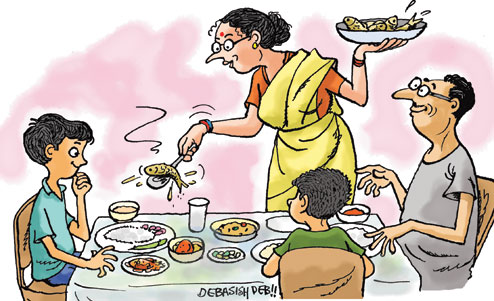
To move from the street to the home, the concept of the ‘joint family’ is taking a beating in Calcutta. Nuclear families are multiplying proportionately to the increase in the flats in multistoreyed buildings. But, be it a joint family or nuclear, the accepted norm is that the male children will stay with their parents even after marriage. So a family here will normally comprise father, mother, son, his wife and their children. In most families the kitchens are run following the ‘mother knows the best’ principle. Mothers decide the day’s menu, cook and serve the food to their family members. In spite of her failing health at the age of 79, my mother cooks too. It is a given that no one else even thinks of cooking some varieties of fish like Bujri Tangra, Bata or the small Pabdas. These are delicate operations and the chief lady of the house is the best person to do justice to them.
Even today a middle-class Bengali household will regularly have at least six courses if not more, balancing the ubiquitous fish with lightly cooked vegetables. Rice will be accompanied by shaak, some seasonal leaf mildly fried with spices or garlic, with kashundi, mustard sauce, on the side. Or you could have shukto, a finely balanced mix of bitter and sweet vegetables. This will be followed by daal being added to the rice, the fulcrum of any normal Bengali meal. Whatever fish will come after the daal, (or a mutton gravy if it’s a special occasion), rounded off by a sweet and sour chutney of tomatoes or green mango. Bengali sweets are legendary around the country, the confections very light and often based on chhana, cottage cheese.
Like most of the Bengali families we also ate fish every day of the week. My father used to visit the market early every morning to buy fresh fish for the day. We had no refrigerator then, so only the vegetables could keep for a couple of days. Fish had to be eaten by the evening itself. This led to close partnership between cook (mother) and shopper (father). It was an adventure to go with my father to the market. Slowly, I began to identify different types of fish, got to know which vegetables to buy (no cold storage or industrial farming in those days so most vegetables were strictly seasonal) for making a particular dish and so on. This was the much-needed knowledge that laid the foundation for my grasp of Bengali cooking. I have seen my mother cooking what we bought from the market, I remember seeing the raw material transforming and the taste of it while eating. This whole process was like an intensive course that educated me in Bengali cooking.
That generation of Bengali mothers has almost disappeared, the ones who knew the mantras of cooking, who formed a bridge between the vast rural tradition and urban complexities of Calcutta’s bourgeois cuisine. We never lived luxuriously or wastefully, but in that spare situation there was a hidden richness that has stayed with me in these times of supermarkets and processed foods. It is now up to us, my generation and the coming ones, to remember, construe and keep revitalising the age-old gastronomic culture of our land and city.
The author is a filmmaker based in Calcutta. He received the National Film Award in 2005 & 2010 for his documentaries, Under This Sun on biological diversity and related folk knowledge in India, and Johar Welcome To Our World on the indigenous food culture of Jharkhand. His other works include Bengalis in the World of Fish.