 |
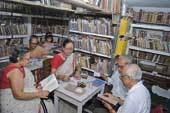
| Central Park Vidyarthi Pathagar. Picture by Rashbehari Das |
Jadavpur’s Central Park came alive with the 50th year celebrations of the Central Park Vidyarthi Pathagar, which brought together members in the parking lot of 8/3 Central Park on May 24.
Partho Pratim Gupta, the librarian, had painstakingly put together the library’s history on large coloured chart-papers, written in a clear hand. On a table in a corner sat file-bound volumes of the library’s history. And not even a heavy morning shower could dampen the spirit.
Central Park Vidyarthi Pathagar is not your ordinary neighbourhood library. It goes back to 1929-1930. Set up by Bina Das and Kalyani Das, Bengal revolutionaries and daughters of Benimadhab Das (mentor of Subhas Chandra Bose during his student days in Cuttack), it was an off-shoot of Chhatri Sangha and went by the name Chhatri Pathagar in its initial years.
Kamala Dasgupta, Ujjala Banerjee and Dhira Das had set up the organisation with the Das sisters. In the beginning it was an all-women organisation. And in the years to come, the library, which started its journey from the Ashutosh Building, Senate Hall, would travel to seven other locations before settling down at 15/3/1 Central Park, Jadavpur.
Spread over a cosy 200sq ft at 15/3/1 Central Park, the library has 80 members. Bengali literature forms a major part of the library’s collection. Rare volumes like Modern Reviews, Basumati, Bharatbarsho and Aamar Amerikar Abhigyata (second part) by Bhupendranath Datta, brother of Swami Vivekananda are housed in it. The library maintains a proper index and a catalogue. The spirit of shechha shrom (voluntary work) keeps the gang of veterans like secretary Nandita Sanyal, treasurer Sankar Sanyal, president Amarnath Ghosal, vice-president Jayasree Sen and librarian Gupta going.
The library buys 100 books every year. “We have a budget of Rs 4,000 to 5,000,” says Sankar Sanyal.
Connecting with the residents of Central Park also features on the library’s priority list. “During Puja, we put up a stall with new books,” says Gupta. A bulletin carrying news of the library, wall magazines, drama, singing and painting contests are also part of the library’s programmes. “We give away awards to students for academic excellence,” said Gupta.
Space crunch is a major problem. “We want to have a reading room where people can come, sit and read,” said Gupta. Some of the old books, which find few takers, are being sold at Rs 2 apiece to make place for new ones.
Against aping
Artist Jeet Ganguli lives the good life. He stays in Goa and exhibits in Mumbai, often to the who’s who of Bollywood. He works in bursts, working with manic speed as the day for an exhibition approaches, or not looking at a canvas for months.
His subjects are a critique of materialism and how a mindless aping of the West is robbing Indians of their true identity. “I work mainly with acrylic. Earlier I was into oils. But I will have to change. If the thought becomes repetitive, it fails to interest me,” said Ganguli.
There’s a sweeper at work, a taxi driver merging into the dark, a handpulled rickshawallah, a slum child. The paintings almost all have a barcode, an image of a foetus and the DNA.
So which famous walls do his paintings grace? “Lara Dutta and Dino Morea have bought my work,” he said.
And when he has finished work on the canvas, Goa is the perfect place to be. “It is still idyllic. You can retreat behind your door and shut out everything that is happening in the world,” Ganguli added.