Bandhs are in! Addas are on their way out! Both, though, have made it to the eleventh edition of the Concise Oxford English Dictionary — along with “filmi” and a whole lot of other words of desi origin. Breaking the good news recently in Calcutta was a visitor from Oxford, Judy Pearsall, publishing manager of OUP, while presiding over an adda session of sorts at HHI.
I couldn’t make it because I was caught up at an adda with teachers of a school, where the session oscillated from Telgi’s future to Dhananjoy’s past and Olympics present. Like all adda sessions, there was no stopping; there were no conclusions and no winners.
That’s what sets a Calcutta adda apart. There are no rules, no agenda, no dress code, no minutes, no decisions. What, then, is an adda and how important a role has it played in the life of a city that turns geo-sense on its head? Calcutta, you will agree, has more hours in a day than any other city in the world, many more than the customary 24!
Pratap Kumar Roy, a former newspaper editor, has this most delightful of definitions to offer: “It is a long talking session, commonly of a recurrent sort, among friends or co-activists. It is not simply a conversation or discussion, or debate or gossip and, yet, it is all of these. It ranges over a variety of subjects — war, theatre, Hindu philosophy, or why Bengali Brahmins eat fish. It is certainly not idle gossip, as the participants are usually well-informed and witty. But what is it if not fundamentally idle or unproductive?”
“Unproductive” it is not, because a good adda invariably sets your creative juices flowing — perhaps because you have nothing to lose or gain, perhaps because you are both relaxed and alert at the same time.
 |
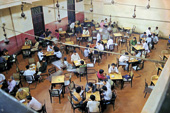
| The Coffee House on College Street: Hours of idle exchange |
Unproductive it hasn’t been for me. Twenty years ago, a “meaningless” adda session with my cricket superior Mudar Patherya on which cricketers would make it to the Best Capricorn XI and which ones had played for more than one country, resulted in a leading publisher producing a book edited by us, entitled The Penguin Book of Cricket Lists. Nine years ago, an “aimless” adda with colleagues in a staff room, on legendary teachers and courageous students, resulted in The Telegraph School Awards for Excellence seeing the light of day.
Many a productive and regular adda has inspired the words to flow from the pens of many a genius wordsmith. In days gone by, every regular publication had an adda — informal sessions through the day to discuss what the magazine could include in its content. The Kallol adda had the likes of Nazrul Islam and Premendra Mitra. Like all addas, people popped in and out and stayed on for as long as they wanted. While the radicals set the pace at the Kallol adda, the conservatives touched base at their haven: Shanibarer Chithi. Chilling out at this magazine’s addas were the likes of Bibhutibhushan Bandyopadhyay and Parimal Goswami. Then there was a toned-down adda — Parichay. A magazine, not-just-literary, it was the work of high IQed intellectuals and benefactors with editor-poet Sudhindranath Dutta playing catalyst. Their sessions must have been some addas!
The talkers and listeners included Oxonians like Humayun Kabir, whom a young Jyoti Basu defeated in his first election half-a-century ago; there were also reps from Cambridge, like Malcolm Muggeridge, then assistant editor of The Statesman; in artist Jamini Ray, they had a passionate participant, while scientist Satyen Bose, was “the greatest addabaj” of them all.
Even Saratchandra was a real addabaj along with Tushar Kanti Ghosh. They were part of less animated sessions at brainstorming binges at M.C. Sarkar’s, the publishers of the children’s magazine, Mouchak. An out-of-the-ordinary addabaj was the humorist Rajsekhar “Parashuram” Basu, an organised let’s-not-fool-around type. Even he found the time to be a part of the conversational circle, such an intrinsic part of life in Bengal.
Sukumar Ray, of course, found plenty of time to give the adda its first organised avatar, through his Mawnda (Monday) Club. For a four-anna membership fee you could be a part of this exclusive gathering where even nonsense was an art form and no art form was nonsense.
At the Coffee House on Chittaranjan Avenue, while the tables in the House of Lords were witness to discussions on art forms and no-nonsense, with the likes of Satyajit Ray, Chidananda Dasgupta and Samaresh Bose calling the shots, those in the House of Commons section, listened in to sweet nonsense from the more common man.
How, I am sure you want to ask, did the concept of adda begin? The most acceptable theory of its origin appears to have a rural slant. After a hard day’s work, villagers would meet for a chat at the Chandimandap where functions and discussions were usually held. The general belief though is that these sessions were mostly restricted to problem-solving and did not have the modern ingredients of a real good adda — a pinch of gossip and a dash of truth with a sprinkling of masala.
Gradually, new elements were added as the adda wound its way into cities and towns and on to “rowaks” — the little platform in front of the house. As the years rolled on, “rowak” was anglicised to “rock” — and that’s where the most authentic para addas orchestrated by the most die-hard rock-bajs still happen!
The down-to-business Delhi’ite and forever-mobile Mumbaikar often take jabs at us, laidback Calcuttans, saying that our energy is boundless, but our inertia is endless. They tease us for being Life Members of the NATO Club — No Action, Talk Only.
But we — we don’t worry! For us, their comments aren’t important enough to even get a mention at the most meaningless of addas. For us, we will continue to use the adda as our perfect platform to relate, relearn, retort, reiterate, restate and recycle as we relish each session to rejuvenate ourselves. So relax, and let it remain!
Speakeasy
Most ‘informed’ addabaj: Mr Gulab of V. Gulab, in New Market
Strengths: Knows everything about everyone and every event; speaks in gossipy, hushed tones.
Weaknesses: Never gossips; never adds masala; like his silverware, his sessions are too polished!
Most versatile addabaj: Basudeb Bhattacharya, Principal, Haryana Vidya Mandir
Strengths: Is 65, but can swing to even 25; plenty of variety as he is a published poet, ghazal singer, fluent in three languages; his jokes and diet include the vegetarian and the non-vegetarian.
Weaknesses: Is often too fair; not a born Calcuttan — has not yet developed the biased streak, so vital for a stormy session!
Best informer addabaj: Jamal of Bihar roll ‘shop’
Strengths: Crisp one-liners while serving roll-eaters; abreast with what’s happening next door in the Corporation office as well as what’s up in one of his former saab’s offices in Sydney.
Weakness: Gives same khabar at every session!
Best forced addabaj: Mothers of students of South Point School
Strengths: Very innovative in venue-selection and management — newspapers spread out on pavements and rented room with fan and FM for a few hours while they wait.
Weaknesses: Not much variety in sessions — topics restricted to K-serials, children not having cereals, and husbands’ bosses behaving like serial killers!