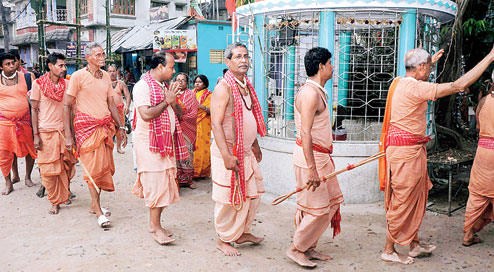

While Chaitra Sankranti marks the end of another Bengali year, it is also the end of Gajan, a period of penance to Lord Shiva. Devotees of Shiva, men and women alike, take sannyas or mendicancy in the month of Chaitra as a pledge to Lord Shiva.
They fast through the day, taking a single meal of boiled rice and vegetables or fruits at night. Through the period of sannyas, they visit people’s homes around the village where they bless them and pray for them.
Over time, however, many of these traditions have changed. Instead of a month-long fast, they cut it short to a week or five days. Gajan and Charak are celebrated in various places in Howrah. Baksara Charaktala got its name from this festival. A grand festival and fair is organised here on the day of Charak. The sannyasis in Panchanan, Baksara Charaktala strongly believe in following the rituals strictly, five days prior to Charak.
“The length of the fast depends on personal ability. A devotee can take sannyas for a minimum of five days or can keep it for a month, depending on how long he or she can sustain it,” said Roop Kumar Ghosh, the chief sannyasi at Panchanan temple at Baksara Charaktala. “The temple is over 500 years old. The Shivalinga is also different from the usual ones. Baba Panchanan is believed to have risen from a pond,” said Ghosh. The Shivalinga is tall, like a kasthi pathar (touchstone) pillar and not rounded at the top. The locals have immense faith.
The Gajan utsav at Baksara Charaktala takes place at the Panchanan temple. This year there were 85 Gajan sannyasis, including women. The sannyasis must wear a thick white thread around their necks. “We have to eat boiled food that is prepared on an earthen hearth behind the Shiva temple. We can eat just one meal,” said Rabindranath Ghosh, another sannyasi. They beg for alms, going door to door in the neighbourhood. “We are cordially received in various neighbourhoods and they often give us huge quantities of rice grains, vegetables and other things,” said Rabindranath. Different rituals start from five days prior to Charak. “One day, we visit all the temples and offer prayers. On another day, we eat only fruits,” said Shankari Prasad Roy, a sannyasi.


The jhanp or dive, takes place on the day of Charak, after taking a dip in the pond behind the temple. “This starts early in the morning. The women take a dip in the pond and come to the temple performing dandi. The men follow later,” said Rabindranath. Jhanp can only be performed by the men. The bamboo structure from where the jhanp is taken is about 20 feet high. “The chief sannyasi decides who is fit to jump from that height. Elderly members and women are not allowed to do it,” said Rabindranath.
Apart from Baksara Charaktala, sannyasis do the jhanp at other places too on days other than the Charak. “We perform jhanp at Dakshinroytala in Santragachhi and also at Bishalaksitala in Baksara,” said Shankari Prasad Roy.
At Dakshinroytala near Santragachhi, the temple is believed to be over 300 years old. “The temple was originally of Dakshin Roy the tiger god, who is worshipped in the Sunderbans. Later, as more people started settling here, it was converted into a Shiva temple. The Charak festival was started by the predecessors of Ramcharan Sett, a wealthy man of Ramrajatala,” said Sujit Bhaduri, a local resident and also the secretary of Santragachhi Sporting Club that looks after the temple.
Five days prior to Charak, another temporary Shiva temple is made next to the Dakshin Roy temple. Shiva is referred to as Buro Shiva in this temple. A ghot is placed at both temples and devotees take sannyas. Puja takes place in both temples simultaneously. The day after, the sannyasis perform jhanp. “This is conditional. The purohit places a flower on both Shivalingas. While he performs puja, the sannyasis dance to the beat of the dhak. They continue to dance till the flowers fall from the Shivalingas. Only then can they perform jhanp,” said Bhaduri.
The jhanp takes place from a height of 10 feet. On the day of Nil puja, the day before Charak, the local women offer prayers at both temples. Devotees believe that Shiva and Durga were married on this day. A wedding ritual is performed at a local resident’s house in the evening. The sannyasis make the rounds of Howrah town on the day of Nil puja and Charak. “We start from Mullickphatak and try to visit all the houses on the way,” said Prabhat Pal, the chief sannyasi at Dakshinroytala.
On the day of Charak, devotees offer prayers at the temples. The first offering, however, comes from the descendants of Ramcharan Sett.
The one-day Charak mela is organised on Chaitra Sankranti and the area around Howrah Homes is chock-a-block as people visit the fair and also watch the sannyasis take the last jump. At the Dakshinroytala Charak, the sannyasis jump on fire and on thorns.
Jagachha Charakdanga Math is known for the Charak mela that is organised every year on Chaitra Sankranti. The mela is estimated to be about 55 years old. A Sitala temple is where the puja takes place, five days prior to Charak. Although the rituals of Gajan and Charak are not followed here, an elaborate fair is organised on the last day of the year. Like a typical village fair, nearly 150 stalls come up around Charakdanga Math where clay dolls, bangles, jewellery, toys, jalebis and a variety of other fare are sold. “This is one of the most popular village fairs and by evening, there is hardly any place to stand and it continues till late at night,” said Bholanath Sutradhar, the joint secretary of Jagachha Azad Hind Sangha, the organiser.