A total of 146 Bangladeshi nationals who had entered India illegally returned to their home country voluntarily in the past few months through the border under the jurisdiction of the BSF’s north Bengal frontier, compared to 43 last year.
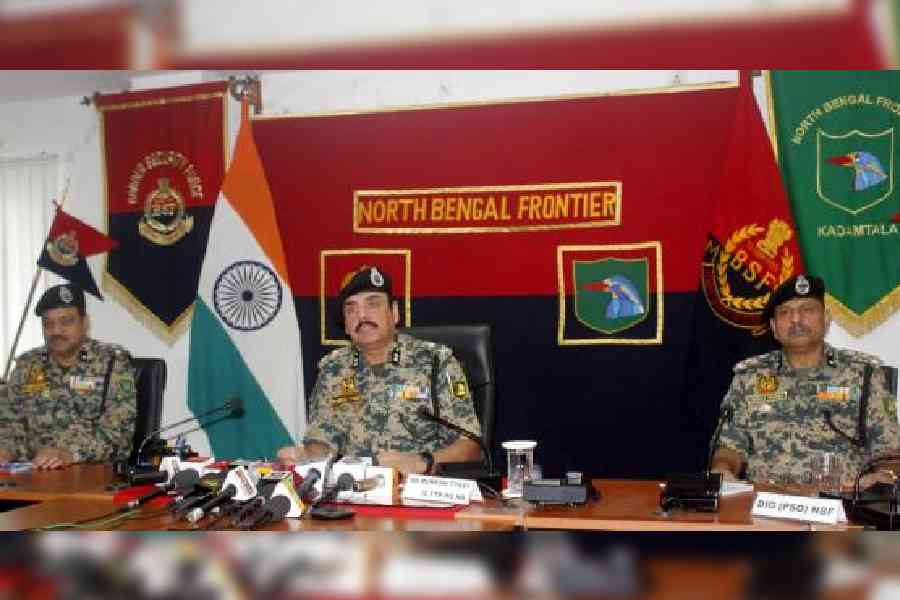
“Over the past four-five months, 146 Bangladeshi nationals willingly returned to their homeland through the border under our jurisdiction,” Mukesh Tyagi, the inspector general of the BSF’s north Bengal frontier, said on Thursday. He was addressing the media at the frontier headquarters in Kadamtala on the outskirts of Siliguri.
Asked whether the ongoing special intensive revision (SIR) of the voter list had prompted the Bangladeshis to return to their homeland, Tyagi said: “I don’t think the SIR was the reason behind the return of these Bangladeshi citizens, as the exercise started hardly a month back. But we recorded these numbers over the past four to five months.”
A BSF officer said all the returnees were infiltrators. He said the number of infiltrators who had returned to Bangladesh this year was significantly higher. "Last year, 43 Bangladeshi intruders had returned to their homeland through the border under the jurisdiction of the BSF's north Bengal frontier," said the BSF officer.
All these intruders were staying at different places in India.
The frontier guards the India-Bangladesh border in North Dinajpur, South Dinajpur, Darjeeling, and Jalpaiguri districts, and in most parts of Cooch Behar district.
A source said the frontier guarded approximately 936km of the international boundary, with around 88 per cent fenced, while 56km are riverine stretches. Tyagi highlighted the initiatives undertaken in recent years to enhance the security architecture.
Among the key measures are installation of the New Designed Fence (NDF), which stands 12 feet high — considerably taller and more secure than the existing 8-foot-high fencing. “The new fencing is anti-climb and thicker, making it difficult to cut. So far, nearly 250km of the border has been covered with NDF,” Tyagi said.
He added that the BSF was also using the Finger Identification Portal (FIP) to maintain biometric records of individuals apprehended or pushed back into Bangladesh. This helps identify repeat offenders and expedite the handover of Bangladeshi nationals to the Border Guards Bangladesh (BGB), a process that now typically concludes within 12 hours of nationality verification.
The BSF has additionally increased engagement with villagers along the border to ensure early reporting of infiltration cases.
Asked about “Chicken’s Neck” or the Siliguri corridor, which is the thinnest stretch of India, Tyagi said the BSF had intensified security in the strategic area.
“Around 75 per cent of the India-Bangladesh border along the Chicken’s Neck is now secured with NDF. Surveillance capabilities have been strengthened through the deployment of drones and PTZ (Pan-Tilt-Zoom) cameras, which enable remote long-distance monitoring and real-time tracking,” said the IG.
The senior officer also furnished details of the contraband items worth ₹8.5 crore, which had been seized from January to November this year.
During the same period, the BSF apprehended around 600 individuals, both Indian and Bangladeshi nationals, in various border-related incidents, he said.