 |
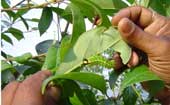
| Cash cocoon:A farmer displays a silkworm on a mulberry leaf. Picture by Himangshu Ranjan Deb |
Jatin Barman is no pin-up star, but the district sericulture department is hoping his small-screen debut will help inspire prospective caterpillar cultivators.
Just ?another poor farmer? till five years ago, Burman swapped traditional crops like jute and tobacco for rearing silkworms of the mooga fabric variety on his five-bigha plot at Barabhita village in Dinhata subdivision.
There has been no looking back since. Today, Burman has not only succeeded in providing his family with a better life but also has savings to show. And Burman?s rags-to-silk story has even inspired a documentary film which was screened here yesterday. Titled Sonar Phasal Mooga, the documentary depicts a proud Barman as a role model.
District officer of the sericulture department Supratim Das said the government has decided to promote rearing of silkworms, which yield mooga, intensively in Cooch Behar.
?The film is an effort to encourage other farmers to take up the profession,? Das said.
He said Namesh Sikdar, an Alipurduar resident, had made the movie. The film, while extolling Barman?s perseverance and skill, shows the audience how to go about producing the silk.
From tending to the mulberry leaves and taking care of the silkworms to harvesting the cocoons, all aspects have been woven into the script.
Joint director of the sericulture department, north Bengal, Pranab Chattopadhyay said Barman had given up traditional farming and taken up an alternative.
?This tale of success would not have reached farmers if the film had not been made. Many would have dismissed it as a concocted story,? he said.
The film is slated to be taken to all north Bengal districts to give the manufacture of mooga silk a fillip
Barman, who was present at the screening yesterday, even fielded questions by enthusiastic farmers raring to taste silk success.
?I suffered huge losses while I was involved in traditional farming. A relative of mine asked me to get in touch with the sericulture department. That was in 1998. I have never regretted my decision. Today I make over Rs 35,000 annually and provide well for my family,? Barman said.