

Santiniketan: Wood apple: 350 pieces, fenugreek seeds: 15kg, urad dal: 40kg, jaggery: 60kg, myrobalan: 20kg.
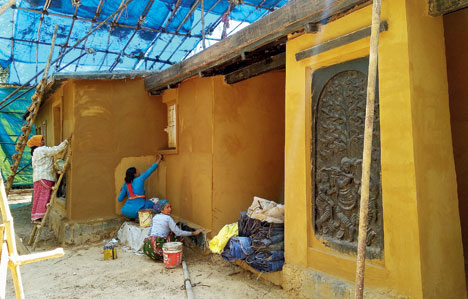
The list is not for a recipe of a little-known exotic dish but of some of the organic items being used by the Archaeological Survey of India (ASI) to renovate and restore Shyamali, Rabindranath Tagore's mud house and summer retreat in Santiniketan.
The house, built in 1935 and one of Tagore's five in the Uttarayan complex, is finally being repaired by the ASI after it was found badly damaged in 2012 following years of water seepage and corrosion.
The central agency is trying to complete the work before the monsoon and hand it over to Visva-Bharati. The varsity authorities had appealed to the ASI in 2013 to renovate the structure and given it around Rs 50 lakh in 2014, but the agency could not take up the work then.
In the final stages of the renovation, the ASI decided to procure organic materials used for centuries to build strong mud houses before the method became obsolete around a century ago.
"Every item was chosen after tests and high-level discussions with multiple experts," said a senior ASI official.
Sources in the ASI said each item being used added to the strength of the house. They said the extract of wood apple is a strong adhesive, juice from fenugreek seeds and myrobalan are anti-insect agents, jaggery used with mud helps in tightening the rooftop and urad dal is a light adhesive. Other materials, such as banana trees and jute, are also being used.
"We are happy to know the ASI is using organic materials. We also wanted this treatment so that the bard's summer abode retains its originality. We are hopeful of getting the house back from the ASI before the monsoon," said Sabujkali Sen, the officiating vice-chancellor of Visva-Bharati.
Sources in the ASI said they went through several plans to renovate the house but work was stalled because of the difficulty in finding an efficient engineer with expertise in mud constructions.
In December last year, the agency deployed Sekhar Kumar Dutta, one of its assistant superintendent engineers posted in Guwahati.
Varsity officials said Dutta had earlier played a key role in renovating 27 houses and structures at Visva-Bharati, including Chaity, a mud structure on the Patha Bhavana premises.
After Dutta took charge, he decided to give Shyamali a complete organic treatment to ensure a longer life. The ASI then hired hundreds of tribal women from Bankura and Birbhum, with expertise in building mud houses.
"After several tests, we decided not to use any modern chemicals. Shyamali is a very typical mud house because of its mud roof. We did not want to use cement or iron rods in the building or modern adhesives. So, we decided to go all-organic to strengthen the house and restore it to its original glory," Dutta told Metro .
The ASI officials said they have been using three different types of soil, in various layers, in renovating Shyamali.