 |
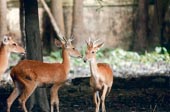
| Brow Antlered deer at Alipore zoo. Picture by Amit Datta |
The Alipore zoo is hosting a study aimed at preserving an endangered variety of deer in captivity. The animal is found in nature only in a national park in Manipur.
Brow Antlered deer — or Manipur dancing deer, as it is popularly known — is listed under the Schedule I of Wildlife (Protection) Act and identified as “critically endangered” in the Red Data Book of the IUCN, an international wildlife-related umbrella organisation.
Around 100 Brow Antlered deer have been spotted in Manipur’s Kaibul Lamjao National Park, the only natural habitat of the animal. In captivity, there are around 170 such animals in 16 zoos across the country.
“The number of animals in nature has hardly increased in the past 50 years, as revealed by the Zoological Survey of India census. That explains the need for an effective conservation programme for those in captivity,” said Subir Chaudhuri, the director of Alipore zoo and research supervisor of the project.
“The Rs 9-lakh project related to conservation and breeding of the animals in captivity has been undertaken by the Central Zoo Authority and covers four zoos in Calcutta, New Delhi, Guwahati and Manipur,” said Chaudhuri.
The study has already started at Alipore zoo, which has been selected as the nodal agency of the two-year project. The zoology department of Calcutta University and the Hyderabad-based Centre for Cellular and Molecular Biology are partners in the scheme.
Scientists say that as most of the captive Brow Antlered deer carry the lineage of only two pairs of animals, brought to Calcutta and Delhi zoos in the 50s and 60s, they run the risk of carrying genetic defects.
“Many of the animals in the zoos may have high-inbreeding or kinship error. The study aims at finding out the extent of the error and draw up a conservation plan accordingly,” said a scientist associated with the project. Inbreeding or kinship errors are genetic defects resulting from mating among members of a genetically close family of any animal group.
“Our ultimate aim is to release some captive animals in nature,” said Choudhuri.