 |
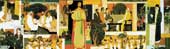
| A mural by Amit Sarkar based on the life and times of Rabindranath Tagore in the gallery of Parliament House, damaged by years of neglect. |
Artist Dhirendranath Brahma has returned to Calcutta an unhappy man. In Delhi last week as a guest of one of his students, the octogenarian had the chance to fulfil a long-cherished dream of seeing the two murals he had executed for the Parliament.
Only, he found that the murals on which he had devoted some of the best years of his career ? Panel No 17 showing the aswamedha yajna by Pushyamitra Sunga (2nd century BC) in which Patanjali officiated as priest over the sacrifice of a horse, and Panel No 18 ? showing Heliodorus as an ambassador in the court of King Bhaagabhadra of Vidisa (2nd century BC) ? were nearly unrecognisable.
The murals he had spent ?nine tireless years to complete? had darkened with age or exposure to smoke from an adjoining canteen.
?The ceiling had just received a coat of whitewash and some drops of it had been carelessly sprinkled on the murals,? says Brahma. ?Painted directly on masonite boards provided by the government the murals had been shoddily enclosed in aluminium frames and fixed directly to the wall. The paintings near mine and one of my own murals have been affected by damp.?
To decorate ?the modern temple of democracy, i.e. the Parliament House? in the tradition of decorating the temples and palaces of ancient India had been the brainchild of GV Mavalankar, the first Lok Sabha Speaker.
In 1951 a planning committee was appointed with the Speaker as chairman and a host of prominent MPs, eminent scholars, archaeologists and historians as its members.
The committee drew up a detailed plan to decorate the corridor on the ground floor of Parliament House at an estimated cost of Rs 3 lakh. The artists were given coated boards measuring 12 ft by 4 ft and Windsor Newton colours.
All paintings had to be in the egg tempera medium and subject to approval of the committee. Government honorarium to artists for the murals, according to Brahma, had been Rs 250 for approved layouts and another Rs 250 for completed works.
Among the 124 listed panels are the names of many well known artists from Bengal, some of whose works are snapped up for lakhs. Artists like Indra Dugar, Sushil Chandra Sen, Satyen Ghosal, Dhirendranath Brahma, Biswanath Mukherji, Suhas Roy, Ganesh Haloi, Indu Rakshit Satyaloka, Bimal Das Gupta, Amit Sarkar, Amulya Gopal Sen Sharma, Ajit Krishna Gupta and others were all there.
?The mural gallery is unclean and ill-lit. There are broad scratch marks on the surface of my mural. Perhaps the bamboo structures used during the whitewashing have grazed it,? said Brahma. He intends to write to Lok Sabha Speaker Somnath Chatterjee, but adds resignedly, ?What is the use? The harm is done already.?
But others disagree. Ganesh Haloi, who finished his 12-by-4 mural in 1982, calls for urgent efforts at restoration and preservation.
He hasn?t visited the Parliament since his mural was installed but hearing about the damage, he said: ?It is not surprising, the location of the murals exposes them to oil, dust and gas pollution. It is not enough just to hang the paintings, there should be someone to take care of them,? he said. He did a good deal of research for his mural (Panel No. 124) on Netaji?s life.
?I had read up quite a few books, visited the museum at Netaji?s residence,? said the artist.
Amit Sarkar, whose mural Panel No. 74, is on the life of Rabindranath Tagore, said: ?Expert help should immediately be taken to restore the damaged paintings and prevent further damage by curing the damp and providing a basic glass covering over all works etc.?
Ill health forced Suhas Roy to take a long time over his mural (1982-1996) on the ancient Indian surgeons Charak and Susruta. Then ?some students from Santiniketan helped out,? he said. He hasn?t felt the need to check his work, because he feels ?I did my work well and taking care of the mural should be their problem?.