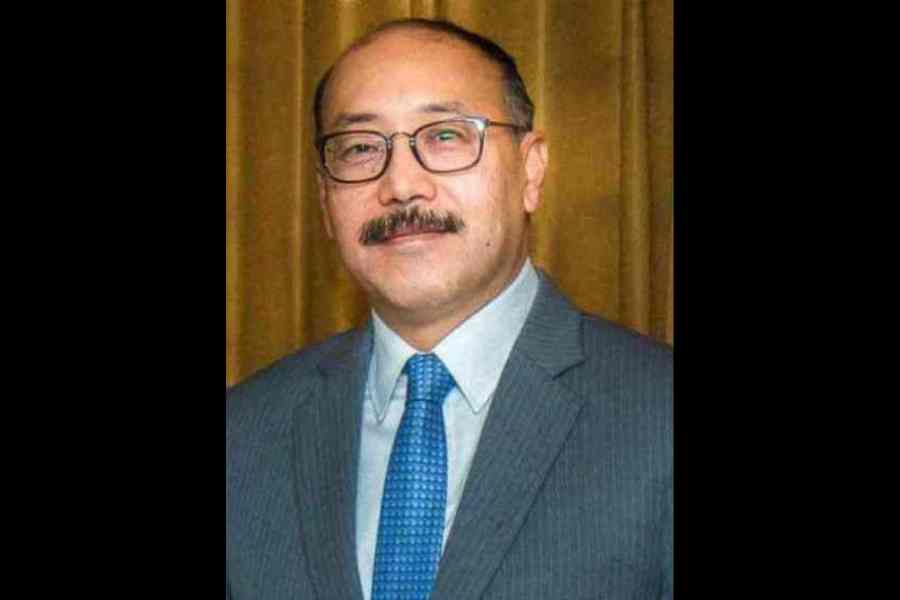
Rajya Sabha member Harsh Vardhan Shringla has sought the Centre’s intervention to make the central government health scheme (CGHS) more accessible to the Darjeeling hills and north Bengal as a whole.
On Monday, speaking in the Upper House of Parliament, the former diplomat-turned MP said that though over two lakh central government employees, pensioners and their dependents resided in north Bengal and Sikkim, they had to make do with one CGHS wellness centre in Siliguri.
“A large section of these beneficiaries comprises senior citizens, widows, retired personnel and patients suffering from chronic and critical illnesses who are entirely dependent on CGHS for timely and affordable healthcare. Despite this substantial population, only a single CGHS wellness centre is currently functioning at Siliguri, making access to healthcare extremely difficult for residents of the hills and remote areas,” Shringla told the Rajya Sabha.
He pointed out that there was no CGHS wellness centre in Darjeeling town. Beneficiaries from Darjeeling, Kalimpong, Kurseong, Mirik and other areas have to travel anywhere between 80km and 120km to avail basic CGHS services.
“I would request the establishment of multiple CGHS wellness centres in Darjeeling, Kalimpong, Kurseong, Mirik, Bagdogra, Naxalbari and Sikkim to ensure last-mile access to primary healthcare. Also, immediate empanelment of more private hospitals, diagnostic centres and nursing homes in both the plains and hills, and creation of an office of an additional director of CGHS in Siliguri would help in addressing the situation,” the MP added.
He also urged the Centre to expedite the shifting of the existing CGHS wellness centre in Siliguri to another building approved by authorities, citing that the current rented area was congested and unsuitable for elderly and sick patients. He also sought empanelment of tertiary care hospitals of the region to ensure people's access to specialised treatment.
Swachh funds
Raju Bista, the BJP MP of Darjeeling, shared details of funds allocated to Bengal under the Swachh Bharat Mission Urban (SBM-U) scheme, meant for solid waste management in civic areas.
He also questioned the Bengal government's performance in the utilisation of such funds.
“Despite higher allocations in SBM-U 2.0 to the state, Municipalities in our Darjeeling hills, Terai and Dooars are yet to benefit,” he said in a statement.
The MP also referred to an answer made in the Lok Sabha by Kirti Vardhan Singh, the Union minister of state for environment, forest and climate change, on Monday.
According to the minister's reply, ₹911.34 crore was allocated to Bengal in the first phase of SBM-U between 2014 and 2019. This increased to ₹1,449.30 crore in SBM-U 2.0 from 2021 to 2026, of which the Centre released ₹577.7 crore so far.
“This allocation for the solid waste management component will help urban local bodies of Darjeeling, Siliguri, Kurseong, Mirik and Kalimpong access central support to set up material recovery facilities and waste-to-energy plants,” said the MP.
He said that in the ecologically fragile and tourism-driven regions like the Darjeeling hills, the Terai and the Dooars, municipalities can improve source segregation, remediate legacy dumpsites and adopt terrain-appropriate technologies to curb open dumping.