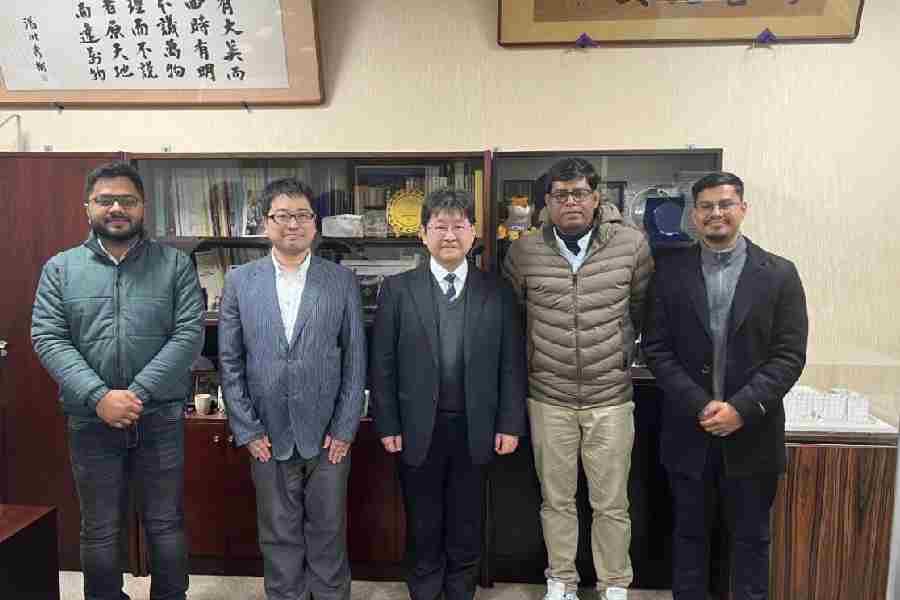
The North Bengal University (NBU) has entered into a partnership with Osaka University of Japan for research collaboration and academic exchange in chemical sciences.
On June 15, the chemistry department at the NBU signed a comprehensive academic agreement and memorandum of understanding (MoU) with the chemistry department of the Graduate School of Science, Osaka University.
However, the NBU formally celebrated the partnership on Tuesday in the presence of faculty members, research scholars and students. Senior representatives from Osaka University joined the programme virtually.
NBU officials believe the partnership will enhance the international profile of the oldest university in north Bengal, strengthen academic ties between India and Japan and generate research outcomes with global relevance.
“The pact seeks to strengthen scientific cooperation between the two institutions through joint research, faculty interaction and student mobility,” a source said.
Officials said the agreement would create opportunities for postgraduate students, doctoral researchers and faculty members to participate in exchange programmes and work in international research environments.
Bhaskar Biswas, the acting registrar of the NBU and coordinator of the exchange programme, said the partnership would encourage collaborative research and advanced training in emerging areas of chemical sciences.
“The two institutions would also explore the shared use of laboratory infrastructure and expertise to address scientific challenges,” he said.
“The agreement grew out of academic discussions between senior officials of Osaka University and me during a visit to Japan under the Sakura exchange fellowship administered by the Japan Science and Technology Agency in January this year. Those discussions eventually led to the formalisation of the partnership,” he added.
Bikash Chandra Paul, dean of the faculty council of science at the NBU, described the agreement as a landmark initiative for the university.
“Partnering with the Graduate School of Science at Osaka University will offer life-changing opportunities for students and researchers. It will help them gain international exposure, understand different academic cultures and build professional networks,” he said.
Representatives of Osaka University also welcomed the partnership and said it would focus on collaborative studies in chemistry and allied disciplines, besides encouraging regular academic interactions through seminars, workshops and conferences.
“The agreement would provide a framework for sustained cooperation between the two departments and help create opportunities for young researchers to engage in international scientific work,” said Nobuto Yoshinari, coordinator of the exchange programme at Osaka University.