 |
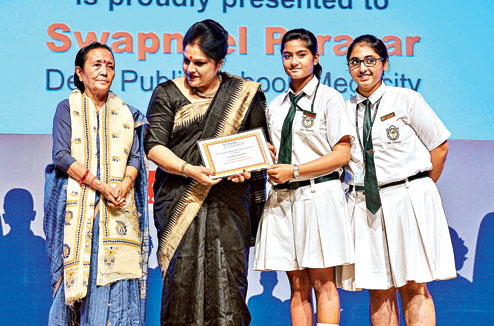
| Anuradha Koirala (left) at the 19th edition of The Telegraph School Awards for Excellence. |
She greets you with a smile so disarming and words so warm that it’s easy to miss the fire in this petite 65-year-old woman’s eyes.
But spend a few minutes with Anuradha Koirala and you know why this crusader against human trafficking is the force behind Maiti, a campaign to protect Nepalese girls and children from exploitation.
To those whose lives Anuradha has touched over the years, she is their saviour, a guardian angel who has made it her mission to give them shelter, love and the opportunities they deserve. To those who know her personal journey, Anuradha is a survivor, a role model for every woman pushed to the precipice.
Anuradha, who was in town recently for the 19th edition of The Telegraph School Awards for Excellence, recounted to Metro how miserable her own life was a few decades ago until she decided to stand up for herself.
“My husband brought another woman home after 30 years of our marriage. I left him and went away with our son. Otherwise, I would have had to stay with another woman and be beaten. I was not prepared to let him prolong the pain that he had already caused me. It was my turning point.”
After being estranged from her husband, Anuradha would visit the Pashupatinath temple every day looking for “peace of mind” and come back wondering whether she wasn’t more fortunate than the scores of women she would see begging outside the shrine.
“Nepal had just transitioned to democracy and people were talking about rights — child rights, women’s rights, human rights. When I spoke to some of these women, I figured that either their husbands had left them for polygamy or they had died and their in-laws had banished them to the streets. They looked healthy and I asked them why they didn’t work. ‘Who will give me a job?’ that used to be the standard response,” she recalled.
Her interactions were the trigger for Anuradha to help women deserted by their husbands rebuild their lives and become independent. “These women were ready to stop begging if I helped them find a job. They also feared for their daughters, more so because the area around Pashupatinath used to be a haven for drug dealers and there was every chance these young girls would be exploited.”
Thus began Anuradha’s journey into a murky world where girls were being trafficked to faraway places and sexually exploited.
“There was a girl who had just returned from India and became the first HIV-positive person in Nepal. I was close to an NGO but they didn’t have a shelter. Those who did were scared to be in contact with her; so I decided to take her home,” Anuradha said.
The time that Anuradha spent with the girl gave her an insight into what a victim of trafficking goes through. She would be awake on most nights, reflecting on stories she had heard about trafficking, torture and abuse.
“It made me realise what was happening to so many village girls who had been reported missing,” Anuradha said.
Starting out with little money and just two rooms, she started providing shelter to the daughters of those women she had found begging on the streets. To raise awareness about trafficking, she would take journalists, police officers, lawyers, doctors, nurses, students and some of the trafficking survivors who had just returned from India to all the villages from where girls had been disappearing.
“We would go to various places on foot, spend two to three days in each village, get the police band to play popular Nepali songs to draw people and then take turns to reach out to families, girls and pimps. The idea was to target the menace at its source, to begin with,” Anuradha said.
When she set up an organised shelter for women in 1993, Anuradha appropriately named it Maiti, which means “mother’s home” in Nepalese.
Maiti is today the strongest organisation in Nepal campaigning against trafficking and exploitation of women and children while providing shelter and rehabilitation to victims.
“India and Nepal share a 1500km border. Maiti girls who are trafficking survivors stand with surveillance guards and police at 11 borders and each day four to five girls are intercepted. At points with loopholes, we have started vigilance groups,” Anuradha said.
Maiti has rescued 25,000 girls and saved 12,000 from cross-border trafficking over the past decade. From building transit homes along Nepal’s porous borders with India to ensure strict patrol to intercepting anyone on the verge of being trafficked, Maiti is everywhere. It has set up a hospice, vigilance booths, rehabilitation homes for survivors and prevention homes for those at risk. Maiti has also been training female volunteers called Naani, the Nepalese word for young girls.
Anuradha’s efforts have been acknowledged, among others, by Prince Charles during a visit to Maiti in 1998. She has won many awards, including the CNN Heroes Award that was conferred on her in 2010 in Los Angeles with an introduction by Demi Moore and Ashton Kutcher.
A milestone for Maiti was September 5 being officially declared “National Anti-Human Trafficking Day” in Nepal.
Two decades after Anuradha set out to transform lives, her credo remains the same and her approach innovative. Her tools of transformation range from street dramas performed by trafficking survivors to a mobile tracking system.
“The origins of trafficking have changed from seven districts to cover all of Nepal. The destinations have changed from Calcutta, Delhi and Mumbai to Pune, Nagpur, Meerut, Allahabad and Siliguri because of continuous raids. The mode is now migration and foreign employment. The girls are usually naive and do not realise that to go to a foreign land you can fly out of an airport and not necessarily go via India. They are tricked into biting the employment bait and sold,” she said.
Police apathy is a constant irritant, so Anuradha has employed groups of Naanis in village development communities and armed them with mobile phones. “The moment a family reports about a girl going missing, the Naanis call the centre, which instantly passes that information to the border patrols and offices in India.”
Mobile telephony is, of course, as much a bane as a boon in Nepal. “That is how girls are being tricked and trafficked to places like Nairobi, Tanzania, Kazakhstan and Kenya. It’s a fancy thing for teenagers in school to carry mobile phones but they are the most vulnerable. When boys message and call them wanting to meet them for coffee or ice-cream, they get carried away and are then trapped,” Anuradha said.
Her message to India is to revisit its laws to make the crusade against trafficking stronger. “The law books say that giving or taking a house in a public place for sexual purposes is a crime. Kalighat, Sonagachhi, Bowbazar are all in public places. GB Road is the heart of Delhi while Grant Road is in the middle of Mumbai. Government is the power and if they want, they can do something. Also, border monitoring should be implemented more strongly.”
But Anuradha is not one to dwell on the negatives. She has seen change and is confident her movement will be stronger. “I am trying to form an Asian coalition and take all influential women from Japan, Myanmar, Cambodia, Korea, Thailand, Bangladesh, Sri Lanka and India to talk about the issue. If Hillary Clinton alone can do so much, we too have influential women in our zone who can get people to open their ears and listen. If we join hands, we can make our society a free one for our children and women.”
What message do you have for Anuradha Koirala? Tell ttmetro@abpmail.com