 |
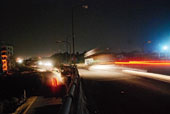
| Head and rear lamps of passing vehicles are the sole source of illumination on the Belghoria flyover and beyond. Picture by Bhabatosh Chakraborty |
A government with the cash and the inclination to bathe some Calcutta streets in an excess of light (think trident lamps) has turned tight-fisted when it comes to a 10km expressway to the airport, reducing it to a crime stretch after dusk.
The state administration has been haggling with the highway authorities over whose responsibility it is to illuminate Belghoria Expressway, connecting the airport with National Highway 2 and the fastest link from the city’s northeast to the other side of the river.
The National Highways Authority of India (NHAI), which took charge of maintaining the expressway in 2009, has told the government that it is accountable for the road, not the lack of lights above it. “That is our policy across India. A circular of the Union road and transport ministry states that the local authority has to bear the cost of illuminating a road,” a senior official said.
The last meeting to end the status quo was around four months ago. The damaged stretches of the expressway have been repaired since, but it remains a road to avoid once darkness descends.
“We stated our position when we last met officials of the state public works department. We haven’t received word from the state government yet about what is the way forward. We hope there is a consensus on the subject soon,” said Ajay Ahluwalia, the chief general manager of the NHAI, Bengal.
Officials of the PWD said the government hadn’t decided whether it would bear the electricity bill for Belghoria Expressway. “The cost of lighting the expressway is estimated to be between Rs 20 and Rs 30 lakh annually. The PWD minister and the department’s secretary know about this. If the government allots the money, the PWD will surely maintain the lights,” an engineer said.
There are around 250 lamp posts along the expressway, but barely 15 of them work. Incidence of crime, mostly snatching, has shot up over the past year, making even residents of the nearby areas wary of taking that road after sunset.
“I would rather drive several kilometres extra through traffic than take the expressway after 8pm. It is completely dark and unsafe. I fail to understand why the authorities are neglecting something as essential as properly illuminating an expressway,” said Saibal Ghosh, a resident of Dunlop.
Junior Mridha, a 26-year-old employee of a software company, was killed on Belghoria Expressway in July 2011. He was returning home in his two-wheeler when he was shot. Mridha’s body was found near Baranagar railway station.
In February this year, a truck loaded with sandalwood worth several lakh rupees was intercepted by police while it was hurtling down the road towards Dakshineswar at night. Two unidentified male bodies were found along the expressway the same month. A car was waylaid on that stretch and stolen around the same time.
Belghoria Expressway is used by airport-bound vehicles coming from the northern fringes of the city as well as residents of Howrah and Hooghly districts travelling towards VIP Road and Rajarhat-New Town.
Housing complexes have mushroomed along the northeastern stretch of the expressway over the past few years.
“We feel very insecure stepping out of the gate after dusk, let alone drive down the expressway. There have been instances of jewellery being snatched from women right under the flyover on this side,” said a resident of the Airport City housing estate.
A senior official at Writers’ Buildings admitted that it wasn’t just a question of the government being short of funds. “The more serious issue is the lack of inclination to do something about this.”