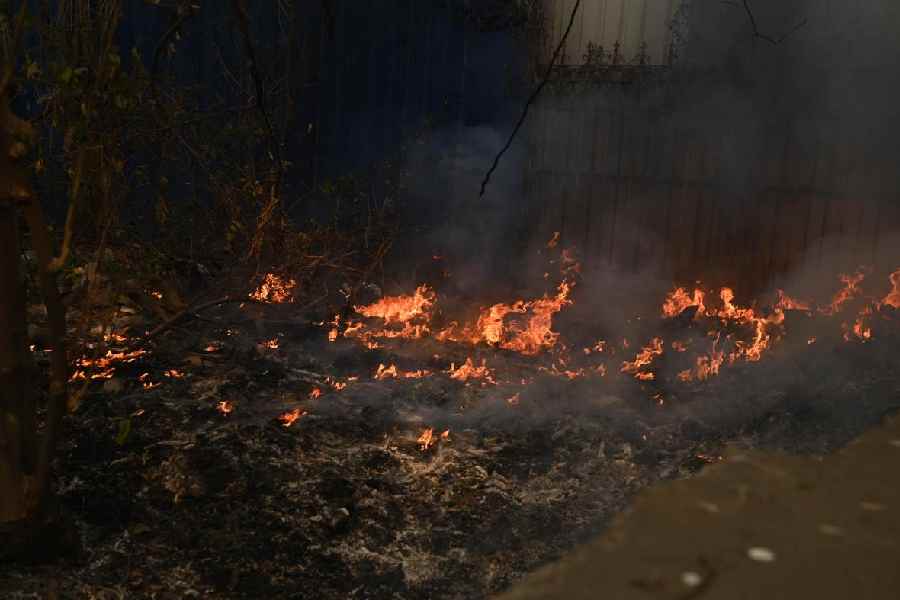
Coal-fire, smoke-belching vehicles and unregulated industries are the chief contributors to Calcutta’s filthy air. But there’s another factor that is not difficult to mitigate but is rarely addressed: the burning of waste.
Environment scientists say the presence of plastic in any solid waste makes burning it a “serious health hazard”. Plastic releases highly toxic and carcinogenic elements when burnt in the open.
A study by The Energy and Resources Institute to determine the major contributors to Calcutta’s foul air, conducted between 2022 and 2024, found that “refuse burning” had a 5 per cent share in the generation of PM10 and the deadlier PM2.5.
Both PM10 and PM2.5 are tiny particles that we breathe in with the air. Of the two, PM2.5 — particulate matter with a diameter of 2.5 micrometers or less — is a greater public health hazard because it can enter the deepest crevices of the human lungs.
Every winter, Calcutta’s air quality plummets with a drop in the mercury. At 10am on Saturday, the air quality was “very poor” at Victoria; “poor” in Ballygunge, Bidhannagar, Jadavpur and Rabindra Bharati University (BT Road campus); and “moderate” in Fort William and Rabindra Sarobar.
“Moderate” — the best reading on Saturday morning, recorded at just two stations — is two levels below the best air quality.
In the National Air Quality Index, prepared by the Central Pollution Control Board, “moderate” is ranked third below “good” and “satisfactory” and comes above “poor” and “very poor”.
The sources of pollution do not disappear in summer or monsoon, but climate factors like warmer air and rain disperse or wash away some of the pollutants.
In winter, the air is cooler and heavier: it does not rise as fast as warm air. The wind speed, too, is generally lower during winter. All this traps the pollutants in the lower atmosphere.
The study to determine the sources of air pollution and their relative contribution to the hazard was commissioned by the state pollution control board.
Dirty five
Dust, coal and biomass-fired cooking, vehicle emissions, industrial pollution and refuse burning are among the top sources of foul air in Calcutta.
The worst among them is dust, its share in generating PM10 the highest at 43 per cent.
The use of coal and biomass for cooking at roadside eateries and by some poor households, and the use of coal by ironing kiosks, are the top contributors to the generation of PM2.5, their combined share being 29 per cent.
At 21 per cent, industrial pollution comes second in generating PM2.5. Vehicle emissions come a close third at 20 per cent.
How they hurt us
Both PM10 and PM2.5 harm us, but PM2.5 harms more.
“PM2.5 includes both fine and ultra-fine particles that can travel across the lungs. These particles can enter the blood circulation and travel to all the organs,” said Arup Halder, a pulmonologist with the Calcutta Medical Research Institute.
Halder said the impact of inhaling PM2.5 depends on both the duration and the intensity of the exposure.
“Prolonged exposure definitely has a bad impact. At the same time, intense exposure for a short duration too causes damage,” he said.
According to the air quality index (AQI), even “moderate” air quality can trigger breathing discomfort among people with asthma, lung disease and heart ailments.
A drop to “poor” air quality can cause “breathing discomfort to most people on prolonged exposure”, while “very poor” air can lead to “respiratory illness” on prolonged exposure.
Doctors said that PM10 got deposited mostly in the throat and the large airways. “They cause irritation in the nose and large airways,” Halder said.
Air pollution also lowers natural immunity and makes people vulnerable to infections, more than one doctor said.
Least we can do
Anumita Roy Chowdhury, executive director of the New Delhi-based Centre for Science and Environment, said that reducing the sources of PM2.5 should be the priority.
Containing industrial pollution, vehicular emissions and waste burning should top the government’s to-do list.
“The sources of industrial pollution are mostly local and peripheral. The government should have a strategy to contain industrial pollution within a region, and that can improve the air quality in Calcutta,” she said.
“It could be that the pollution is coming from Howrah or the peripheries of Calcutta. The strategy should factor in these neighbouring places also.”
Roy Chowdhury advocated having more electric vehicles, replacing those that run on diesel and petrol.
“Even with advanced engines, there will be some amount of tailpipe emission, which will be nil with electric vehicles,” she said.
Replacing all coal-fired ovens with induction ovens that run on electricity can cut down the small eateries’ contribution to air pollution.
“Hawkers and those running ironing units should be incentivised to run electric-powered induction ovens or heating,” said Punarbasu Chaudhuri, professor and head of environmental science at Calcutta University.
“The government should think of giving them access to subsidised power.”
State pollution control board officials said that construction activities across the city were responsible for so much dust remaining suspended in the air.
“Road dust can be suppressed by sprinkling water. Those in charge of construction sites should keep the soil and construction materials moist by sprinkling water. This will prevent the dust from rising,” an official said.