Speeding is the leading contributor to fatal road crashes in India, and the most vulnerable are two-wheeler riders and pedestrians, road safety experts said.
Government officials, public health experts, researchers and road safety practitioners met at the IIT Kharagpur Research Park in New Town last week for a dialogue on road safety.
With India recording over 1.8 lakh road crash fatalities in 2024, they discuss urgent actions needed to help the country halve road fatalities and serious injuries by 2030.
A key focus of the discussions at Thursday’s event was speeding, which continues to be the leading contributor to road crashes in India.
According to the latest Union ministry of road transport and highways (MORTH) Road Accidents 2024 report, over-speeding accounted for 62% of all road accidents and resulted in more than one lakh fatalities nationwide.
The data also highlighted the disproportionate impact on vulnerable road users.
Two-wheeler riders accounted for 46.2% of fatalities (more than 80,000 deaths) across the country.
Pedestrians accounted for 36,526 fatalities, representing 20.6% of all road crash deaths, making them the second most affected category.
The dialogue on road safety was organised by the Road Safety Network, a coalition of civil society organisations working to reduce road crash fatalities, in partnership with IIT Kharagpur
“Speed is the most dangerous thing because it has a dual impact. The chance of a crash increases. The severity of the crash also increases with speed. The other thing that road safety experts, engineers and researchers have found consistently, across the world, is that even a small increase in speed levels increases the probability of fatalities,” said Ranjit Gadgil of Parisar, a Pune-based NGO dedicated to sustainable urban development.
“If you increase the speed by about 10 miles per hour (15kmph), you will double the chance of a fatality in the case of a crash involving a pedestrian. So, if a vehicle hits a pedestrian at 20kmph, there is a 5 to 10% chance that the pedestrian will die. If that speed goes up to 50kmph, the probability of survival drops to 50%. If you go up to 70kmph, the chances drop to 10%,” he said.
Against this backdrop, participants highlighted Bengal’s pilot project — a scientific speed management framework — as “an important step towards aligning speed limits with road function, surrounding land use and the safety needs of vulnerable road users”.
Papia Ghosh Roy Choudhury, special secretary, department of urban development and municipal affairs of the Bengal government,
said Bengal’s new government was committed to making pavements accessible for pedestrians.
“The present regime’s commitment to making pavements encroachment-free is very important. Pedestrians are forced to walk on the roads because of encroachments. The present government is very strict; we have to restore the right to walk on pavements. The Supreme Court has also said the right to walk on pavements is a fundamental right,” she said.
IIT Kharagpur presented findings from a study conducted on a 51km stretch of NH-16 between Balihati and Kolaghat in Bengal.
The study found that design-based speed management interventions reduced operating speeds by 39 to 45% for cars, 29 to 33% for heavy vehicles and 18 to 28% for two-wheelers.
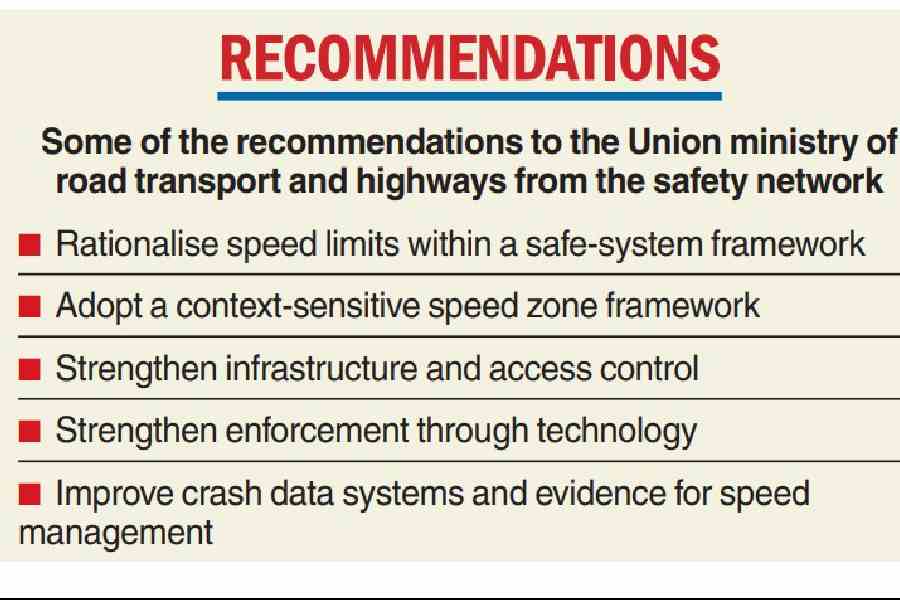
“Reducing road fatalities will require a combination of context-sensitive speed limits, safer road design, technology-enabled enforcement, improved pedestrian infrastructure, stronger emergency response systems and greater coordination among transport, urban development, police, health and local government agencies,” said Bhargab Maitra, professor, civil engineering department, IIT Kharagpur, and member of Road Safety Network.