
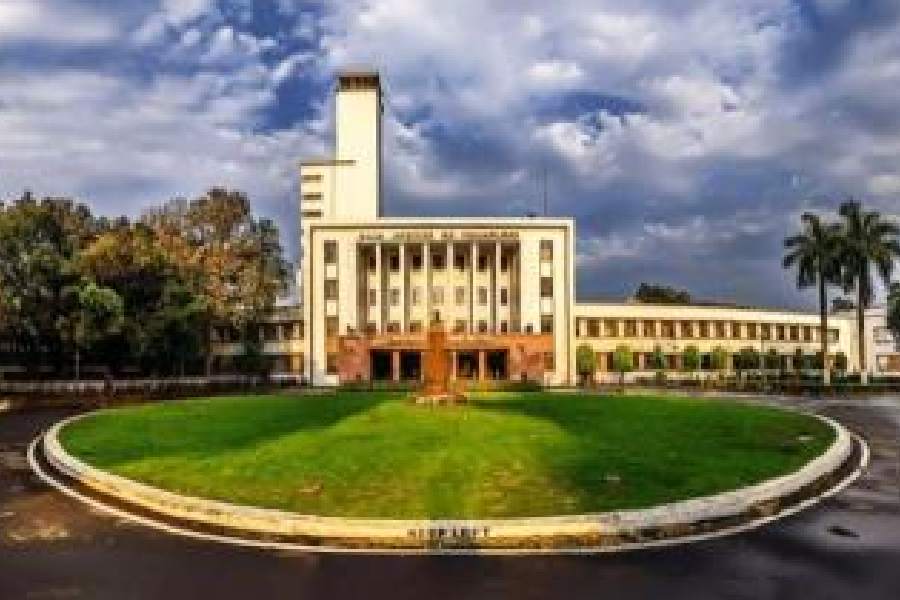
IIT Kharagpur has decided to file an application with the National Medical Council (NMC) by March 31 to introduce a postgraduate MD (Doctor of Medicine) programme, said the institute’s director on Thursday.
It would be the first IIT to offer a postgraduate medical programme.
Suman Chakraborty, the director of IIT Kharagpur, said the institute will apply by March 31 seeking NMC’s approval. The postgraduate programme will start with 20 seats.
“We will be the first IIT to start a postgraduate medical programme,” Chakraborty told Metro.
“We have already appointed 20 skilled doctors. They will be teaching students who will enrol in the MD programme,” he said.
The plan was placed before the institute’s board of governors for approval on September 23, 2025, he said.
An institute official said students will be taught at a medical college named after Dr B.C. Roy, the first chief minister of Bengal, who had donated the land for setting up the country’s first IIT. The medical college is located on the IIT Kharagpur campus.
They will receive hands-on training at a hospital developed by the IIT at Balarampur, on the outskirts of the campus.
“To start a medical programme, an institute must have a medical college supported by a hospital. We have both. If the council permits us, IIT will start the programme from this academic year. We are ready,” the director said.
On May 17, 2007, then President A.P.J. Abdul Kalam laid the foundation stone of the Dr B.C. Roy Multi-Speciality Medical Research Centre, with the vision of launching both an MBBS college and a superspecialty hospital.
However, IIT Kharagpur is set to foray into medical education by introducing a postgraduate MD programme, putting its MBBS plan on hold, apparently owing to a lack of infrastructure.
“We are focusing on technology-empowered postgraduate medical education. We plan to make some changes to the MD curriculum by exercising our autonomy. We will start some dual degree programmes, like in engineering,” Chakraborty said.
“A new class of technology-empowered medical education and research programme will emerge out of it. With the basic MD programme in mind, we want to bring certain technology-empowered elements to it,” the IIT director said.
Students will be screened through the National Entrance-cum- Eligibility-Test (NEET), he said.
A team from the National Medical Council is likely to visit the campus to assess the infrastructure before approving.
During the institute’s convocation in 2021, then IIT Kharagpur director V.K. Tewari said they were likely to start an MBBS college in the name of Dr B.C. Roy.
Hopefully, we will be able to start with 100 students this year. The superspeciality hospital named after Syama Prasad Mookerjee has also started, Tewari had said.
Mookerjee is the founder of Jan Sangh, from which the RSS had originated.
Asked about the MBBS programme, the present director said: “When an MD programme is run in an institution for some years, it is quite logical to introduce an MBBS programme there as well”.
A senior IIT official said they are primarily an institute dedicated to engineering programmes, handling 16,000 BTech, MTech, and PhD students.
“It will take us time to take up the MBBS programme,” the official said.
Last September, the IIT announced that the first surgery had been successfully performed at Syama Prasad Mookerjee Institute of Medical Science and Research (SPMSH) — the hospital.
“With the operation theatre now functional, the Syama Prasad hospital is set to expand to a 220-bed Mission Mode IPD hospital, providing world-class healthcare to students, faculty, staff, and the wider community,” the institute had said in a statement in September.