Eighty-four years have passed since his death, but there are still ample photographs of Rabindranath Tagore that are not in the public domain.
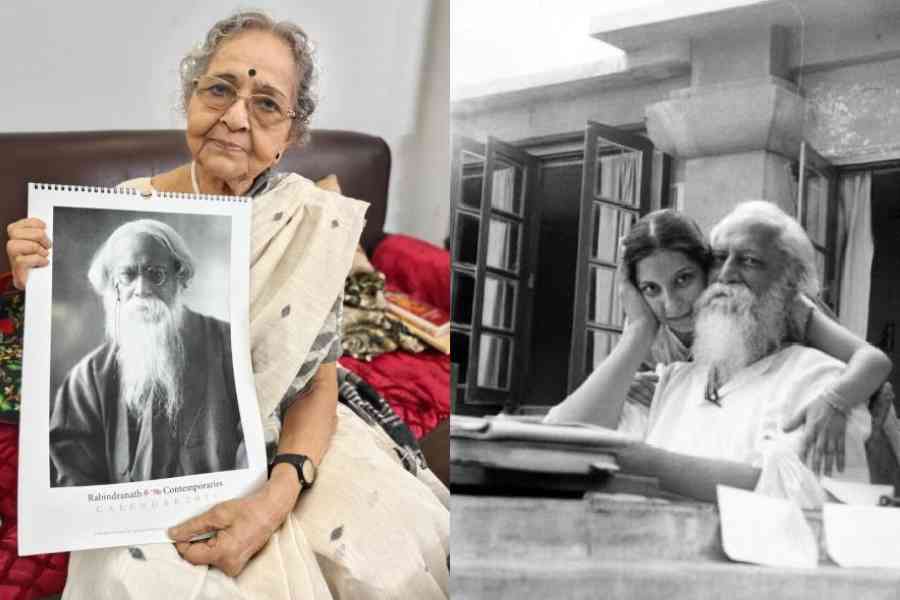
A wall calendar has been published, sourcing a dozen such pictures for its theme “Rabindranath and his contemporaries”, for which the research was done by JC Block resident Minakshi Sinha. The 84-year-old lady is known to most block cultural committees for her prowess in acting and directing plays. Some have also attended the discussion-based classes the retired teacher of Bengali takes every Friday afternoon on Tagore at her home since 2022.
“The calendar is the brainchild of Agniva Chakraborty, a software engineer, who has designed the covers of a couple of my books. He asked me to help with research for the text that accompanies each photograph. That is all that I have done,” said the author of 34 books, including 14 on Tagore.
Agniva, who had earlier produced calendars on Satyajit Ray’s calligraphy and Narayan Debnath, Chandi Lahiri and Debasish Deb’s cartoons, among others, planned the calendar to mark the Bard’s 165th birth anniversary. “Tagore was among the most photographed persons in 20th-century India. I heard Visva-Bharati had many unreleased photographs in its archives, which I took permission to access,” he told The Telegraph Salt Lake about the calendar, which is currently on sale online and in bookstores.
The list of personalities photographed with Tagore includes George Bernard Shaw, Lady Ranu Mukherjee, Romain Rolland, C.F. Andrews, Sir William Rothenstein, Maitreyi Devi, Okakura Kakuzo, William Pearson, Maharaja Radhakishore Manikya and Dr Kalidas Nag, among others. “Agniva had asked me for 12 names whose pictures he wanted to search for. But Tagore had met so many prominent figures that it would have been easier to name 50,” Sinha said.
From her wishlist, the only two persons missing in the calendar were Annapurna Tarkhad, a Marathi girl two years older than him, from whom 17-year-old Tagore was to learn etiquette before sailing for England, and W.B. Yeats. “Agniva found solo pictures in the archive but none with Tagore,” she said. Her favourite photograph is the one featured in January, with Ranu, who first came to Jorasanko the day after Tagore lost his daughter Madhurilata. Incidentally, she started her Tagore classes at home on her elder daughter’s advice after losing her younger daughter.
Agniva’s favourite is one with Victoria Ocampo. The Argentine lady, who had helped organise an exhibition of Tagore’s art in Paris, had smudged her own face in most photographs kept in the archive, he said. “I have used the only one which is intact.”
Sinha pointed out that Ocampo had gifted Tagore an easy chair in which he used to sit when he visited her. “It was too large to be carried into the ship. Using her influence, she made the captain agree to chop the entrance to allow the chair to be loaded. The poet had referred to the chair as her gift in his final collection of poems released posthumously,” said she.
A niece of former Visva-Bharati vice-chancellor Nimaisadhan Bose, Sinha, who retired in 2001 from Rabindra Bharati University, still takes classes at Bethune College, where she started her teaching career. And if Tagore had acted at the age of 62, Sinha continues to act in the play put up in the college’s annual reunion since 1963. “In some years, when it was not possible to get people to rehearse, I put up solo acts but there has never been a break in the tradition,” the alumna said with a smile.