As the fear of mass disenfranchisement hangs over Bengal, a campaign for social amity has pledged support for those struck off the revised electoral rolls.
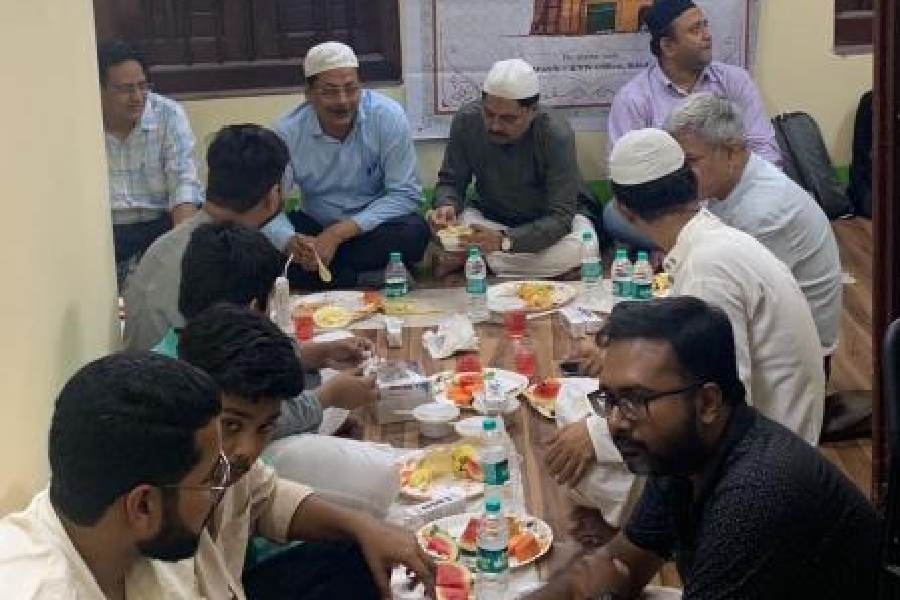
At an interfaith iftar in Kidderpore last Wednesday, some participants were voters placed under adjudication. Some of them are retired government officials.
“Exclusion from the rolls is not the end of the road. The Supreme Court has directed the constitution of special tribunals to decide their appeals. But no one knows when the tribunals will be formed. There is no clarity on whether these tribunals will be district-specific,” said Sabir Ahamed, convener of the Know Your Neighbour campaign.
“We are in the process of preparing a dossier on how and where to appeal against the exclusion from the electoral rolls. The dossier will be multilingual. Our volunteers will take it to the districts so that more and more people can use it,” said Ahamed.
Several lawyers and legal experts associated with the campaign have come forward to help those excluded from the list, especially those from marginalised sections of
society.
Section 24 of the Representation of the People Act, 1950 (RPA 1950), provides the legal framework for appeals against orders made by the electoral registration officer regarding voter registration.
“The tribunals will hopefully help these people. However, there are legal provisions that can be used by people who think they have been unfairly kept out of the rolls. They can file appeals to higher authorities,” said Sarfaraz Ahmed Khan, professor of law at the West Bengal National University of Juridical Sciences (NUJS), Kolkata, who is associated with the campaign.
He outlined the process for filing an appeal.
Any person aggrieved by an order of the electoral registration officer (ERO) under Section 22 (correction or deletion of names) or Section 23 (inclusion of names) may appeal to the designated authority — usually a district magistrate, an additional district magistrate, an executive magistrate, a district collector, or an officer of equivalent rank.
If a person is unsatisfied with the decision of the first appellate authority, a second appeal can be made to the chief electoral officer (CEO) of the state.
Every appeal must be a memorandum signed by the appellant. It must be presented to the appellate officer within a period of 15 days from the date of announcement of the decision or sent to that officer by registered post to reach him within that period.
A writ petition can be filed in the high court challenging the decision by the appellate authority. An order from a single bench of the high court can be challenged before the division bench of the court.
The order by the division bench of the high court can be challenged in the Supreme Court.
The SIR exercise has so far decided the cases of the 32 lakh “unmapped” voters and about half the 1.2 crore voters with “logical discrepancies”, with those excluded marked “deleted” on the preliminary “final” list published on February 28. These deleted voters can presumably approach the tribunals, expected to be set up over the next few days.
But the remaining half of those with discrepancies — about 60 lakh — who have been marked “under adjudication” can know whether they have been excluded only after the supplementary lists (of those included) are published. One such list is expected to come out in a day or two.
The campaign for social harmony will also submit a deputation to the state government, seeking legal and financial help for excluded
voters.
“Many affected individuals lack the financial resources and legal knowledge necessary to challenge administrative decisions. The state government should therefore provide financial assistance and legal aid to support citizens filing claims, objections, or appeals,” said Ahamed.